
 Earn with Nexo
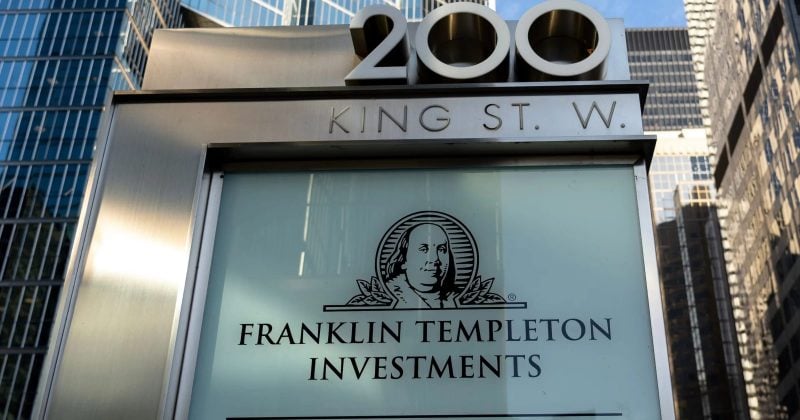
Franklin Templeton launches tokenized ETFs trading 24/7 in crypto wallets
The $1.68 trillion asset manager is blurring the line between Wall Street and Web3, letting investors trade fund shares around the clock directly from their crypto wallets.
The stock market closes at 4 PM Eastern. Your crypto wallet does not. Franklin Templeton just decided to side with the wallet.
The investment giant, which manages roughly $1.68 trillion in assets, has rolled out tokenized ETFs that can be traded 24 hours a day, seven days a week, directly within crypto wallets. It’s the kind of move that sounds like a fintech startup pitch deck — except this time it’s coming from a firm that’s been around since 1947.
What Franklin Templeton actually built
Here’s the thing. Traditional ETFs are tethered to market hours. You want to buy shares of an S&P 500 fund at 2 AM on a Saturday because you just read something alarming? Tough luck, wait until Monday morning.
Franklin Templeton’s tokenized ETFs eliminate that constraint entirely. By representing fund shares as tokens on a blockchain, investors can trade them at any hour, from any compatible crypto wallet, without waiting for exchanges to open.
This isn’t the firm’s first foray into blockchain-native finance. Franklin Templeton launched its Benji Technology Platform back in 2021, which hosted the first US-registered money market fund to live on a blockchain — the Franklin OnChain US Government Money Fund, known by its ticker FOBXX.
That fund has since grown to $557 million in assets by February 2026. Not exactly pocket change.
The firm has also been aggressive on the crypto ETF front more broadly. Its Franklin Crypto Index ETF (EZPZ), which allocates about 77% to Bitcoin with the rest spread across other digital assets, has attracted serious institutional attention. And the XRPZ ETF, which launched in November 2025, pulled in $225.83 million in just its first two months of trading.
In English: Franklin Templeton isn’t dabbling in crypto. It’s building an entire parallel infrastructure.
Why this matters more than it sounds
The ability to trade tokenized securities around the clock might seem like a convenience feature. It’s actually a structural shift in how capital markets could function.
Traditional finance operates on a patchwork of clearing houses, settlement windows, and market hours that were designed decades ago. Blockchain-based trading collapses all of that into something much closer to real-time. Settlement that used to take two business days can happen in minutes.
For institutional investors, this changes the math on liquidity risk. If you can exit a position at any time rather than waiting for a market to open — potentially during a crisis — that’s a fundamentally different risk profile.
And institutions are paying attention. According to recent survey data, 73% of institutional investors plan to increase their digital asset allocations in 2026. That’s not a fringe group of crypto-curious hedge funds. That’s the mainstream starting to lean in.
Franklin Templeton has also partnered with Binance to allow tokenized fund shares to be used as collateral for institutional trades. Think about what that means: shares of a regulated US money market fund, living on a blockchain, being posted as collateral on a crypto exchange. Five years ago, that sentence would have read like science fiction.
The regulatory backdrop
None of this happens in a vacuum. The regulatory environment has shifted meaningfully over the past year, and that shift is a big part of why firms like Franklin Templeton feel comfortable making these moves.
The GENIUS Act, passed in July 2025, established clear requirements for stablecoin issuers, including a mandate for 100% reserves. That legislation gave the broader tokenized asset ecosystem a regulatory floor to build on. It signaled that Washington wasn’t going to try to ban its way out of crypto — it was going to regulate it.
The SEC’s classification of XRP as a commodity, placing it alongside Bitcoin and Ethereum in that category, provided additional clarity. For asset managers launching products like XRPZ, knowing the regulatory classification of the underlying asset isn’t a moving target is worth quite a lot.
Stablecoin transaction volume hit an estimated $62 trillion in 2025. That figure — roughly three times the annual GDP of the United States — suggests the infrastructure for on-chain financial activity isn’t just theoretical. It’s already handling real volume at scale.
The combination of regulatory clarity and proven infrastructure is exactly the environment that draws in the Franklin Templetons of the world. They don’t move until the road is paved, but once it is, they move fast.
What this means for investors
Look, the immediate practical impact for a retail investor is straightforward: more flexibility in when and how you trade certain fund products. That alone is useful but not revolutionary.
The bigger story is about what happens next. When a $1.68 trillion asset manager starts treating blockchain rails as a primary distribution channel rather than an experiment, competitors notice. BlackRock has already been moving in this direction with its own tokenized fund products. Fidelity has made similar noises. The race to tokenize traditional financial products is no longer a race — it’s a stampede.
For the crypto-native crowd, this represents something of a double-edged sword. On one hand, institutional adoption brings legitimacy, liquidity, and generally more stable market conditions. On the other hand, it also brings the same players and dynamics that many crypto enthusiasts were trying to escape in the first place. The decentralized dream gets a little more centralized every time a Wall Street firm sets up shop on-chain.
There are risks worth watching. Bitcoin, for context, hit an all-time high of roughly $126,198 in October 2025 but was trading around $70,599 by March 2026 — a decline of about 44%. Tokenized ETFs don’t insulate anyone from underlying asset volatility. They just make it easier to access that volatility at 3 AM.
The collateralization angle with Binance also introduces counterparty considerations. Regulated fund shares being used as collateral on a crypto exchange creates new interconnections between traditional and decentralized finance. Those connections can be efficient in good times and fragile in bad ones. Anyone who watched 2022’s cascade of crypto collapses knows how quickly contagion can spread through interconnected systems.
Still, the direction of travel is clear. The walls between traditional finance and crypto markets are getting thinner by the quarter. Franklin Templeton’s latest move doesn’t just illustrate that trend — it accelerates it.
Bottom line: Franklin Templeton putting tokenized ETFs in crypto wallets with 24/7 trading isn’t a gimmick. It’s a $1.68 trillion asset manager betting that the future of fund distribution runs on blockchain rails. Whether that future arrives smoothly or messily, the bet has been placed — and the rest of Wall Street is watching closely.