
Nexo Earn with Nexo
Tokenized assets hit $34 billion as a16z charts the winners and laggards

Tokenized assets hit $34 billion as a16z charts the winners and laggards

Asset-backed credit reached $1 billion in just 185 days, while venture capital took over seven years to hit the same mark.

Not all tokenized assets grow at the same speed, and the gap between the fastest and slowest is striking. A16z crypto’s latest analysis breaks down exactly how different categories of real-world assets have scaled on-chain, and the numbers tell a story about where institutional appetite is actually flowing.

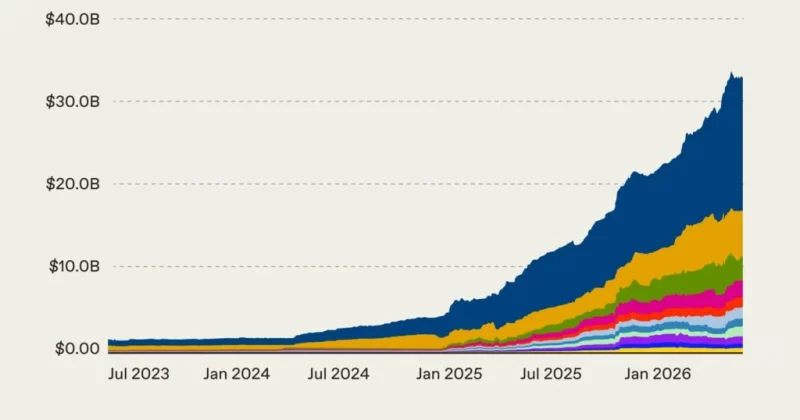
The tokenized asset market, excluding stablecoins, now sits at approximately $34 billion. That’s roughly 10x growth from under $3 billion in mid-2024.

The speed gap is enormous

Asset-backed credit, a category that includes tokenized home equity lines of credit and lending vault tokens, hit the $1 billion market cap milestone in just 185 days after its first on-chain activity. That’s six months, give or take.

Advertisement

Specialty finance was the next fastest. Think tokenized reinsurance contracts and bitcoin mining notes. That category crossed $1 billion in under two years.

Then there’s venture capital. Tokenized VC strategies took over seven years to reach the same $1 billion threshold.

Who controls the $34 billion pie

Government debt and commodities together account for roughly two-thirds of the total tokenized asset market. Tokenized gold alone sits at around $5 billion in value.

Ethereum commands more than half the market at approximately $15.7 billion. BNB Chain, Solana, and Stellar have carved out meaningful positions as well.

A16z’s report also flags an important wrinkle: many of the largest tokenized bonds and precious metals have limited composability. That’s a technical way of saying these assets can exist on a blockchain but can’t easily plug into the broader decentralized finance ecosystem.

From digitization to composability

The a16z report frames the current moment as a transition point. Tokenized assets have proved the concept. The harder challenge is building infrastructure that lets these assets interact seamlessly with DeFi protocols, lending markets, and automated strategies.

Right now, a tokenized treasury bill might live on Ethereum, but it can’t necessarily be used as collateral in a lending protocol without custom integration work.

Disclosure: This article was edited by Editorial Team. For more information on how we create and review content, see our Editorial Policy.

Tokenized assets hit $34 billion as a16z charts the winners and laggards

Tokenized assets hit $34 billion as a16z charts the winners and laggards

Asset-backed credit reached $1 billion in just 185 days, while venture capital took over seven years to hit the same mark.

Not all tokenized assets grow at the same speed, and the gap between the fastest and slowest is striking. A16z crypto’s latest analysis breaks down exactly how different categories of real-world assets have scaled on-chain, and the numbers tell a story about where institutional appetite is actually flowing.

The tokenized asset market, excluding stablecoins, now sits at approximately $34 billion. That’s roughly 10x growth from under $3 billion in mid-2024.

The speed gap is enormous

Asset-backed credit, a category that includes tokenized home equity lines of credit and lending vault tokens, hit the $1 billion market cap milestone in just 185 days after its first on-chain activity. That’s six months, give or take.

Advertisement

Specialty finance was the next fastest. Think tokenized reinsurance contracts and bitcoin mining notes. That category crossed $1 billion in under two years.

Then there’s venture capital. Tokenized VC strategies took over seven years to reach the same $1 billion threshold.

Who controls the $34 billion pie

Government debt and commodities together account for roughly two-thirds of the total tokenized asset market. Tokenized gold alone sits at around $5 billion in value.

Ethereum commands more than half the market at approximately $15.7 billion. BNB Chain, Solana, and Stellar have carved out meaningful positions as well.

A16z’s report also flags an important wrinkle: many of the largest tokenized bonds and precious metals have limited composability. That’s a technical way of saying these assets can exist on a blockchain but can’t easily plug into the broader decentralized finance ecosystem.

From digitization to composability

The a16z report frames the current moment as a transition point. Tokenized assets have proved the concept. The harder challenge is building infrastructure that lets these assets interact seamlessly with DeFi protocols, lending markets, and automated strategies.

Right now, a tokenized treasury bill might live on Ethereum, but it can’t necessarily be used as collateral in a lending protocol without custom integration work.

Disclosure: This article was edited by Editorial Team. For more information on how we create and review content, see our Editorial Policy.