
Nexo Earn with Nexo
Russia’s A7A5 stablecoin claims it can thrive post-sanctions, and the numbers are hard to ignore

Russia’s A7A5 stablecoin claims it can thrive post-sanctions, and the numbers are hard to ignore

The ruble-pegged stablecoin has processed up to $100B in on-chain volume in its first year, positioning itself as a cornerstone of Russia's de-dollarization playbook.

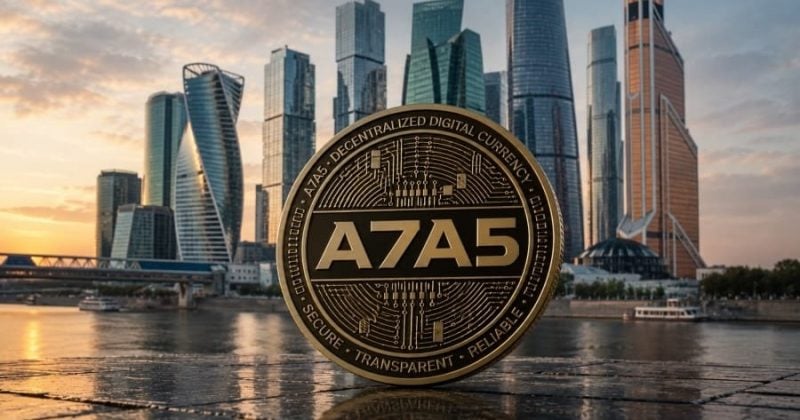
A stablecoin most people have never heard of has quietly become one of the largest non-dollar stablecoins on the planet. A7A5, a ruble-pegged token issued by a Kyrgyz company called Old Vector, has processed between $70 billion and $100 billion in on-chain transaction volume since launching in January 2025.

A7A5 is backed by ruble deposits held at Promsvyazbank, a Russian bank that has been under Western sanctions for years. The token is issued by Old Vector, which operates under Kyrgyzstan’s digital asset regulatory framework, giving it a jurisdictional home that sits outside the direct reach of US and EU enforcement.

Advertisement

The token primarily runs on Tron and Ethereum. Its circulating market cap sits above $500 million, making it the 21st-largest stablecoin globally.

A7A5 accounts for approximately 15% of Russia’s cross-border monetary transactions. It has been described as the primary currency for Russia’s alternative payment network, facilitating trade with China, Southeast Asian nations, and Iran. Most of the trading volume flows through Grinex, an exchange purpose-built for this corridor.

The US and EU have imposed sanctions on A7A5 and entities associated with its operation, resulting in delistings from major platforms and accessibility restrictions on decentralized exchanges like Uniswap. And yet the token keeps functioning. A7A5 surpassed $100 billion in on-chain transaction value within its first year.

Kyrgyzstan has its own digital asset framework, and Old Vector operates within it. Western regulators can sanction the entities involved, but they cannot compel a sovereign nation to shut down a domestically regulated business.

If a ruble-pegged stablecoin can handle $70 billion to $100 billion in transaction volume in its first year, the A7A5 model—issuing a stablecoin through a friendly jurisdiction, backing it with domestic bank deposits, and running it on permissionless blockchains—is replicable by other sanctioned economies.

Disclosure: This article was edited by Editorial Team. For more information on how we create and review content, see our Editorial Policy.
Advertisement

Russia’s A7A5 stablecoin claims it can thrive post-sanctions, and the numbers are hard to ignore

Russia’s A7A5 stablecoin claims it can thrive post-sanctions, and the numbers are hard to ignore

The ruble-pegged stablecoin has processed up to $100B in on-chain volume in its first year, positioning itself as a cornerstone of Russia's de-dollarization playbook.

A stablecoin most people have never heard of has quietly become one of the largest non-dollar stablecoins on the planet. A7A5, a ruble-pegged token issued by a Kyrgyz company called Old Vector, has processed between $70 billion and $100 billion in on-chain transaction volume since launching in January 2025.

A7A5 is backed by ruble deposits held at Promsvyazbank, a Russian bank that has been under Western sanctions for years. The token is issued by Old Vector, which operates under Kyrgyzstan’s digital asset regulatory framework, giving it a jurisdictional home that sits outside the direct reach of US and EU enforcement.

Advertisement

The token primarily runs on Tron and Ethereum. Its circulating market cap sits above $500 million, making it the 21st-largest stablecoin globally.

A7A5 accounts for approximately 15% of Russia’s cross-border monetary transactions. It has been described as the primary currency for Russia’s alternative payment network, facilitating trade with China, Southeast Asian nations, and Iran. Most of the trading volume flows through Grinex, an exchange purpose-built for this corridor.

The US and EU have imposed sanctions on A7A5 and entities associated with its operation, resulting in delistings from major platforms and accessibility restrictions on decentralized exchanges like Uniswap. And yet the token keeps functioning. A7A5 surpassed $100 billion in on-chain transaction value within its first year.

Kyrgyzstan has its own digital asset framework, and Old Vector operates within it. Western regulators can sanction the entities involved, but they cannot compel a sovereign nation to shut down a domestically regulated business.

If a ruble-pegged stablecoin can handle $70 billion to $100 billion in transaction volume in its first year, the A7A5 model—issuing a stablecoin through a friendly jurisdiction, backing it with domestic bank deposits, and running it on permissionless blockchains—is replicable by other sanctioned economies.

Disclosure: This article was edited by Editorial Team. For more information on how we create and review content, see our Editorial Policy.
Advertisement