
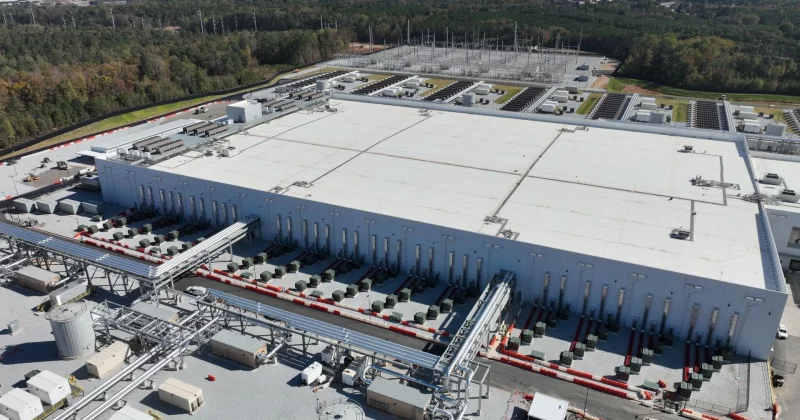
Growing demand for AI drives need for more data centers in US
America's AI appetite is triggering a data center construction boom that could reshape energy grids, real estate markets, and the broader tech economy.
The US is in the middle of an infrastructure buildout that hasn’t been seen since the fiber-optic frenzy of the late 1990s. This time, the catalyst isn’t dial-up internet going broadband. It’s artificial intelligence.
Data centers are expanding at a breakneck pace to keep up with the computational demands of AI workloads, and the numbers are staggering. According to MarketsandMarkets, the US AI data center market is projected to grow at a compound annual growth rate of 29% through 2032. In English: the physical infrastructure powering AI is roughly doubling every two and a half years.
The power problem no one can ignore
Here’s the thing about AI data centers. They’re not just bigger versions of the server farms that host your email and streaming services. They’re dramatically more power-hungry.
US data centers consumed 183 terawatt-hours of electricity in 2024, according to the International Energy Agency. That figure is projected to balloon to 426 TWh by 2030. For context, 183 TWh is roughly what the entire country of Thailand uses in a year. Now imagine more than doubling that in six years.
Goldman Sachs projects that global data center power demand will rise 165% by 2030. And looking further out, Deloitte estimates that power demand from US AI data centers alone could grow more than 30 times by 2035, reaching 123 gigawatts. That’s the equivalent of adding roughly 100 nuclear power plants’ worth of capacity dedicated solely to AI computation.
The math here is relentless, and the existing power grid wasn’t designed for it.
In some regions, AI-driven power demand is already outpacing grid capacity, according to research from the Belfer Center. The result is project delays, as utilities scramble to figure out how to supply electricity to facilities that consume as much power as small cities. Developers are signing deals years in advance just to secure power connections, and some are exploring on-site generation, including nuclear microreactors, to sidestep the bottleneck entirely.
AI, tech, and the markets they move—in one daily briefing.
Daily. Free. Join 34,000+ readers across crypto, finance, and policy.
Who’s building and where
The construction wave is being driven by two distinct groups. Traditional hyperscale cloud providers like Amazon Web Services, Microsoft Azure, and Google Cloud are expanding existing campuses and breaking ground on new ones. Simultaneously, a newer cohort of AI-focused infrastructure companies is entering the market, building facilities specifically optimized for the GPU-dense computing that large language models and generative AI require.
The geography is shifting too. Historically, Northern Virginia’s “Data Center Alley” dominated, hosting the densest concentration of data centers on the planet. But grid constraints and land costs are pushing developers into new markets. States across the Sun Belt and Midwest are competing aggressively for these projects, offering tax incentives, expedited permitting, and access to cheaper power.
The appeal for local governments is obvious. A single large data center can represent hundreds of millions of dollars in capital investment. The catch is that these facilities create relatively few permanent jobs compared to traditional industrial development, and their energy consumption can crowd out other users on constrained grids.
This tension is already producing regulatory friction. Several municipalities have imposed moratoriums on new data center construction while they assess the impact on local infrastructure. Others are requiring developers to invest in renewable energy or grid upgrades as a condition of approval.
What this means for investors
The data center boom creates a cascade of investment implications across multiple sectors. The most direct beneficiaries are the companies building and operating these facilities, along with the semiconductor manufacturers supplying the GPUs and custom AI chips that go inside them. Nvidia’s dominance in this space has been well documented, but the demand is broad enough to lift suppliers across the entire value chain, from cooling systems to fiber optics to backup power generation.
Real estate investors are paying close attention. Data center REITs have become one of the fastest-growing segments in commercial real estate, and the AI tailwind is only intensifying that trend. Land near substations with available power capacity has become some of the most sought-after real estate in the country, a sentence that would have sounded absurd a decade ago.
Energy markets are feeling the pull as well. The projected surge in electricity demand is bullish for utilities, particularly those with excess generation capacity or exposure to renewable energy development. It’s also creating strange bedfellows: tech companies that spent years touting their sustainability credentials are now signing long-term contracts with natural gas plants because renewable supply simply can’t scale fast enough to meet immediate demand.
For crypto markets, the dynamic is a double-edged sword. AI data centers compete directly with Bitcoin mining operations for the same scarce resources: cheap electricity, grid connections, and suitable real estate. As AI workloads offer higher margins and more predictable revenue than proof-of-work mining, some operators are converting mining facilities into AI compute centers. The competitive pressure on power resources could squeeze miners in regions where AI developers are willing to pay premium rates for electricity access.
The risk that investors should watch most closely is execution. A 29% CAGR assumes sustained demand growth, continued capital availability, and a power grid that can actually deliver the electricity these facilities need. If grid upgrades lag behind construction timelines, the bottleneck shifts from computing capacity to energy supply, and the entire growth curve bends.