
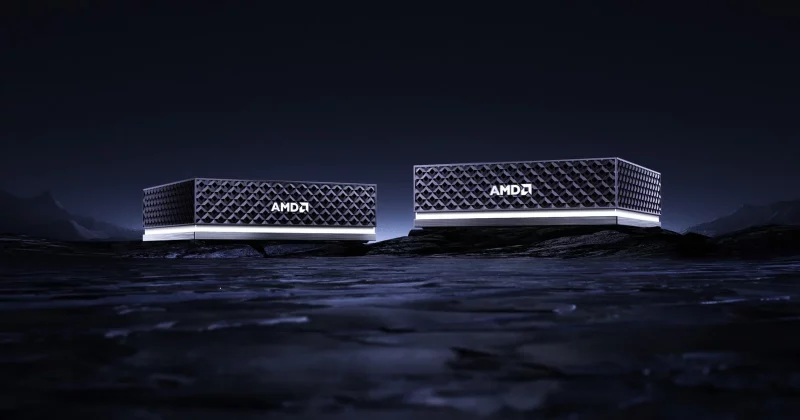
AMD launches $3,999 Ryzen AI Halo PC to compete with Nvidia DGX Spark
AMD's compact AI workstation packs up to 128 GB of unified memory and 60 TFLOPS of GPU compute, giving developers an open alternative to Nvidia's CUDA-locked ecosystem.
AMD just entered the local AI workstation race with a tiny box that packs a serious punch. The Ryzen AI Halo, unveiled at CES 2026, is a mini-PC designed to let developers run large AI models right on their desks, no cloud subscription required.
The system is built around AMD’s Ryzen AI Max+ processors, offering up to 128 GB of unified memory and up to 60 TFLOPS of GPU compute. It supports both Windows and Linux out of the box, with the ROCm software stack optimized for AI development, and ships pre-loaded with developer-focused AI applications.
What AMD is actually selling here
Think of the Ryzen AI Halo as AMD’s answer to Nvidia’s DGX Spark, which occupies roughly the same market niche: a compact, powerful machine that sits on your desk and lets you prototype, fine-tune, and run AI models locally. The difference is the ecosystem each box plugs into.
Nvidia’s DGX Spark locks developers into CUDA, the proprietary software framework that has become the de facto standard for GPU-accelerated computing. AMD’s Halo runs on ROCm, an open-source alternative. For developers who want flexibility, or who are building tools meant to run across different hardware, that distinction matters quite a bit.
The Halo also integrates AMD’s XDNA 2 NPU, a dedicated neural processing unit designed to handle AI inference tasks efficiently. In English: there’s a specialized chip inside that’s optimized specifically for running trained AI models, separate from the main GPU. This kind of dedicated silicon is increasingly important as AI workloads diversify beyond just training into real-time inference at the edge.
The speculated price point of $3,999 would position the Halo as a competitive entry in the developer workstation market. AMD has not officially confirmed that number, with final pricing expected closer to the Q2 2026 launch window. But even at that ballpark, it represents a meaningful alternative for AI practitioners who don’t want to rent GPU time from cloud providers or invest in rack-mounted server hardware.
Why this matters beyond traditional AI development
Here’s the thing. A $3,999 machine with 128 GB of unified memory and 60 TFLOPS of compute isn’t just interesting for Silicon Valley ML engineers. It has real implications for the crypto and Web3 space too.
The crypto and markets news you actually need—every morning.
Daily. Free. Join 34,000+ readers across crypto, finance, and policy.
Decentralized compute networks, the kind built by projects trying to create distributed GPU marketplaces, need affordable and powerful hardware at the node level. A compact workstation like the Halo could serve as a node in these networks, running AI inference tasks for decentralized applications without requiring an entire server closet.
On-premises AI model inference is also becoming critical for privacy-focused applications. In a world where regulatory scrutiny around data handling is intensifying, the ability to run models locally rather than shipping sensitive data to a cloud provider is a genuine competitive advantage. Web3 projects building privacy-preserving AI tools would find a machine like this particularly useful.
The open-source ROCm stack adds another dimension. Decentralized AI projects that want hardware agnosticism, meaning they don’t want their entire infrastructure dependent on a single vendor’s proprietary software, have historically struggled with the CUDA monoculture. AMD offering a viable open alternative, bundled in a turnkey workstation, could accelerate adoption in that corner of the market.
There’s also the simple math of ownership versus rental. Cloud GPU costs have been climbing as demand for AI compute surges. For a developer or small team running regular inference workloads, a one-time hardware purchase around $4K could pay for itself within months compared to equivalent cloud compute bills. That calculus gets even more attractive for crypto-native builders who are already philosophically inclined toward self-sovereignty and minimizing reliance on centralized infrastructure.
What investors and builders should watch
The Ryzen AI Halo is AMD’s clearest signal yet that it’s serious about challenging Nvidia in the AI developer hardware market. But signals and execution are different things. Nvidia’s CUDA ecosystem has years of library support, community documentation, and enterprise integration baked in. ROCm is improving, but the gap in software maturity remains real.
The Q2 2026 launch timeline means the final product will arrive in a market that’s moving fast. Nvidia will almost certainly iterate on its own compact AI hardware. Apple’s M-series chips continue to gain traction among ML developers. And cloud providers keep dropping prices to compete with local hardware purchases. AMD needs the Halo to not just match specs on paper but deliver a developer experience smooth enough to pull people away from established workflows.
For the crypto sector specifically, watch whether decentralized compute networks start certifying or optimizing for AMD hardware. Projects like Akash, Render, and io.net have largely been built around Nvidia GPUs. If the Halo’s price-to-performance ratio proves competitive, it could open a second hardware lane for these networks, reducing single-vendor risk across the decentralized compute landscape.
The unified memory architecture is worth paying attention to as well. Having 128 GB shared between CPU and GPU means the Halo can load larger models without the memory bottlenecks that plague systems with separate memory pools. For running large language models locally, that’s not a nice-to-have, it’s the difference between running a model and not running it at all.
AMD’s bet here is straightforward: make powerful AI hardware accessible, open, and affordable enough that developers choose it over renting Nvidia GPUs in the cloud. Whether that bet pays off depends less on the hardware specs, which look strong, and more on whether the software ecosystem can keep pace. The Halo is a compelling piece of silicon. The question is whether ROCm can be a compelling reason to leave CUDA behind.