
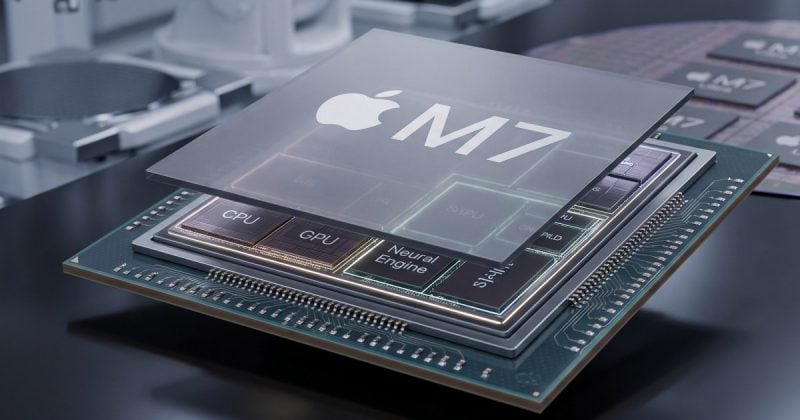
Apple develops M7 Ultra chip with potential 1.5TB memory capacity, and AI traders should pay attention
Apple's next-generation silicon could challenge Nvidia's dominance in AI workloads, with ripple effects across crypto mining and on-device inference markets
Apple is building a chip that could hold 1.5 terabytes of unified memory. That’s not a typo, and it’s not a spec for a data center rack. It’s for a desktop computer.
According to Mark Gurman’s Bloomberg Power On newsletter from July 12, the M7 Ultra is slated for a 2028 release and aims to deliver AI performance “closer to” Nvidia’s Blackwell-class accelerators.
What Apple is actually building
The M7 Ultra’s 1.5TB unified memory target represents roughly double the capacity of the current M5 Ultra. To put that in perspective, it matches the highest RAM configuration Apple ever offered on its 2019 Intel Mac Pro.
Unified memory lets the CPU and GPU share the same memory pool, which eliminates the bottleneck of shuttling data between separate chips. For running large language models and AI inference workloads, that architectural choice matters enormously.
The M7 Pro and Max variants are expected to arrive by the end of 2027, with the Ultra following in 2028. Apple’s silicon timeline is accelerating: the M7 is projected to tape out just six months after the M6. The research also notes Apple is strategically skipping specific high-end M6 variants to expedite the launch of a dedicated AI-optimized M7 line.
The full 1.5TB configuration depends on high-bandwidth memory supply chains cooperating. Memory chip shortages have already forced Apple to limit configurations on recent Mac Studio models.
AI, tech, and the markets they move—in one daily briefing.
Daily. Free. Join 34,000+ readers across crypto, finance, and policy.
Why crypto and DeFi builders should care
Running a 70-billion-parameter model locally currently requires specialized hardware or creative quantization tricks. A machine with 1.5TB of unified memory could theoretically run models that today demand multi-GPU server setups.
Projects building decentralized GPU networks, think Render, Akash, and similar protocols, have historically relied on Nvidia hardware as their backbone. If Apple silicon reaches competitive AI performance at potentially lower power consumption, it introduces an alternative hardware path for node operators and inference providers.
The Nvidia question
Nvidia’s Blackwell architecture represents the bleeding edge, and Apple positioning the M7 Ultra as “closer to” that benchmark is both ambitious and carefully hedged.
Nvidia’s pricing power directly affects the economics of decentralized compute. When Nvidia GPUs are expensive and scarce, the cost per inference on decentralized networks rises, which flows through to token valuations, staking yields, and protocol competitiveness.
What to watch from here
High-bandwidth memory shortages have been a persistent theme across the semiconductor industry, affecting everything from gaming GPUs to AI accelerators. If those shortages persist into 2028, the M7 Ultra’s most impressive configuration might ship in limited quantities.
Apple’s M7 Pro and Max chips arriving in late 2027 will serve as an early signal. Their memory capacities, AI benchmark results, and pricing will telegraph what the Ultra tier can realistically deliver.