
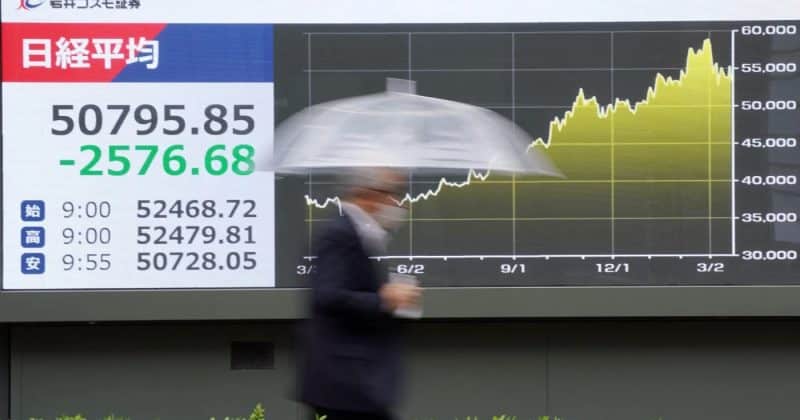
Asia shares, oil slip as markets adjust to Fed rate hike expectations
Risk assets sell off globally as traders price in a more aggressive Fed tightening path for late 2026
The Federal Reserve said nothing new on June 17. It held rates steady, updated its projections, and let officials speak their minds. Markets spent the next week deciding they did not like what they heard.
By June 23, Asian equities and oil were both sliding as traders repriced the probability of further rate hikes before year-end. The MSCI Asia-Pacific ex-Japan index fell as much as 2.9%. Brent crude dropped 1.22% to $76.95 per barrel. South Korea’s Kospi index plunged as much as 8.1% during intraday trading.
The selloff was not spontaneous. It was the delayed reaction to a Fed that left its benchmark rate at 3.5% to 3.75% but updated its dot plot to show a median end-2026 funds rate of 3.8%, with nine of 18 officials signaling expectations for at least one more hike this year. Futures markets moved accordingly, pricing in an 80% probability of a 25 basis point increase arriving by October or December.
Higher for longer, again
The Fed, now under Chair Kevin Warsh, has kept inflation concerns at the center of its policy framework. Several officials publicly signaled openness to resuming hikes if price pressures do not cool sufficiently.
Oil added a geopolitical wrinkle to the picture. A US waiver of sanctions on Iran briefly eased supply concerns, which would ordinarily support lower prices. But the broader macro backdrop, dominated by demand-side worries tied to tighter financial conditions, kept crude under pressure. Brent settling near $76.95 was more a story about global growth anxiety than Iranian barrels.
Crypto caught in the crossfire
Bitcoin is not a stock, but it trades like one when fear is the dominant market emotion. Following the June 17 Fed meeting, Bitcoin declined approximately 1.5%, tracking the broader risk-off move that swept through equities and commodities.
The broader crypto market followed. Major digital assets saw declines ranging from 1% to 3% in the days after the Fed’s update.
The yen added a separate layer of tension to the Asian session. The Japanese currency approached levels not seen in roughly 40 years as widening rate differentials between the US and Japan put sustained downward pressure on the exchange rate.
What investors should watch from here
The 80% probability that futures markets have assigned to a hike by October or December is not a certainty, but it is close enough that investors should treat it as the working assumption.
For equities, the pressure falls hardest on high-multiple sectors, particularly technology, which depends on cheap capital and long-duration earnings projections. Asian tech-heavy indices are disproportionately exposed to that dynamic, which helps explain why the regional selloff was sharper than what US markets experienced on the same signals.