
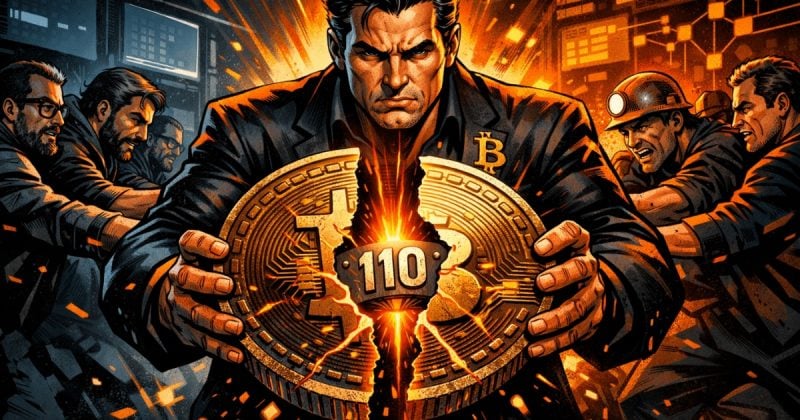
Bitcoin’s BIP-110 ignites debate over protocol governance

Bitcoin’s BIP-110 ignites debate over protocol governance

A proposal to restrict arbitrary data in Bitcoin transactions has exposed deep fault lines over who actually controls the network's future

Bitcoin’s latest governance skirmish isn’t about price. It’s about power. BIP-110, a proposal designed to limit non-monetary data stuffed into Bitcoin transactions, has sparked one of the most contentious debates since the block size wars. And like that earlier conflict, the real question underneath it all is deceptively simple: who gets to decide what Bitcoin becomes?

The proposal, formally known as the “Reduced Data Temporary Softfork,” was introduced on December 3, 2025, by developer Dathon Ohm. Its goal was to curtail what proponents consider spam, things like large witness data blobs, oversized OP_RETURN outputs, and certain Taproot features being used to embed arbitrary data onto the blockchain.

What BIP-110 actually does

The proposal adds seven temporary rules that restrict various data fields within Bitcoin transactions for approximately one year, or roughly 52,416 blocks. Specifically, it targets large scriptPubKeys, witness data exceeding 256 bytes, and OP_RETURN outputs larger than 83 bytes.

BIP-110 was designed to activate through miner signaling, using version bit 4 with a relatively low 55% threshold for early lock-in. The activation window was targeted for around August to September 2026. Ocean pool, the mining operation closely associated with Bitcoin developer Luke Dashjr, mined the first signaling block in early March 2026.

Advertisement

Node adoption told a slightly more encouraging story for supporters. BIP-110-enabled versions of Bitcoin Knots, an alternative node implementation, reached between 8% and 15% of listening nodes at peak periods.

Miners said no, loudly

Miner signaling for BIP-110 never came close to mattering. Support peaked below 1%, hovering in the range of 0.1% to 0.7% across most measurement periods. For a proposal needing 55% to lock in, that’s not a close call.

The low engagement wasn’t just apathy. It was active resistance from prominent voices in the Bitcoin ecosystem. Michael Saylor, whose company MicroStrategy holds the largest corporate Bitcoin treasury on the planet, emerged as a vocal opponent. Adam Back, CEO of Blockstream and one of the few people cited in the Bitcoin whitepaper, also pushed back. Both emphasized that Bitcoin changes require broad, genuine consensus, not activation by a motivated minority.

Opponents framed BIP-110 as a threat to valid transaction types and, more fundamentally, to decentralization itself. Supporters countered that the blockchain was being clogged with data that has nothing to do with peer-to-peer electronic cash, driving up fees and burdening node operators who have to store and process all of it.

The governance precedent matters more than the proposal

The market largely shrugged at BIP-110. No significant price volatility accompanied the debate.

BIP-110’s failure reinforces a narrative institutional investors find comforting: Bitcoin is exceptionally hard to change, even when well-intentioned developers want to change it. The fact that a proposal with a sympathetic pitch couldn’t clear even 1% miner support demonstrates that Bitcoin’s consensus mechanism works as a formidable defense against unilateral changes.

The 55% activation threshold was deliberately set lower than the traditional 95% threshold used in previous soft forks, which critics viewed as an attempt to lower the bar for consensus.

Disclosure: This article was edited by Editorial Team. For more information on how we create and review content, see our Editorial Policy.

Bitcoin’s BIP-110 ignites debate over protocol governance

Bitcoin’s BIP-110 ignites debate over protocol governance

A proposal to restrict arbitrary data in Bitcoin transactions has exposed deep fault lines over who actually controls the network's future

Bitcoin’s latest governance skirmish isn’t about price. It’s about power. BIP-110, a proposal designed to limit non-monetary data stuffed into Bitcoin transactions, has sparked one of the most contentious debates since the block size wars. And like that earlier conflict, the real question underneath it all is deceptively simple: who gets to decide what Bitcoin becomes?

The proposal, formally known as the “Reduced Data Temporary Softfork,” was introduced on December 3, 2025, by developer Dathon Ohm. Its goal was to curtail what proponents consider spam, things like large witness data blobs, oversized OP_RETURN outputs, and certain Taproot features being used to embed arbitrary data onto the blockchain.

What BIP-110 actually does

The proposal adds seven temporary rules that restrict various data fields within Bitcoin transactions for approximately one year, or roughly 52,416 blocks. Specifically, it targets large scriptPubKeys, witness data exceeding 256 bytes, and OP_RETURN outputs larger than 83 bytes.

BIP-110 was designed to activate through miner signaling, using version bit 4 with a relatively low 55% threshold for early lock-in. The activation window was targeted for around August to September 2026. Ocean pool, the mining operation closely associated with Bitcoin developer Luke Dashjr, mined the first signaling block in early March 2026.

Advertisement

Node adoption told a slightly more encouraging story for supporters. BIP-110-enabled versions of Bitcoin Knots, an alternative node implementation, reached between 8% and 15% of listening nodes at peak periods.

Miners said no, loudly

Miner signaling for BIP-110 never came close to mattering. Support peaked below 1%, hovering in the range of 0.1% to 0.7% across most measurement periods. For a proposal needing 55% to lock in, that’s not a close call.

The low engagement wasn’t just apathy. It was active resistance from prominent voices in the Bitcoin ecosystem. Michael Saylor, whose company MicroStrategy holds the largest corporate Bitcoin treasury on the planet, emerged as a vocal opponent. Adam Back, CEO of Blockstream and one of the few people cited in the Bitcoin whitepaper, also pushed back. Both emphasized that Bitcoin changes require broad, genuine consensus, not activation by a motivated minority.

Opponents framed BIP-110 as a threat to valid transaction types and, more fundamentally, to decentralization itself. Supporters countered that the blockchain was being clogged with data that has nothing to do with peer-to-peer electronic cash, driving up fees and burdening node operators who have to store and process all of it.

The governance precedent matters more than the proposal

The market largely shrugged at BIP-110. No significant price volatility accompanied the debate.

BIP-110’s failure reinforces a narrative institutional investors find comforting: Bitcoin is exceptionally hard to change, even when well-intentioned developers want to change it. The fact that a proposal with a sympathetic pitch couldn’t clear even 1% miner support demonstrates that Bitcoin’s consensus mechanism works as a formidable defense against unilateral changes.

The 55% activation threshold was deliberately set lower than the traditional 95% threshold used in previous soft forks, which critics viewed as an attempt to lower the bar for consensus.

Disclosure: This article was edited by Editorial Team. For more information on how we create and review content, see our Editorial Policy.