
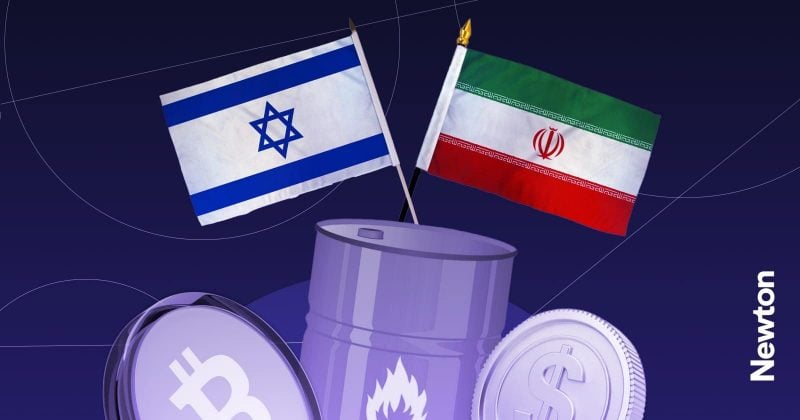
Bitcoin slips to $62,900 as oil prices jump 3% amid Iran-Israel conflict
Rising crude prices and geopolitical instability are pushing Bitcoin and major altcoins into risk-off territory, testing the digital safe haven narrative once again.
Bitcoin dropped to roughly $62,900 on June 8, shedding about 1.3% from its recent peak near $63,700. The culprit: a fresh round of hostilities between Iran and Israel that sent West Texas Intermediate crude oil futures surging more than 3% to around $93.50 per barrel.
The move wasn’t isolated to Bitcoin. Ethereum, Solana, and XRP all faced selling pressure as the broader crypto market traded lower in tandem with Asian equities. South Korea’s Kospi index posted sharp declines, painting a picture of classic risk-off behavior across virtually every asset class that isn’t oil or gold.
What triggered the sell-off
A fragile ceasefire between Iran and Israel collapsed, with both nations exchanging airstrikes in a rapid escalation that caught markets off guard. The breakdown reignited fears of a wider regional conflict, one that could directly threaten oil supply routes through the Strait of Hormuz, a chokepoint for roughly a fifth of the world’s crude.
US President Donald Trump reportedly urged Israeli Prime Minister Benjamin Netanyahu to exercise restraint and avoid further retaliatory actions. The diplomatic intervention signals that Washington recognizes the economic stakes: sustained oil prices above the $90 to $100 range have historically tightened financial conditions across the board.
Bitcoin’s safe haven problem
Bitcoin’s decline mirrored equity market weakness almost perfectly. Rather than absorbing capital fleeing traditional markets, BTC moved in the same direction as stocks, behaving more like a liquidity-sensitive tech bet than a store of value during acute stress.
The news moving money, markets, and the world—before your day starts.
Daily. Free. Join 34,000+ readers across crypto, finance, and policy.
Previous Iran-Israel escalations produced similar patterns, with Bitcoin declining alongside equities during the initial shock before recovering once volatility subsided.
The complication this time is that institutional participation in Bitcoin has grown significantly. ETF inflows have brought a wave of traditional finance capital into the market, capital that tends to be more sensitive to macro conditions and more likely to de-risk quickly when headlines turn ugly.
What this means for investors
If WTI crude settles back below $90 as diplomatic efforts gain traction, the crypto sell-off likely proves shallow and short-lived. But if oil stays above $93 or pushes toward $100, sustained high energy prices would put upward pressure on inflation readings, potentially delaying or reversing any rate-cutting expectations that have been supporting risk assets.
For crypto-specific positioning, the altcoin weakness in ETH, SOL, and XRP is worth monitoring closely. These assets typically exhibit higher beta to Bitcoin during drawdowns, meaning they fall faster and recover more slowly.
The next 48 to 72 hours of diplomatic maneuvering between Washington, Jerusalem, and Tehran will likely set the tone for both crude and crypto markets heading into the rest of June. Traders would be wise to watch oil futures as closely as they watch Bitcoin charts.