
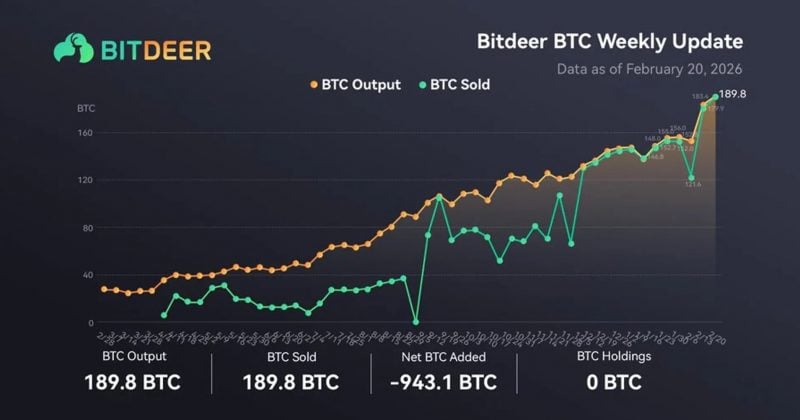
Bitdeer reports zero net Bitcoin holdings after selling 206.2 BTC
The Singapore-based miner continues its aggressive liquidation strategy, converting every coin it mines into cash to fund its AI pivot.
Most Bitcoin miners treat their mined coins like a savings account. Bitdeer treats them like a paycheck: earned on Friday, spent by Monday.
The company disclosed that it sold its entire weekly production of 206.2 BTC as of May 29, 2026, leaving it with exactly zero Bitcoin on its balance sheet.
A zero-treasury strategy, by design
This isn’t a one-off fire sale. Bitdeer has maintained a zero net Bitcoin holdings policy since at least February 2026, when it liquidated over 943 BTC from its treasury in a single move. Every week since, the company has converted its freshly mined coins into fiat, funneling the cash into operations and expansion.
That need is driven largely by the company’s pivot toward AI and high-performance computing infrastructure. Building data centers isn’t cheap, and Bitdeer has chosen to fund that buildout with mining revenue rather than sitting on a volatile digital asset.
In April 2026 alone, Bitdeer mined 783 BTC, reflecting significant year-over-year production growth.
The financial picture: growth with a catch
Bitdeer’s Q1 2026 financials tell a story of a company growing fast and burning through capital even faster. Revenue hit $188.9 million for the quarter, a massive jump from $70.1 million in Q1 of the prior year. The company also posted a net loss of $159.5 million in that same quarter.
The news moving money, markets, and the world—before your day starts.
Daily. Free. Join 34,000+ readers across crypto, finance, and policy.
Bitdeer, listed on NASDAQ under the ticker BTDR, operates across a sprawling global footprint. Its mining and data center facilities span the US, Norway, Bhutan, Canada, Malaysia, and Ethiopia. The company also develops its own SEALMINER hardware and offers AI cloud services, positioning itself as something more than a traditional miner.
How Bitdeer’s approach differs from the pack
The zero-treasury model puts Bitdeer in a small and somewhat lonely camp among public mining companies. Companies like Marathon Digital and Riot Platforms have historically accumulated large BTC treasuries, betting that holding the asset will deliver returns as Bitcoin’s price appreciates over time.
Bitdeer is making the opposite bet. Rather than treating Bitcoin as a store of value, it’s treating it purely as a revenue source, a commodity to be produced and immediately monetized.
What this means for investors
For anyone holding BTDR stock or considering it, this strategy fundamentally changes the investment thesis compared to other mining stocks. You’re not getting indirect Bitcoin exposure through Bitdeer. You’re getting a bet on the company’s ability to profitably mine and sell Bitcoin while simultaneously building an AI infrastructure business.
The $159.5 million net loss against $188.9 million in revenue is worth watching closely. Bitdeer’s consistent selling also creates a steady stream of supply pressure on Bitcoin, albeit a modest one. Selling 206 BTC per week isn’t going to move the market on its own, but it represents a philosophical shift that could gain traction if other miners adopt similar strategies to fund their own AI pivots.