
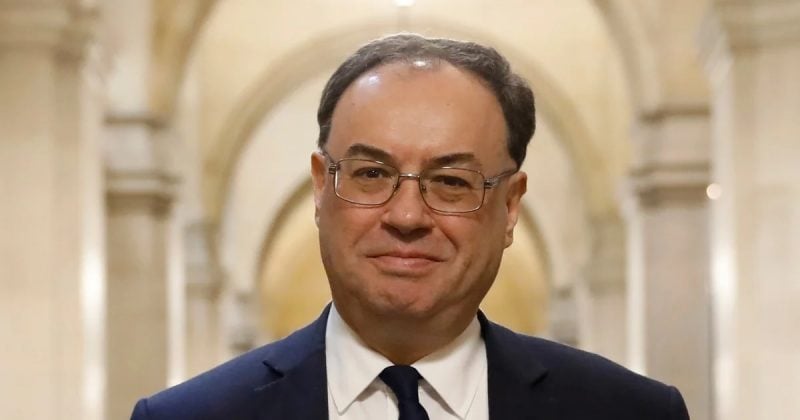
Bank of England Governor Bailey calls for sensible policy on balance sheet
The BoE is methodically shrinking its balance sheet, and Bailey wants reserves to match what banks actually need, not what crisis-era programs left behind.
Bank of England Governor Andrew Bailey is pushing a straightforward idea that turns out to be surprisingly complicated in practice: the central bank’s balance sheet should reflect actual demand for reserves, not the bloated legacy of a decade-plus of emergency bond-buying.
The numbers behind the normalization
Bailey first laid out a detailed framework during a lecture at the London School of Economics in May 2024. There, he introduced what the BoE calls a Preferred Minimum Range of Reserves, or PMRR, pegging it between £345 billion and £490 billion.
At the time, reserves sat at roughly £760 billion. That gap, somewhere between £270 billion and £415 billion, represents the distance the BoE needs to travel to reach what it considers a healthy equilibrium.
By April 2025, reserves had fallen to approximately £695 billion, a reduction of about £65 billion from the May 2024 figure. More than £73 billion of those remaining reserves were being supplied through repo operations rather than outright asset holdings, signaling a meaningful structural shift in how the BoE manages liquidity.
From QE hangover to repo-led framework
After the 2008 financial crisis, and again during COVID, the BoE hoovered up enormous quantities of government bonds, known as gilts, through quantitative easing. The idea was to push down long-term interest rates and flood the banking system with reserves to keep credit flowing.
That £553 billion figure is what Bailey highlighted in December 2025 when he reiterated plans to offload the BoE’s public sector gilt holdings. His primary concern: minimizing the interest rate risk that comes with holding such a massive portfolio of fixed-income assets while monetary policy shifts.
The news moving money, markets, and the world—before your day starts.
Daily. Free. Join 34,000+ readers across crypto, finance, and policy.
Bailey indicated that the equilibrium reserve level could be reached within roughly a year of his December 2025 remarks, putting a tentative timeline of late 2026 or early 2027 on achieving something resembling a normalized balance sheet.
The transition to a repo-led framework is the mechanical piece that makes this possible. Instead of relying on outright bond holdings to supply reserves, the BoE increasingly uses short-term repurchase agreements. In English: the central bank lends money to banks against collateral for short periods, rather than permanently holding assets on its books.
What this means for investors
When a central bank actively sells gilts or allows them to mature without reinvestment, it removes a major buyer from the market. That puts upward pressure on yields, all else being equal. For bondholders, rising yields mean falling prices. For borrowers, it means higher costs.
Bailey’s emphasis on matching reserves to actual bank demand rather than maintaining artificially elevated levels suggests the BoE is trying to find a steady state where monetary policy operates through interest rates rather than balance sheet size.
For crypto markets specifically, the absence of any digital asset discussion in Bailey’s framework is notable but not surprising. The BoE under Bailey has consistently treated monetary policy as a traditional-instruments conversation.
The practical takeaway for investors across asset classes is that the BoE has drawn itself a map from £695 billion to somewhere in the £345 billion to £490 billion range, and every step along that path will ripple through UK financial markets.