
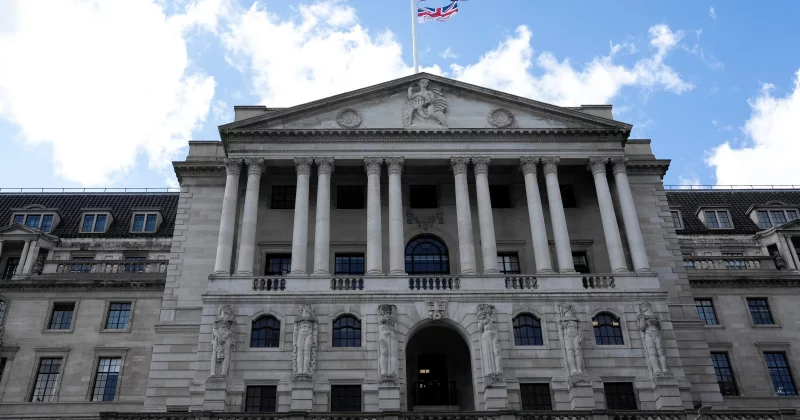
Bank of England’s Taylor warns UK economy is weak, calls interest rates far too restrictive
MPC member Alan Taylor says the current Bank Rate sits roughly 100 basis points above neutral, risking a prolonged period of deficient demand.
Alan Taylor, a member of the Bank of England’s Monetary Policy Committee, is sounding an alarm that most central bankers prefer to whisper about: the UK economy is weak, supply shocks are stoking inflation, and monetary policy is too tight to help with either problem.
Taylor’s assessment boils down to a painful squeeze. The economy lacks demand, but inflationary pressures from energy prices and trade disruptions make it politically awkward to cut rates aggressively. The result is a policy rate that Taylor believes is roughly 100 basis points above where it should be.
The numbers behind the warning
The current Bank Rate stands at 4.25%. Taylor pegs the neutral rate, the theoretical level that neither stimulates nor restricts economic activity, at around 2.75%. In English: the BoE is applying the brakes on an economy that’s already struggling to accelerate.
Here’s the thing. Inflation has actually been coming in weaker than the BoE’s own forecasts. Wage growth has followed the same pattern, undershooting expectations. Meanwhile, unemployment is running higher than anticipated.
That trifecta, softer inflation, slower wages, higher joblessness, points squarely at deficient demand. The economy isn’t overheating. It’s cooling faster than the central bank’s models predicted.
Taylor was part of a minority on the MPC that pushed for a more aggressive cut at the latest meeting, advocating for a reduction to 3.5%. That would have been a 75-basis-point move, a pace the committee majority clearly wasn’t comfortable with. The majority opted for a more cautious approach, leaving Taylor and his fellow dissenters outvoted but very much on the record.
The tension is familiar to anyone who watches central bank politics. Doves see deteriorating demand data and want to act before the damage compounds. Hawks point to sticky supply-side inflation and argue that cutting too fast risks credibility. Taylor sits firmly in the dove camp, and his argument carries a specific kind of weight: the data keeps proving him closer to right.
Supply shocks complicate everything
Taylor isn’t ignoring inflation. He explicitly identifies energy prices and geopolitical disruptions as ongoing supply shocks hitting the UK economy. These are the kinds of price pressures that monetary policy is poorly equipped to address.
Macro, rates, and crypto—what moved markets and what matters next.
Daily. Free. Join 34,000+ readers across crypto, finance, and policy.
Think of it this way. If grocery prices rise because a shipping route gets disrupted, raising interest rates doesn’t fix the shipping route. It just makes it harder for consumers to afford the groceries. Supply-driven inflation and demand-driven inflation require fundamentally different responses, and Taylor’s argument is that the BoE is treating the former like the latter.
The risk he’s flagging is specific and measurable. If the Bank Rate stays at 4.25% while neutral sits at 2.75%, every month of inaction is another month of unnecessarily restrictive policy weighing on businesses, consumers, and employment. Prolonged tightness in the face of weakening demand could push inflation below the BoE’s target for an extended period, which is just as problematic as running above it.
Central banks have symmetric mandates for a reason. Undershooting the inflation target signals an economy that’s running too cold, where investment dries up and labor markets deteriorate. Taylor’s warning is that the UK may already be heading there.
Why this matters beyond Threadneedle Street
The BoE’s rate decisions ripple far beyond traditional finance. For crypto markets and broader risk assets, the stance of major central banks is one of the most important macro inputs. Tighter policy means higher borrowing costs, reduced liquidity, and less appetite for risk. Looser policy does the opposite.
Taylor’s push for faster rate cuts, if it eventually gains traction within the MPC, would ease financial conditions across the UK economy. Lower rates tend to weaken the pound, push investors further out on the risk curve, and increase the attractiveness of alternative assets. That dynamic has historically been constructive for crypto and other macro-sensitive holdings.
Look, one dissenting MPC member doesn’t change policy overnight. But Taylor’s argument is becoming harder for the majority to dismiss when the data keeps cooperating with his thesis. Every inflation print that undershoots, every jobs report that disappoints, adds evidence to the case that 4.25% is too high.
The broader context matters too. The BoE isn’t operating in isolation. The Federal Reserve, the European Central Bank, and other major central banks are all navigating their own versions of this tension between supply-side inflation and demand-side weakness. If the consensus among global central banks shifts toward faster easing, the BoE will face mounting pressure to follow, regardless of internal MPC politics.
For investors watching the UK macro picture, the key variable is whether Taylor’s minority position becomes the majority view over the next several meetings. The gap between 4.25% and his preferred 3.5% represents significant policy space. Closing that gap would meaningfully change the cost of capital across the economy.
The risk scenario Taylor is warning about, a prolonged period of deficient demand driven by excessively tight policy, is the kind of slow-moving problem that doesn’t generate dramatic headlines until the damage is already done. By the time unemployment rises enough to shift the political calculus inside the MPC, the economy may have already lost momentum that takes quarters to rebuild. That’s the core of his argument, and it’s one that markets would be wise to take seriously even if the committee majority hasn’t fully embraced it yet.