
Bank of America strategist warns mega IPOs could push tech weighting past bubble-era levels
SpaceX and OpenAI listings could drive technology's share of equity benchmarks above 48%, triggering forced buying by passive funds.
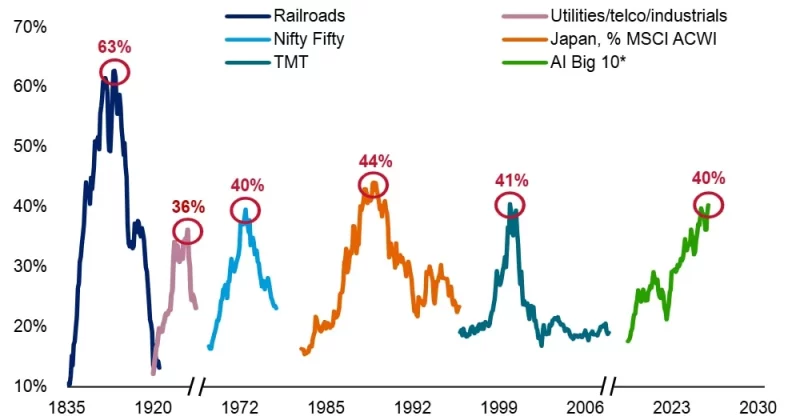
Bank of America’s chief investment strategist Michael Hartnett warned on May 22 that anticipated mega-IPOs from SpaceX and OpenAI could push technology’s weighting in major equity benchmarks like the S&P 500 beyond 48%. That’s a threshold he associates with historical market bubbles.
The numbers behind the warning
SpaceX has filed its S-1, targeting a valuation north of $1.75 trillion. The company aims to raise up to $75 billion in what would be one of the largest IPOs ever, with a potential Nasdaq debut in June.
Meanwhile, OpenAI is preparing a confidential IPO filing. Its most recent private valuation hit $830 billion following a $120 billion investment round.
Hartnett drew explicit comparisons to the Roaring ’20s and the Nifty Fifty era, periods when investor enthusiasm about a narrow set of stocks created concentration levels that eventually unwound painfully.
The passive fund problem
If SpaceX and OpenAI are rapidly included in benchmark indices after their listings, passive funds would be required to purchase large amounts of shares in a compressed timeframe. That forced buying amplifies demand regardless of valuation, pushing prices higher and, by extension, increasing tech’s overall weighting even further.
The current tech weighting in the S&P 500 is already elevated by historical standards. Adding two mega-cap entrants with combined valuations exceeding $2.5 trillion would concentrate the index further in a sector that already dominates it. Past the 48% level Hartnett flagged, you’re in territory that hasn’t been seen outside of bubble conditions.
Why crypto investors should pay attention
OpenAI’s IPO sits directly at the intersection of AI and technology, a narrative that has driven significant capital flows into AI-related crypto tokens over the past two years. A public market debut that prices OpenAI at $830 billion or higher could either validate those token valuations or expose the gap between hype and revenue.
SpaceX’s listing creates a new publicly tradable vehicle for exposure to Elon Musk’s empire. Historically, Musk-adjacent assets, including Dogecoin and other meme tokens, have shown sensitivity to developments in his business portfolio.
If passive funds are forced to allocate billions toward two new mega-cap listings, that capital comes from somewhere. Massive equity market events can temporarily starve alternative assets of inflows.