
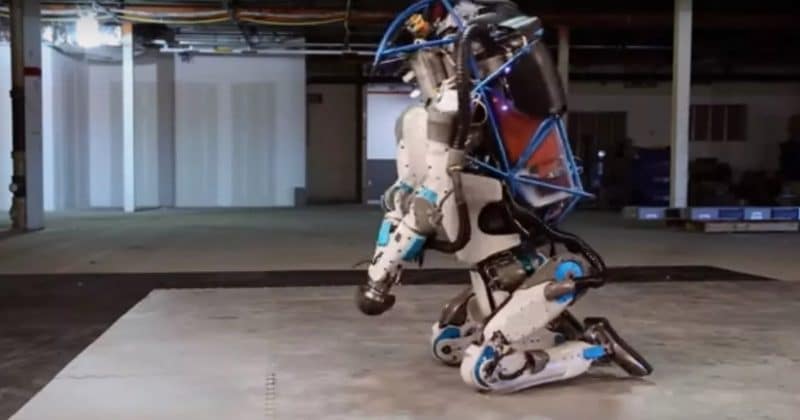
Boston Dynamics’ Atlas robot walks onto FIFA World Cup pitch, and crypto has nothing to do with it
Hyundai's humanoid robot delivered the match ball at halftime of a World Cup game, marking a milestone for robotics that the crypto world is watching closely for different reasons
A five-foot humanoid robot named Atlas walked pitchside at New York/New Jersey Stadium during a FIFA World Cup Round of 16 match between Brazil and Norway, performed goal celebrations mimicking Harry Kane, Erling Haaland, Matheus Cunha, and Son Heung-min, then handed the match ball to the referee. In front of 80,000 people and a global TV audience, it was the first time a humanoid robot had ever appeared in that capacity at a World Cup.
The robot, the car company, and the football tournament
Atlas is built by Boston Dynamics, which is roughly 80% owned by Hyundai Motor Group. The electric version of Atlas was unveiled at CES on January 5, 2026, with full-scale production kicking off immediately after. All initial units were allocated for 2026 deployment across Hyundai facilities and for Google DeepMind.
The World Cup appearance was part of Hyundai’s “School of Football” campaign, leveraging the automaker’s role as FIFA’s official automotive partner. The campaign featured Atlas demonstrating complex soccer moves, including something called the Ghost Rabona, a trick the robot reportedly learned through reinforcement learning trained on live World Cup footage.
Atlas wasn’t the only Boston Dynamics creation at the tournament. Spot, the company’s quadruped robot, was also present at World Cup venues, reportedly offering candy to FIFA President Gianni Infantino on June 12, 2026.
Why crypto should care about robots that have nothing to do with crypto
There is no cryptocurrency token, blockchain protocol, or decentralized project connected to the Atlas-Hyundai-FIFA collaboration. Zero. None. The research confirms it explicitly.
The news moving money, markets, and the world—before your day starts.
Daily. Free. Join 34,000+ readers across crypto, finance, and policy.
There is an unrelated meme token called “Boston Dynamics (ATLAS)” that has no affiliation with Boston Dynamics, Hyundai, or FIFA.
Every component of this activation — the hardware, the AI training, the deployment logistics, the sponsorship economics — ran through traditional corporate structures. Hyundai spent the money. Boston Dynamics built the robot. Google DeepMind contributed the learning frameworks. FIFA sold the sponsorship rights.
The AI-robotics convergence and what it means for markets
Hyundai’s strategy here is transparent. The company is using the World Cup’s massive audience to rebrand itself from an automaker into a robotics and mobility company. It’s a playbook similar to what Tesla attempted with Optimus, though Hyundai has the advantage of owning Boston Dynamics.
For crypto investors, the relevant question is whether blockchain-based projects in the AI and robotics space — from decentralized compute networks like Render and Akash to AI-focused tokens like FET and TAO — are actually positioned to capture any value from the robotics buildout, or whether this entire sector will be dominated by traditional corporate R&D budgets that make token economics irrelevant.