
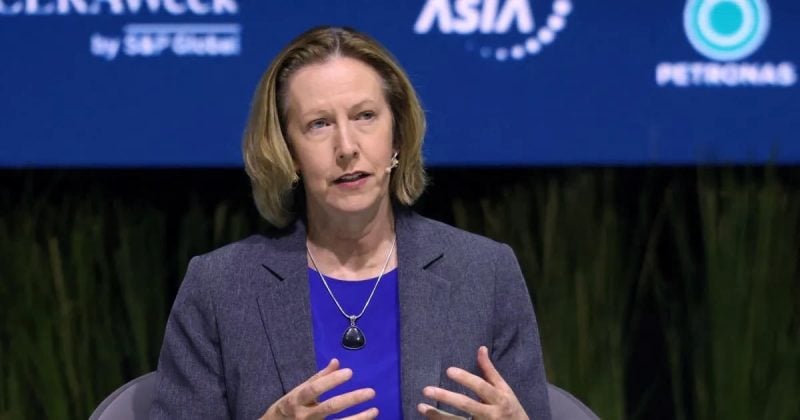
BP CEO Meg O’Neill reorganizes leadership to focus on oil and gas
BP's first external CEO in over a century is splitting the company into two divisions and ditching the renewables pivot that defined the last era of leadership.
BP is going back to basics. New CEO Meg O’Neill, who took the helm on April 1, 2026, announced a sweeping reorganization that will consolidate the energy giant into two primary divisions: an upstream segment for oil and gas exploration and production, and a downstream segment covering refining, fuels, and retail.
The restructuring takes effect July 1, 2026. It represents a decisive retreat from the renewables-heavy strategy that BP pursued under previous leadership.
A new structure, a new era
The reorganization, formally announced on June 9, 2026, is designed to strip away organizational complexity and sharpen decision-making. Two divisions instead of a sprawling web of business units.
The upstream division will handle resource development and production. The downstream division gets refining, fuels, and the company’s retail operations.
O’Neill herself is a historic appointment on multiple fronts. She’s BP’s first external CEO in over a century, and the first woman to lead a major oil company. She’s also the fifth person to hold the role in a relatively short span.
Macro, rates, and crypto—what moved markets and what matters next.
Daily. Free. Join 34,000+ readers across crypto, finance, and policy.
Chairman Albert Manifold has been pushing for a leaner organization, and O’Neill appears to be executing that vision with urgency. Since her appointment, she has been actively engaging stakeholders and laying the groundwork for what amounts to a philosophical U-turn for one of the world’s largest energy companies.
The renewables retreat
BP spent years positioning itself as the major oil company most committed to the energy transition. Now O’Neill is reallocating capital back toward fossil fuel projects. The company has set a target of $20 billion in asset divestitures by 2027, a massive sell-off intended to fund the pivot and clean up the balance sheet.
What this means for investors
For energy investors, BP’s restructuring sends a clear message: the company is prioritizing cash flow and returns over transition optics. The simplified two-division structure should make it easier for analysts to evaluate performance and for management to be held accountable.
The $20 billion divestiture target is the number to watch. If BP executes that plan successfully, it frees up significant capital for reinvestment in high-return oil and gas projects and potential shareholder returns through buybacks or dividends.
There’s also a competitive angle. BP has been underperforming relative to peers like Shell and ExxonMobil, both of which maintained a heavier focus on traditional energy. O’Neill’s reorganization is essentially an admission that BP needs to close that gap.