
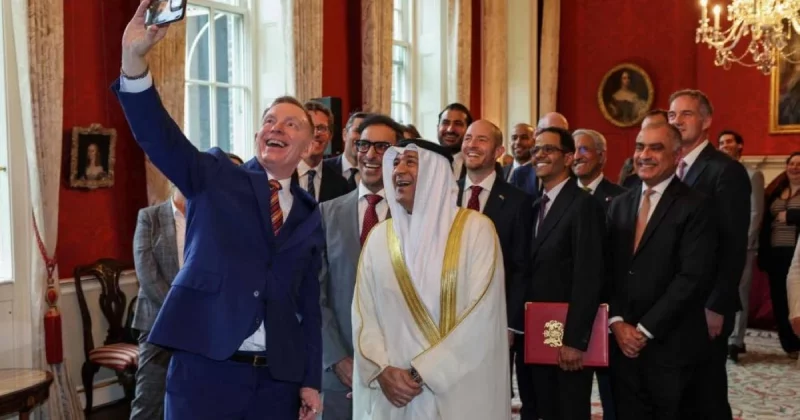
Britain secures $5B annual trade deal with Gulf Cooperation Council in first-of-its-kind G7 agreement
The UK becomes the first G7 nation to lock in a comprehensive free trade agreement with the six-nation Gulf bloc, slashing tariffs on 93% of British exports.
Britain has landed a free trade agreement with the Gulf Cooperation Council worth roughly $5 billion a year, making the UK the first G7 country to secure a comprehensive deal with the six-nation Gulf bloc. The agreement covers Saudi Arabia, the UAE, Qatar, Kuwait, Oman, and Bahrain, collectively one of the wealthiest economic corridors on the planet.
The deal, valued at approximately £3.7 billion annually, will eliminate tariffs on up to 93% of UK exports to GCC nations over time. Think of it as removing the tollbooths on a highway that British manufacturers, financial services firms, and energy exporters have been paying to use for decades.
What the deal actually covers
The agreement targets several pillars of British economic strength. Manufacturing, financial services, and energy exports all stand to benefit from the dramatically reduced trade barriers. In return, Gulf nations gain improved access to UK services, technology, and investment opportunities.
Before this deal, UK-GCC trade already operated at a significant scale, with annual flows in the tens of billions of dollars. The FTA was negotiated against a baseline target of £30 billion to £40 billion in annual trade between the two sides. The $5 billion figure represents the estimated additional economic value the agreement is expected to generate each year, not the total trade volume.
Negotiations have been running since at least 2022, which by trade deal standards is actually pretty quick. The EU spent over two decades trying to finalize a deal with the Mercosur bloc. Britain, freshly unshackled from Brussels, appears to be moving faster on its own.
The 93% tariff elimination figure is the headline number, but the real significance lies in which sectors those tariffs cover. British goods heading to the Gulf have historically faced meaningful duties that made them less competitive against local producers and rivals from countries with existing preferential arrangements. Stripping those away changes the math for every UK exporter running a spreadsheet on Gulf market entry.
Why the Gulf, and why now
Post-Brexit Britain has been on a trade deal sprint, trying to prove that leaving the EU’s single market wasn’t an economic own goal. Agreements with Australia, New Zealand, and Japan were early wins, but the GCC deal carries a different weight. The Gulf states are sitting on sovereign wealth funds worth trillions and are actively diversifying their economies away from oil dependence.
Macro, rates, and crypto—what moved markets and what matters next.
Daily. Free. Join 34,000+ readers across crypto, finance, and policy.
Saudi Arabia’s Vision 2030, the UAE’s push to become a global financial and technology hub, and Qatar’s post-World Cup infrastructure buildout all create enormous demand for exactly the kind of services Britain excels at exporting. Financial advisory, legal services, engineering consulting, and fintech solutions are all areas where London firms have deep expertise and the Gulf has deep pockets.
The timing also reflects a broader geopolitical recalibration. With trade tensions simmering between the US and China, and the EU focused inward on its own competitiveness challenges, Britain is carving out a lane as a connector between Western capital markets and Gulf wealth. It’s a bet that geographic and regulatory positioning can compensate for the smaller domestic market Britain now represents outside the EU.
The GCC nations, for their part, get something valuable too. Access to London’s financial infrastructure, one of the deepest capital markets in the world, becomes easier. UK technology firms gain a clearer path into markets that are spending aggressively on digital transformation, smart cities, and renewable energy transitions.
What this means for investors
The fintech and digital assets angle is worth watching closely. The UAE and Bahrain have built some of the most sophisticated virtual asset regulatory frameworks in the world, while Britain has been loudly positioning itself as a global fintech hub. The FTA doesn’t appear to include explicit digital asset provisions, but improved financial services cooperation between London, Dubai, and Riyadh creates fertile ground for cross-border fintech activity.
Lower trade barriers mean more capital flowing between the two regions. More capital flows mean more demand for the payment rails, compliance infrastructure, and digital financial products that fintech companies build. For crypto-adjacent firms operating in either jurisdiction, the reduced friction could accelerate expansion plans that previously looked like multi-year projects.
The competitive landscape shifts too. Other G7 nations, the US, Canada, France, Germany, Italy, and Japan, don’t have equivalent agreements with the GCC. That gives British firms a first-mover advantage in sectors where tariff differentials matter. Whether that advantage proves durable depends on how quickly rival nations negotiate their own deals, but in trade, timing matters enormously. The relationships and market positions built during an exclusivity window tend to stick.
The risk side of the ledger isn’t empty. Trade deals create winners and losers within domestic economies, and industries that currently benefit from protection against Gulf competition may find themselves exposed. The 93% figure also implies that 7% of exports didn’t make the cut, and what’s in that remaining slice could matter for specific sectors. Investors in UK-listed companies with significant Gulf exposure should be reading the fine print when it becomes available, because the devil in trade agreements is always in the tariff schedules, not the press releases.