
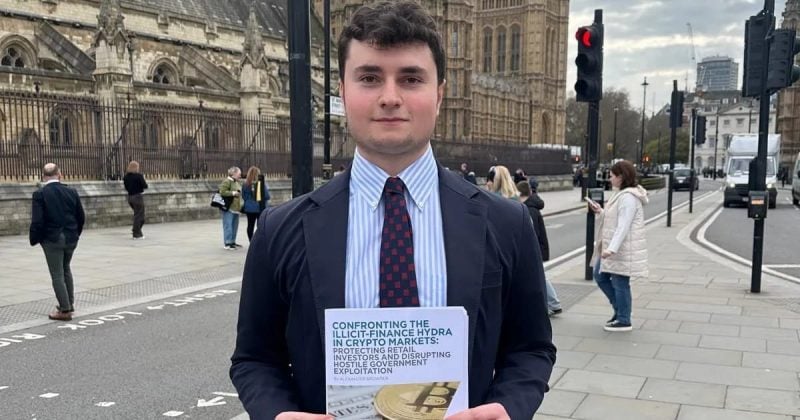
British teenager Alexander Browder sanctioned by Russia over crypto laundering report
The 17-year-old researcher traced $350 billion in illicit crypto flows and called Moscow's retaliation 'a badge of honour.'


Russia sanctioned 17 year old British researcher Alexander Browder after he published a report alleging that Moscow linked actors used crypto networks and stablecoins to evade Western financial restrictions.
Browder, founder of the Global Cryptocurrency Laundering Database, was added to Russia’s sanctions list alongside several other UK nationals, including Washington Post journalist Catherine Belton.
Moscow accused him of spreading false information about Russian policy, while Browder said the move showed his research had hit a sensitive point.
His report, published by the Henry Jackson Society in March, examined 164 crypto laundering cases across 20 years and estimated that about $350 billion in illicit funds had moved through digital assets.
The report said stablecoins have become increasingly important to criminal groups and hostile governments because they offer less volatility than Bitcoin while still operating across global crypto rails.
The central case is A7A5, a ruble linked stablecoin issued in Kyrgyzstan and tied by Western authorities to Russian sanctions evasion networks.
The crypto and markets news you actually need—every morning.
Daily. Free. Join 34,000+ readers across crypto, finance, and policy.
Chainalysis reported that A7A5 recorded $93 billion in trading volume in its first year, with most activity flowing through exchanges with strong Russian ties.
US and UK authorities have already targeted parts of that network. The US Treasury designated Grinex, described as a successor to sanctioned exchange Garantex, along with A7 and related entities. Treasury said Grinex helped users regain access to funds through A7A5 after enforcement actions against Garantex.
The UK has also sanctioned crypto companies and individuals linked to the A7 network, including entities accused of helping Russia bypass trade restrictions.
Chainalysis said the sanctions package focused on crypto rails used to move funds around Western restrictions and support Russia’s war economy.
Browder later submitted written evidence to the UK Parliament’s House of Lords Financial Services Regulation Committee, where he argued that illicit crypto activity has shifted from Bitcoin toward stablecoins. He said his database draws on open sources, court records, indictments, law enforcement actions, and investigative reports.
The Browder name adds political weight to the case. Alexander is the son of Sir Bill Browder, the financier and Kremlin critic who helped drive the Magnitsky Act, which created a framework for sanctions against officials accused of human rights abuses.