
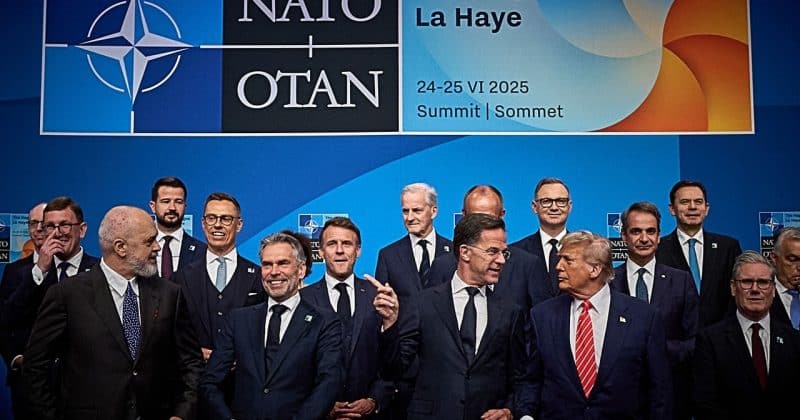
Canada to unveil 10-nation coalition backing $133 billion global defence bank at NATO summit

Canada to unveil 10-nation coalition backing $133 billion global defence bank at NATO summit

The Defence, Security and Resilience Bank represents the largest new multilateral financial institution in decades, and crypto-native capital markets should be paying attention.

A new $133 billion multilateral bank is about to enter the global financial landscape. Canada plans to announce approximately ten founding member nations for the Defence, Security and Resilience Bank (DSRB) at the NATO summit in Ankara, Turkey, scheduled for July 7-8, with ambitions to fundamentally reshape how allied nations finance their military and security infrastructure.

What the DSRB actually is

The Defence, Security and Resilience Bank is a proposed multilateral development bank designed to mobilize low-cost, long-term financing for NATO allies’ defense and security projects. Its target capital pool: up to £100 billion, roughly $133 billion.

Advertisement

Canada was selected as the host country for the DSRB headquarters in late April 2026, following a competitive bidding process that included representatives from 19 countries. The initiative is being led by Isabelle Hudon, CEO of the Business Development Bank of Canada, who has been driving the project with a clear timeline in mind.

“We gave ourselves the NATO summit as a deadline. What we are aiming to announce is the list of founding members,” Hudon said.

The founding coalition is primarily composed of European countries alongside Canada, though the institution’s architecture could eventually extend membership to up to 40 NATO allies. Major Canadian banks, including RBC, TD, CIBC, Scotiabank, National Bank of Canada, and BMO, are backing the initiative.

The geopolitical pressure cooker

Canada’s role as host country and driving force behind the bank represents a strategic repositioning. By housing the DSRB’s headquarters and marshaling support from its own banking sector, Canada is placing itself at the center of NATO’s financial architecture rather than just its military commitments.

The 19 countries that participated in preparatory meetings suggest broad interest, though not all will necessarily sign on as founding members. The ten nations expected to be announced at the Ankara summit represent the core coalition willing to commit early.

Negotiations on precise capital commitments remain ongoing, which is typical for institutions of this scale. The Asian Infrastructure Investment Bank, the last major multilateral development bank to launch (in 2016), went through similar rounds of founding member announcements before finalizing its capital structure.

Disclosure: This article was edited by Editorial Team. For more information on how we create and review content, see our Editorial Policy.

Canada to unveil 10-nation coalition backing $133 billion global defence bank at NATO summit

Canada to unveil 10-nation coalition backing $133 billion global defence bank at NATO summit

The Defence, Security and Resilience Bank represents the largest new multilateral financial institution in decades, and crypto-native capital markets should be paying attention.

A new $133 billion multilateral bank is about to enter the global financial landscape. Canada plans to announce approximately ten founding member nations for the Defence, Security and Resilience Bank (DSRB) at the NATO summit in Ankara, Turkey, scheduled for July 7-8, with ambitions to fundamentally reshape how allied nations finance their military and security infrastructure.

What the DSRB actually is

The Defence, Security and Resilience Bank is a proposed multilateral development bank designed to mobilize low-cost, long-term financing for NATO allies’ defense and security projects. Its target capital pool: up to £100 billion, roughly $133 billion.

Advertisement

Canada was selected as the host country for the DSRB headquarters in late April 2026, following a competitive bidding process that included representatives from 19 countries. The initiative is being led by Isabelle Hudon, CEO of the Business Development Bank of Canada, who has been driving the project with a clear timeline in mind.

“We gave ourselves the NATO summit as a deadline. What we are aiming to announce is the list of founding members,” Hudon said.

The founding coalition is primarily composed of European countries alongside Canada, though the institution’s architecture could eventually extend membership to up to 40 NATO allies. Major Canadian banks, including RBC, TD, CIBC, Scotiabank, National Bank of Canada, and BMO, are backing the initiative.

The geopolitical pressure cooker

Canada’s role as host country and driving force behind the bank represents a strategic repositioning. By housing the DSRB’s headquarters and marshaling support from its own banking sector, Canada is placing itself at the center of NATO’s financial architecture rather than just its military commitments.

The 19 countries that participated in preparatory meetings suggest broad interest, though not all will necessarily sign on as founding members. The ten nations expected to be announced at the Ankara summit represent the core coalition willing to commit early.

Negotiations on precise capital commitments remain ongoing, which is typical for institutions of this scale. The Asian Infrastructure Investment Bank, the last major multilateral development bank to launch (in 2016), went through similar rounds of founding member announcements before finalizing its capital structure.

Disclosure: This article was edited by Editorial Team. For more information on how we create and review content, see our Editorial Policy.