
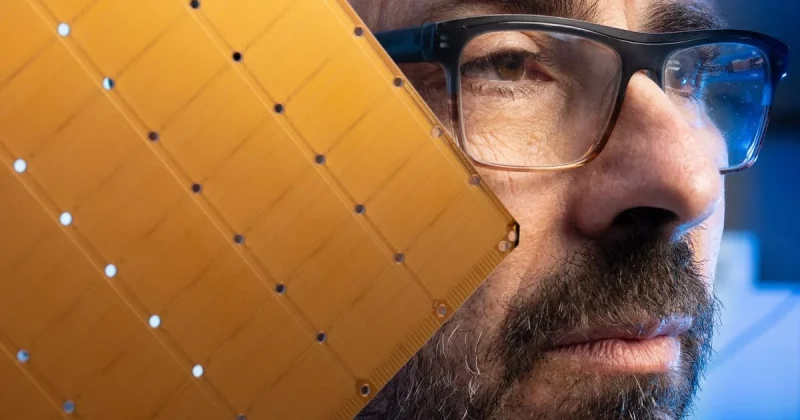
Cerebras CEO Andrew Feldman explains why he built the world’s largest AI chip
The Wafer Scale Engine is roughly 50 times larger than Nvidia's biggest chips, and Feldman thinks that size advantage changes everything about AI processing.
Most semiconductor companies try to make chips smaller. Andrew Feldman went the other direction.
The Cerebras Systems CEO built what is currently the largest single computer chip designed for AI workloads. Called the Wafer Scale Engine, it occupies an entire 300 mm silicon wafer, the same circular platter that traditional chipmakers slice into hundreds of individual processors. Cerebras just skipped the slicing part.
The result is a processor roughly 50 times larger than the biggest chips from Nvidia and Intel. And Feldman’s bet that bigger means faster for AI has attracted serious money: a $1.1B Series G funding round, a $5.55B IPO, and a first-day market cap of approximately $95B.
Why one giant chip instead of many small ones
Here’s the thing about training large language models. The standard approach involves stringing together thousands of GPUs and getting them to communicate with each other constantly. Think of it like hiring 10,000 workers who all need to be on the same conference call simultaneously. The work itself is fast. The coordination is the bottleneck.
Cerebras’ approach eliminates that conference call entirely. By putting everything on a single wafer-scale chip, combined with custom memory and networking hardware, the company creates an end-to-end AI system where data doesn’t need to hop between separate processors.
In English: instead of a cluster of chips shouting at each other across a data center, you get one massive chip that keeps the conversation internal. The multi-GPU communication overhead that plagues traditional setups simply disappears.
The third-generation version of this architecture, the WSE-3, delivers unprecedented memory bandwidth and compute power for a single device. That matters because AI models keep getting larger, and the physics of shuttling data between separate chips creates a hard ceiling on how fast you can train them.
Feldman’s argument is straightforward. If the chip is big enough, you don’t need the complex orchestration software and networking infrastructure that makes multi-GPU clusters so expensive and difficult to manage. The hardware does what the software used to do.
From startup contrarian to public company heavyweight
Cerebras didn’t arrive at a $95B market cap overnight. The company spent years as a private startup, raising progressively larger rounds while the AI industry was still figuring out whether purpose-built chips could compete with Nvidia’s GPU ecosystem.
That question now has at least a partial answer. The company’s $5.55B IPO was a landmark event, validating that investors see a genuine market for AI-specific hardware beyond the GPU paradigm that Nvidia has dominated for years.
Fidelity emerged as a major backer, holding an 11.3% stake in Cerebras following the public offering. For a company whose core product defies conventional chip design wisdom, having one of the world’s largest asset managers as a significant shareholder sends a clear signal about institutional confidence.
The IPO also represented a massive win for early investors who backed Feldman’s unconventional vision when the wafer-scale concept was still largely theoretical. Turning an entire silicon wafer into a single functional processor is an engineering challenge that most semiconductor veterans considered impractical, if not impossible.
What this means for AI infrastructure investors
The AI chip market has been Nvidia’s playground for the better part of a decade. The company’s GPUs became the default hardware for training neural networks, and its CUDA software ecosystem created switching costs that kept customers locked in. Cerebras represents one of the most credible architectural alternatives to emerge in that time.
But credible alternative and dominant competitor are very different things. Nvidia’s moat isn’t just hardware. It’s the vast library of software tools, pre-trained models, and developer familiarity that make its chips the path of least resistance for most AI teams. Cerebras has to convince customers not just that its chip is faster, but that the productivity gains justify rebuilding their workflows around a fundamentally different architecture.
The $95B market cap prices in a lot of optimism. For context, that valuation on the first day of trading puts Cerebras in the same neighborhood as companies with far more revenue and established customer bases. Investors are clearly betting on future demand rather than current financials.
Look, the AI hardware market is expanding fast enough that multiple architectures can probably coexist. Not every workload needs the same solution, and as models grow larger, the communication bottlenecks in GPU clusters become more painful. That’s exactly the pain point Cerebras is designed to address.
The risk for investors is execution. Manufacturing a wafer-scale chip with acceptable yields is extraordinarily difficult. One defect that would ruin a single small chip in a traditional process now has to be managed across a surface area 50 times larger. Cerebras has clearly solved this well enough to ship products, but scaling production to meet enterprise demand is a different challenge entirely.
What to watch: customer adoption beyond early partners, competitive responses from Nvidia and AMD, and whether Cerebras can build the software ecosystem needed to make its hardware accessible to mainstream AI developers. The chip itself is a genuine engineering breakthrough. Whether it becomes a business breakthrough depends on everything that surrounds it.