
Cerebras achieves record speeds serving trillion-parameter AI model Kimi K2.6
The chip startup's wafer-scale engine delivers nearly 7x faster inference than GPU clouds on Moonshot AI's massive model, signaling a shift in how the biggest AI workloads get processed.
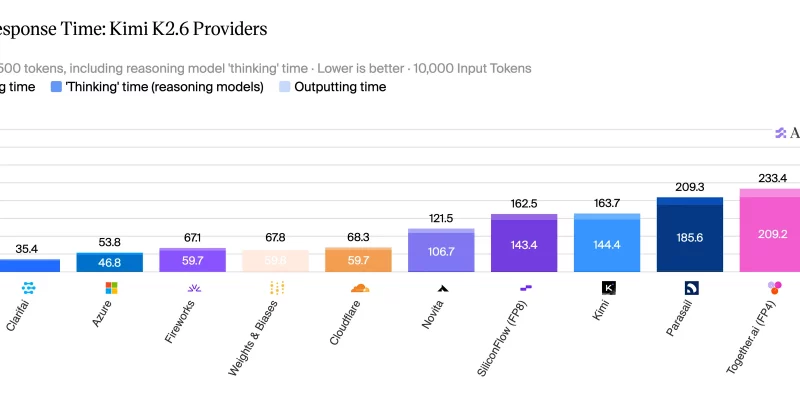
Cerebras Systems just posted the kind of benchmark that makes GPU cloud providers uncomfortable. The company’s inference platform is running Kimi K2.6, a trillion-parameter AI model, at 981 output tokens per second. That’s roughly 6.7 times faster than the next-best GPU cloud provider and 23 times faster than the median, according to benchmarking data from Artificial Analysis.
To put that in human terms: imagine reading a dense technical document and having an AI generate coherent, useful responses nearly seven times faster than the best alternative on the market. For enterprises building products on top of large language models, that kind of speed difference isn’t incremental. It’s architectural.
What Cerebras actually pulled off
Kimi K2.6 is built on Moonshot AI’s Kimi K2 family and uses a Mixture-of-Experts (MoE) architecture. Think of MoE as a team of specialists rather than one generalist: instead of activating every parameter for every input, the model routes each token through 32 of its many experts, keeping things efficient despite the model’s enormous size. A trillion parameters is, for context, roughly six times the size of GPT-3 and places Kimi K2.6 among the largest models currently in deployment anywhere.
The 981 tokens-per-second figure represents the fastest performance ever measured on a model of this scale. Cerebras didn’t just edge out the competition. It lapped the field.
The speed gains come from three technical ingredients working together. First, Cerebras’s wafer-scale engine, a chip architecture that puts an entire wafer’s worth of silicon to work as a single processor rather than stitching together thousands of discrete GPUs. Second, custom inference kernels optimized specifically for how these massive models move data. Third, speculative decoding, a technique where the system predicts likely next tokens in parallel and then verifies them, effectively trading cheap compute for wall-clock time.
Cerebras also reported that K2 Think, a reasoning-focused variant of the model, runs at 2,000 tokens per second on its platform. That model has been posting top-tier results on math benchmarks, positioning it as one of the strongest open-source reasoning models available. The company is making enterprise trials of Kimi K2.6 available now, targeting use cases where real-time responsiveness and low latency are non-negotiable.
Why this matters beyond benchmarks
Here’s the thing about inference speed: it’s the bottleneck that determines whether AI stays a novelty or becomes infrastructure.
AI, tech, and the markets they move—in one daily briefing.
Daily. Free. Join 34,000+ readers across crypto, finance, and policy.
Training a model gets all the headlines. But inference, the process of actually using a trained model to generate outputs, is where companies spend the majority of their compute budget over time. Every chatbot response, every code suggestion, every document summary runs through the inference stack. When inference is slow or expensive, companies either limit how often they call the model, use smaller models that sacrifice quality, or accept latency that degrades the user experience.
A nearly 7x speed advantage changes the calculus on all three fronts. Real-time applications that were previously impractical with trillion-parameter models, think multi-agent systems, live financial analysis, or complex reasoning chains, suddenly become viable. The cost per token drops when you can process more tokens in less time on the same hardware.
This is particularly relevant for the crypto and decentralized finance space, where AI inference is increasingly being woven into on-chain analytics, automated trading strategies, and smart contract auditing. Running a trillion-parameter model fast enough for real-time use means DeFi protocols could theoretically deploy more sophisticated AI without the latency penalty that comes with routing requests through conventional GPU clouds.
The competitive landscape is shifting fast
Cerebras has been making the case for years that its wafer-scale approach represents a fundamentally different path from the GPU-centric paradigm dominated by Nvidia. The argument has always been elegant on paper: instead of networking thousands of individual GPUs together and dealing with the communication overhead, build one massive chip and keep everything on-die.
The counterargument has been equally straightforward. Nvidia’s ecosystem is enormous, its software stack (CUDA) is deeply entrenched, and the sheer manufacturing complexity of wafer-scale chips introduces risks that traditional chipmakers avoid. Building one giant chip is hard. Getting customers to trust it for production workloads is harder.
Results like this erode the skepticism. When the performance gap is measured in single-digit percentages, ecosystem advantages can win. When it’s measured in multiples, the conversation shifts.
Look, Nvidia isn’t going anywhere. The company’s dominance in AI training remains unchallenged, and its inference offerings continue to improve. But Cerebras is carving out a lane where its architecture has a natural advantage: serving the absolute largest models at speeds that GPU clusters struggle to match. As models continue to grow, and the industry’s trajectory suggests they will, that lane gets wider.
For investors watching the AI hardware space, the question isn’t whether Cerebras can beat GPUs on benchmarks. It clearly can. The question is whether enterprises will shift production workloads onto the platform in meaningful volume, and whether the company can maintain its speed advantage as Nvidia and others iterate on their own inference optimizations.
The enterprise trial availability for Kimi K2.6 is the next indicator to watch. Benchmarks prove capability. Customer adoption proves viability. The gap between those two things is where most hardware startups go to die, and where a select few become indispensable.