
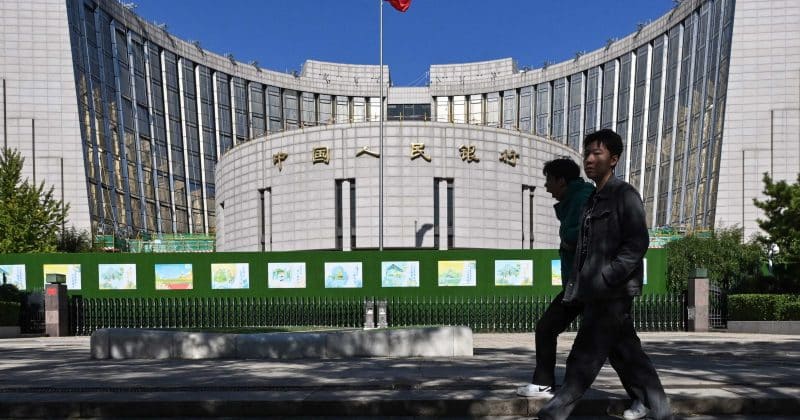
China’s M2 money supply reaches record 240% of GDP

China’s M2 money supply reaches record 240% of GDP

China's broad money supply has ballooned to a ratio that dwarfs every other major economy, raising serious questions about where all that liquidity is actually going

There is a number floating around global macro circles right now that deserves more attention than it is getting. China’s M2 money supply, the broad measure of money that includes cash, deposits, and near-money assets, has climbed to roughly 242.75% of the country’s GDP.

For context, the US ratio historically sits somewhere between 100% and 110%. China’s number is more than twice that.

What the numbers actually say

As of May 2026, China’s M2 stood at CNY 353.67 trillion, which converts to roughly $51 to $52 trillion USD. That figure grew 8.6% year-on-year, a pace that has remained consistent since the start of the year according to People’s Bank of China data.

The M2-to-GDP ratio hit 242.75% in 2025, up from 232.38% in 2024. In English: for every dollar of economic output China produces, there is roughly $2.43 floating around in the financial system.

Advertisement

Nominal GDP growth in China has remained subdued relative to the pace of credit creation. Analysts have flagged that liquidity is increasingly moving into non-real-economy channels, meaning it is not translating into consumer spending, wage growth, or the kind of productive economic activity that would justify this level of monetary expansion.

How China got here

The structural roots of China’s elevated M2 ratio trace back to the period following the global financial crisis of 2008 and 2009, when Beijing responded with an aggressive credit expansion to sustain growth. Infrastructure spending, state-directed lending, and financial sector deepening all accelerated through that period and never fully unwound.

China is contending with a stagnant real estate sector that once served as one of the primary channels for credit absorption. Property developers that previously soaked up lending are now deleveraging or defaulting. Deflationary pressures have taken hold in pockets of the economy, which means nominal GDP growth is running slower than it otherwise would, making the ratio look even more stretched.

The People’s Bank of China continues to expand the money supply, but the transmission mechanism, the path from new money to real economic activity, is increasingly clogged.

What this means for investors

The more immediate concern is asset allocation distortion. When credit grows faster than the real economy can absorb it, liquidity tends to pile into financial assets and hard assets in ways that inflate prices beyond what fundamentals support. China’s real estate sector has already demonstrated what that cycle looks like when it unwinds.

For international investors considering exposure to Chinese markets, the disconnect between money supply growth and consumer spending is a meaningful risk factor.

Despite the scale of liquidity circulating in China’s financial system, there is no meaningful evidence that this monetary expansion is finding its way into digital assets. China’s regulatory posture toward crypto remains restrictive, and no specific tokens or digital assets were referenced in data regarding M2 growth. If anything, a record M2 ratio that raises concerns about monetary stability could push regulators toward tighter controls rather than looser ones.

Disclosure: This article was edited by Editorial Team. For more information on how we create and review content, see our Editorial Policy.

China’s M2 money supply reaches record 240% of GDP

China’s M2 money supply reaches record 240% of GDP

China's broad money supply has ballooned to a ratio that dwarfs every other major economy, raising serious questions about where all that liquidity is actually going

There is a number floating around global macro circles right now that deserves more attention than it is getting. China’s M2 money supply, the broad measure of money that includes cash, deposits, and near-money assets, has climbed to roughly 242.75% of the country’s GDP.

For context, the US ratio historically sits somewhere between 100% and 110%. China’s number is more than twice that.

What the numbers actually say

As of May 2026, China’s M2 stood at CNY 353.67 trillion, which converts to roughly $51 to $52 trillion USD. That figure grew 8.6% year-on-year, a pace that has remained consistent since the start of the year according to People’s Bank of China data.

The M2-to-GDP ratio hit 242.75% in 2025, up from 232.38% in 2024. In English: for every dollar of economic output China produces, there is roughly $2.43 floating around in the financial system.

Advertisement

Nominal GDP growth in China has remained subdued relative to the pace of credit creation. Analysts have flagged that liquidity is increasingly moving into non-real-economy channels, meaning it is not translating into consumer spending, wage growth, or the kind of productive economic activity that would justify this level of monetary expansion.

How China got here

The structural roots of China’s elevated M2 ratio trace back to the period following the global financial crisis of 2008 and 2009, when Beijing responded with an aggressive credit expansion to sustain growth. Infrastructure spending, state-directed lending, and financial sector deepening all accelerated through that period and never fully unwound.

China is contending with a stagnant real estate sector that once served as one of the primary channels for credit absorption. Property developers that previously soaked up lending are now deleveraging or defaulting. Deflationary pressures have taken hold in pockets of the economy, which means nominal GDP growth is running slower than it otherwise would, making the ratio look even more stretched.

The People’s Bank of China continues to expand the money supply, but the transmission mechanism, the path from new money to real economic activity, is increasingly clogged.

What this means for investors

The more immediate concern is asset allocation distortion. When credit grows faster than the real economy can absorb it, liquidity tends to pile into financial assets and hard assets in ways that inflate prices beyond what fundamentals support. China’s real estate sector has already demonstrated what that cycle looks like when it unwinds.

For international investors considering exposure to Chinese markets, the disconnect between money supply growth and consumer spending is a meaningful risk factor.

Despite the scale of liquidity circulating in China’s financial system, there is no meaningful evidence that this monetary expansion is finding its way into digital assets. China’s regulatory posture toward crypto remains restrictive, and no specific tokens or digital assets were referenced in data regarding M2 growth. If anything, a record M2 ratio that raises concerns about monetary stability could push regulators toward tighter controls rather than looser ones.

Disclosure: This article was edited by Editorial Team. For more information on how we create and review content, see our Editorial Policy.