
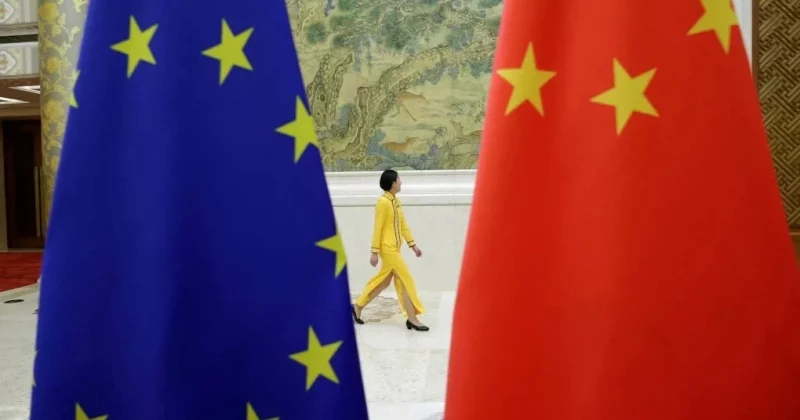
China warns EU of countermeasures against new trade restrictions
Beijing's latest threat underscores a deepening rift between the world's two largest trading blocs, with hundreds of billions in bilateral commerce at stake.
China has told the European Union, in no uncertain terms, that new restrictions on Chinese imports will be met with retaliation. The warning lands at a moment when the two economies are locked in a slow-motion trade standoff that’s been building for years, and it’s starting to look less like posturing and more like policy.
Here’s the thing: when your bilateral trade in goods hits roughly €732 billion in a single year, as EU-China trade did in 2024, threats of countermeasures aren’t abstract. They’re a financial earthquake waiting for a trigger.
The numbers behind the tension
The EU’s trade deficit with China reached €359.9 billion in 2024. That’s not a rounding error. It means the EU imported vastly more from China than it sent back, creating the kind of imbalance that makes politicians on both sides reach for tariff levers.
Brussels has been increasingly uncomfortable with this gap. The EU’s response hasn’t been limited to finger-wagging. It has been actively pursuing trade agreements with other economic blocs, most notably Mercosur and Australia, in what amounts to a diversification strategy.
Think of it like an investor rebalancing a portfolio that’s dangerously overweight in a single stock. The EU wants more trading partners so that any one relationship, particularly the one with Beijing, carries less systemic risk.
The EU-Mercosur trade agreement is set to provisionally apply from May 1, 2026. The EU-Australia deal, meanwhile, is projected to boost the EU’s GDP by €4 billion by 2030. Neither figure is transformational on its own, but together they signal a clear strategic direction: less dependence on China, more options elsewhere.
Beijing, predictably, is not thrilled.
Retaliation is already happening
China’s countermeasure warnings aren’t purely hypothetical. The country has already shown its willingness to use trade tools as weapons in this dispute.
In December 2025, China imposed anti-dumping tariffs of up to 19.8% on EU pork imports. Pork might sound like a niche battlefield, but it’s a deliberate choice. European pork producers, particularly in Spain, Germany, and Denmark, are heavily reliant on the Chinese market. Targeting that sector sends a pointed message to EU member states whose domestic industries stand to lose the most.
Macro, rates, and crypto—what moved markets and what matters next.
Daily. Free. Join 34,000+ readers across crypto, finance, and policy.
It’s the same playbook Beijing has used against other trading partners. When Australia pushed for an investigation into the origins of COVID-19, China slapped tariffs on Australian wine, barley, and coal. The message was consistent: challenge us commercially or politically, and we’ll find the pressure point that hurts.
The latest warning from Beijing suggests more of the same is on the table if Brussels proceeds with additional restrictions on Chinese goods.
Look, trade wars rarely have clean winners. The original US-China tariff escalation under the Trump administration demonstrated that both sides absorb significant economic pain. The EU-China version is shaping up along similar lines, where each round of restrictions invites a calibrated response that targets politically sensitive industries.
Why this matters for markets
The immediate concern for investors is supply chain disruption. EU-China trade spans everything from electronics and machinery to chemicals and textiles. Any escalation in restrictions, or retaliatory tariffs, ripples through global manufacturing networks in ways that are difficult to predict and expensive to manage.
Companies that rely on Chinese components or raw materials face higher input costs. Companies that export to China face potential market access restrictions. And companies caught in the middle, say, a German automaker sourcing parts from Shenzhen while selling vehicles in Shanghai, face a squeeze from both directions.
The EU’s push to diversify trade relationships is a long-term hedge, but it doesn’t solve the near-term problem. Mercosur and Australia can’t replace China as a trading partner overnight. China remains the EU’s largest source of imports, and that dependency doesn’t unwind in a year or even five.
For crypto markets, the implications are indirect but real. Trade tensions between major economies tend to increase macroeconomic uncertainty, which historically drives interest in assets perceived as uncorrelated to traditional financial systems. Bitcoin has benefited from previous episodes of US-China trade friction, and a sustained EU-China standoff could create a similar dynamic.
The bigger risk is a broader slowdown in global trade. If retaliatory measures escalate beyond targeted tariffs into broader restrictions on investment, technology transfer, or financial services, the knock-on effects could weigh on global growth. That’s bad for risk assets across the board, crypto included.
What investors should watch is whether the EU actually follows through on new restrictions, and if so, how targeted they are. A narrow set of measures aimed at specific sectors might provoke a proportional Chinese response. A broader package could trigger an escalation cycle that neither side can easily exit. The gap between €359.9 billion in trade deficit and zero-sum retaliation is where the real danger lives.