
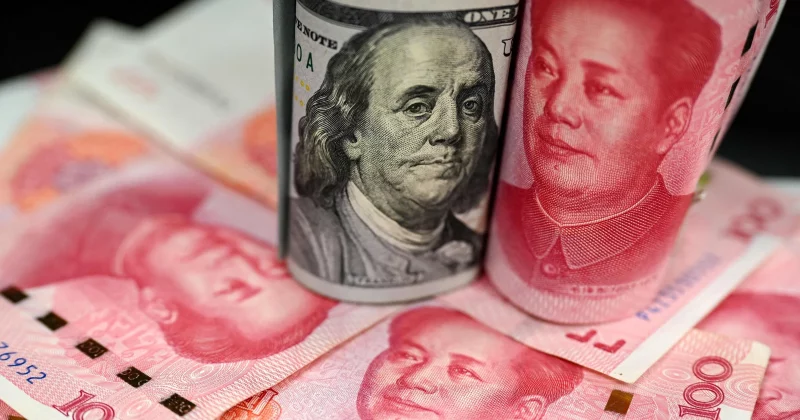
China faces exporter strain as yuan strengthens, complicating Beijing’s policy balancing act
Nearly a quarter of Chinese firms are reporting foreign exchange losses as a stronger yuan squeezes exporters and forces Beijing into an increasingly awkward policy juggling act.
A stronger currency is usually something governments brag about. For Beijing, it’s becoming a headache.
The yuan’s appreciation, roughly 5.6-5.8% against the dollar over the past year, is hitting Chinese exporters where it hurts most: their margins. About 25% of Chinese firms are now reporting foreign exchange losses tied to the stronger currency, turning what might look like a sign of economic confidence into a genuine policy dilemma.
The exporter squeeze
The USD/CNY exchange rate currently sits around 6.83-6.85, and analysts are eyeing further appreciation toward 6.7 per dollar by the end of the quarter. That trajectory, if it holds, would deepen the pain for export-dependent firms that price contracts in dollars but pay workers and suppliers in yuan.
Mainland firms listed in Hong Kong are planning to distribute nearly $70 billion in dividends this summer, a massive outflow that’s already prompting a wave of foreign exchange hedging activity among Chinese corporations.
Beijing’s three-way balancing act
China’s policymakers are stuck trying to optimize for at least three things simultaneously, and they don’t all point in the same direction.
First, export competitiveness. China’s economic recovery remains uneven, and exports are one of the few reliable growth engines. A stronger yuan directly undermines that engine by making Chinese goods pricier on world markets.
Macro, rates, and crypto—what moved markets and what matters next.
Daily. Free. Join 34,000+ readers across crypto, finance, and policy.
Second, capital flow management. China has long maintained tight controls on capital moving in and out of the country. A strengthening yuan can attract speculative inflows from investors betting on further appreciation. On the flip side, letting the yuan weaken too much risks triggering capital flight.
Third, renminbi internationalization. The currency currently accounts for approximately 3-4% of global payments and reserves. A stable or gradually appreciating currency supports that internationalization agenda. A currency that Beijing aggressively weakens does not.
The geopolitical overlay
The stronger yuan reduces the cost of imports for Chinese consumers and businesses, which helps keep imported inflation in check. It simultaneously puts downward pressure on the US dollar index.
What this means for investors
The $70 billion dividend payout wave this summer creates short-term pressure on the yuan and generates hedging demand that can amplify currency volatility. Investors holding Hong Kong-listed mainland stocks should factor in the FX component of their returns, not just equity performance.
Analysts expecting a move toward 6.7 per dollar suggest the consensus view is gradual, managed appreciation rather than a sharp reversal.
For crypto markets specifically, yuan dynamics matter more than casual observers might think. Historically, periods of yuan weakness have correlated with increased capital flows into Bitcoin and other digital assets as Chinese investors seek dollar-denominated stores of value. A stronger yuan reduces that pressure valve.