
China’s yuan slides to 2.38% of global SWIFT payments in April, dropping two spots to sixth place
The renminbi lost ground against every major currency in April as payment values fell over 14% month-on-month, underscoring the limits of Beijing's internationalization push.
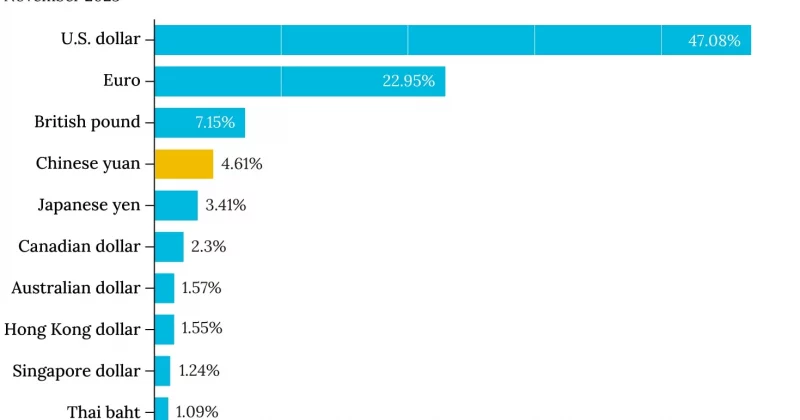
The Chinese yuan just had a rough month on the global payments stage. According to SWIFT’s RMB Tracker, the renminbi’s share of international payments (excluding intra-Eurozone transactions) dropped from 3.10% in March to 2.38% in April 2025, knocking it from fourth to sixth place among global currencies.
For all payments including Eurozone flows, RMB held a 3.50% share, good enough for fifth place.
The numbers behind the slide
The actual value of RMB-denominated payments fell 14.14% month-on-month in April. That’s a steep drop by any measure, made even more conspicuous by the fact that overall global payments in all currencies actually rose by 1.35% during the same period.
Beijing’s infrastructure push vs. structural headwinds
China’s Cross-Border Interbank Payment System, known as CIPS, had amassed over 1,500 participants across nearly 200 areas by early 2025. That’s a significant expansion from roughly 1,100 participants in 2021.
Beijing has also signed currency swap agreements with more than 40 central banks globally, with a particular focus on Belt and Road Initiative partner countries.
Macro, rates, and crypto—what moved markets and what matters next.
Daily. Free. Join 34,000+ readers across crypto, finance, and policy.
Federal Reserve analysis has consistently pointed to this tension. The RMB remains a minor global currency compared to the dollar and euro due to capital controls and what analysts describe as governance concerns.
What this means for investors
April’s data is a useful reality check for anyone tracking de-dollarization narratives. A 14.14% drop in payment values is hard to dismiss as noise, and that kind of volatility in usage patterns is itself a barrier to reserve currency status.
The CIPS expansion to 1,500 participants is genuinely impressive infrastructure development. But until Beijing resolves the fundamental contradiction between wanting a global currency and maintaining tight capital controls, investors watching the de-dollarization narrative should calibrate their expectations accordingly.