
Circle Internet Group shares fall over 75% from IPO highs

Circle Internet Group shares fall over 75% from IPO highs

The USDC issuer's stock has cratered from a peak near $299 to around $60, raising questions about stablecoin economics and what comes next

Circle Internet Group had one of the flashier Wall Street debuts in recent memory. The company priced its IPO at $31 per share on June 5, 2025, watched the stock open at $69 on day one, and then saw it run all the way to roughly $299 by late June. That is the kind of trajectory that makes investors feel like geniuses.

By mid-July 2026, those same investors were staring at a price somewhere between $60 and $64. That is a decline of more than 75% from the peak, a 52-week low of $49.90 in the rearview mirror, and a story that now reads a lot less like a triumph and a lot more like a lesson.

How you go from $299 to $64

Circle’s core business is issuing USDC, a dollar-pegged stablecoin currently circulating at around $73 billion. The problem is that growth has stalled, and in a market where investors are paying a premium for a growth story, stagnation is expensive.

Advertisement

USDC’s circulation numbers have plateaued even as the broader stablecoin market continues to expand. Visa has thrown its weight behind a rival stablecoin project, which is the kind of competitive signal that makes institutional investors nervous. Analyst downgrades have added pressure.

Circle earns revenue primarily through the yield on the Treasury assets and other reserves that back USDC. When rates fall or when the Federal Reserve pivots, that revenue stream compresses. Investors pricing in a lower-rate environment are essentially discounting Circle’s future earnings, which explains some of the multiple compression the stock has experienced.

The actual business is not a disaster

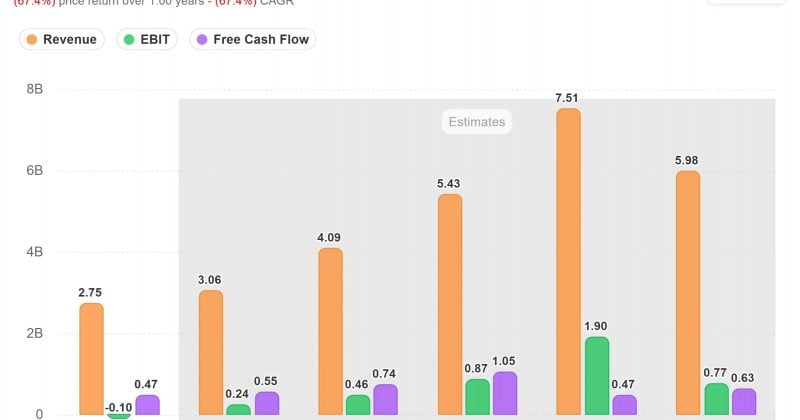
Circle reported Q1 2026 revenue of $694 million, a 20% increase year-over-year. The company also ran a presale for its ARC token that generated $222 million. USDC also commands roughly 70% of adjusted stablecoin transaction volume for the first half of 2026.

On the regulatory front, Circle received a meaningful piece of good news. The Office of the Comptroller of the Currency granted final approval for Circle’s national trust bank charter on July 10, 2026. The stock got a temporary lift from the news, but the boost did not hold.

What investors are actually watching now

The OCC charter approval gives Circle a formal place in the regulated financial system and could open doors to institutional clients and partnerships that were previously unavailable.

The more immediate risk is the circulation growth story. Investors who paid $100, $150, or $200 for CRCL shares were betting on USDC supply expanding aggressively as stablecoin regulation cleared and institutional adoption accelerated. The 52-week range, from $49.90 at the low to $262.97 at the high, tells you everything about how violently the market has been repricing its expectations. Circle’s path back to investor confidence runs through USDC circulation growth resuming, interest income holding up, and the regulatory advantages of that new charter translating into tangible business wins.

Disclosure: This article was edited by Editorial Team. For more information on how we create and review content, see our Editorial Policy.

Circle Internet Group shares fall over 75% from IPO highs

Circle Internet Group shares fall over 75% from IPO highs

The USDC issuer's stock has cratered from a peak near $299 to around $60, raising questions about stablecoin economics and what comes next

Circle Internet Group had one of the flashier Wall Street debuts in recent memory. The company priced its IPO at $31 per share on June 5, 2025, watched the stock open at $69 on day one, and then saw it run all the way to roughly $299 by late June. That is the kind of trajectory that makes investors feel like geniuses.

By mid-July 2026, those same investors were staring at a price somewhere between $60 and $64. That is a decline of more than 75% from the peak, a 52-week low of $49.90 in the rearview mirror, and a story that now reads a lot less like a triumph and a lot more like a lesson.

How you go from $299 to $64

Circle’s core business is issuing USDC, a dollar-pegged stablecoin currently circulating at around $73 billion. The problem is that growth has stalled, and in a market where investors are paying a premium for a growth story, stagnation is expensive.

Advertisement

USDC’s circulation numbers have plateaued even as the broader stablecoin market continues to expand. Visa has thrown its weight behind a rival stablecoin project, which is the kind of competitive signal that makes institutional investors nervous. Analyst downgrades have added pressure.

Circle earns revenue primarily through the yield on the Treasury assets and other reserves that back USDC. When rates fall or when the Federal Reserve pivots, that revenue stream compresses. Investors pricing in a lower-rate environment are essentially discounting Circle’s future earnings, which explains some of the multiple compression the stock has experienced.

The actual business is not a disaster

Circle reported Q1 2026 revenue of $694 million, a 20% increase year-over-year. The company also ran a presale for its ARC token that generated $222 million. USDC also commands roughly 70% of adjusted stablecoin transaction volume for the first half of 2026.

On the regulatory front, Circle received a meaningful piece of good news. The Office of the Comptroller of the Currency granted final approval for Circle’s national trust bank charter on July 10, 2026. The stock got a temporary lift from the news, but the boost did not hold.

What investors are actually watching now

The OCC charter approval gives Circle a formal place in the regulated financial system and could open doors to institutional clients and partnerships that were previously unavailable.

The more immediate risk is the circulation growth story. Investors who paid $100, $150, or $200 for CRCL shares were betting on USDC supply expanding aggressively as stablecoin regulation cleared and institutional adoption accelerated. The 52-week range, from $49.90 at the low to $262.97 at the high, tells you everything about how violently the market has been repricing its expectations. Circle’s path back to investor confidence runs through USDC circulation growth resuming, interest income holding up, and the regulatory advantages of that new charter translating into tangible business wins.

Disclosure: This article was edited by Editorial Team. For more information on how we create and review content, see our Editorial Policy.