
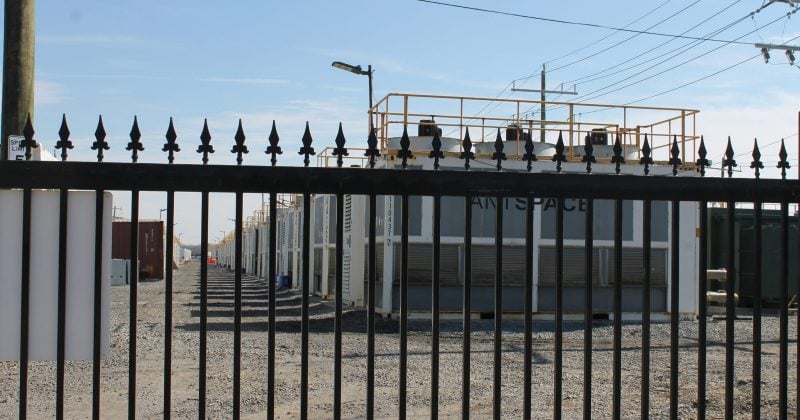
Data-center developers are turning old Bitcoin mines into AI gold
Former crypto mining facilities are becoming some of the most valuable real estate in tech, as hyperscalers race to secure power for AI workloads.
The most valuable thing Bitcoin miners ever built might not have been Bitcoin. It was the power infrastructure underneath it.
Data-center developers across America, many of whom cut their teeth powering crypto mining rigs, are now repositioning themselves to capture a much larger prize: the insatiable demand for AI compute.
The great pivot is already underway
On June 15, AiOnX closed a $500 million deal to acquire a 77% stake in Genesis Digital Assets, one of the larger crypto mining operations with facilities in the US and Sweden. The acquisition gives AiOnX access to 1.3 GW of capacity at those sites, which will be repurposed for AI and high-performance computing workloads.
That deal pushed AiOnX’s total capacity to 3.6 GW.
The same day, IREN made its own move, acquiring Spanish developer Nostrum Group to add approximately 490 MW of secured power capacity. That deal is aimed at accelerating IREN’s expansion into European AI markets.
A $750 billion spending spree meets a power bottleneck
Projected capex among the 14 largest public data center operators is expected to hit roughly $750 billion in 2026. That’s nearly double the less-than-$450 billion spent in 2025.
AI, tech, and the markets they move—in one daily briefing.
Daily. Free. Join 34,000+ readers across crypto, finance, and policy.
Globally, more than 23 GW of IT capacity is currently under construction specifically for AI applications.
More than $130 billion worth of US data center projects experienced delays in the first quarter of 2026. The culprits are familiar: power constraints, equipment shortages, and community opposition. More than half of US data center projects this year face holdups from a shortage of critical equipment like transformers.
This bottleneck is precisely why existing facilities with secured power are so valuable. If you already have a substation, utility agreements, and cooling infrastructure in place, you’ve skipped the hardest part of the process.
Bitcoin miners are cashing in
The most striking example of this dynamic is Hut 8, which entered a $9.8 billion AI lease deal. That figure alone tells you how dramatically the market has repriced ready-to-go infrastructure.
A Bitcoin mining facility earning modest returns on its hardware can potentially generate multiples of that revenue by hosting AI workloads instead. The infrastructure requirements overlap significantly: both need massive amounts of electricity, robust cooling, and locations where land and power are relatively cheap.
What this means for investors
The gap between what hyperscalers want to build and what the grid can actually deliver creates a structural advantage for incumbents. With $130 billion in projects already stalled, that premium isn’t shrinking anytime soon.
But investors should watch for a few risks. Community opposition to data centers is growing, driven by concerns about water usage, noise, and strain on local power grids. Not every former mining operation has the right location, power quality, or network connectivity to serve enterprise AI customers. Proximity to fiber backbones, redundant power feeds, and compliance with enterprise security standards all separate the facilities that will command premium lease rates from those that won’t.