
Nexo Earn with Nexo
Digital asset treasuries pulled in $2.19B in May, with Bitcoin taking the lion’s share

Digital asset treasuries pulled in $2.19B in May, with Bitcoin taking the lion’s share

Corporate Bitcoin treasuries continue to attract billions in capital, though the strategy faces growing questions about sustainability and valuation premiums.

Companies that hold Bitcoin on their balance sheets attracted $2.19 billion in fresh capital during May, reinforcing a trend that has quietly reshaped how institutional money flows into crypto.

The vast majority of those inflows went straight into Bitcoin, which remains the gravitational center of the digital asset treasury (DAT) universe. Think of DATs as corporate vehicles that raise money through traditional Wall Street tools, stocks and bonds, then park that capital in Bitcoin instead of, say, a money market fund.

What DATs actually are, and why $2.19B matters

A DAT is essentially a publicly traded company whose primary treasury strategy involves holding significant amounts of Bitcoin. The playbook was pioneered by Michael Saylor’s MicroStrategy, now known as Strategy (MSTR), which began accumulating Bitcoin in 2020. Since then, more than 200 companies have followed suit, collectively holding over $115 billion in digital assets by early 2026.

Advertisement

The $2.19 billion in May inflows sits well below the peak. Weekly inflows hit approximately $5.57 billion during a single week in July 2025, a high-water mark that underscored just how aggressively capital was flooding into these vehicles during last year’s bull momentum. By late 2025, those weekly figures had declined significantly.

How the money machine works

DATs actively raise capital through at-the-market (ATM) equity offerings and convertible debt instruments. An ATM offering lets a company sell new shares directly into the open market at prevailing prices. Convertible debt gives bondholders the option to convert their bonds into equity at a later date.

This model only works smoothly when the company’s stock trades at or above a premium to its net asset value, specifically its modified net asset value (mNAV). When a DAT’s stock price sits above the per-share value of its Bitcoin holdings, issuing new shares is accretive. When the stock trades at a discount to mNAV, issuing shares dilutes existing holders without proportional Bitcoin accumulation. Many DATs are currently navigating exactly this pressure, with some trading at premiums to their net asset value while others have slipped into discount territory.

The bigger picture for investors

Strategy remains the dominant player in this space, but the field has expanded considerably. Companies like BitMine Immersion Technologies (BMNR) and Metaplanet have carved out their own positions, and the broader roster now spans hundreds of firms across multiple geographies.

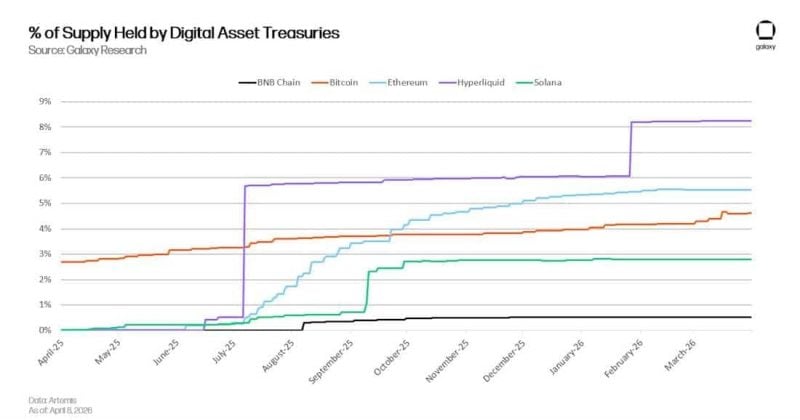
Collectively, DATs hold an estimated 3.7% to 4.3% of the total Bitcoin supply. For retail investors, DATs offer leveraged or proxy exposure to Bitcoin through a regular brokerage account, without wallets, custody headaches, or navigating crypto exchanges. However, management decisions, share dilution, debt covenants, and the mNAV premium/discount dynamic all introduce variables that pure Bitcoin ownership avoids.

Disclosure: This article was edited by Editorial Team. For more information on how we create and review content, see our Editorial Policy.

Digital asset treasuries pulled in $2.19B in May, with Bitcoin taking the lion’s share

Digital asset treasuries pulled in $2.19B in May, with Bitcoin taking the lion’s share

Corporate Bitcoin treasuries continue to attract billions in capital, though the strategy faces growing questions about sustainability and valuation premiums.

Companies that hold Bitcoin on their balance sheets attracted $2.19 billion in fresh capital during May, reinforcing a trend that has quietly reshaped how institutional money flows into crypto.

The vast majority of those inflows went straight into Bitcoin, which remains the gravitational center of the digital asset treasury (DAT) universe. Think of DATs as corporate vehicles that raise money through traditional Wall Street tools, stocks and bonds, then park that capital in Bitcoin instead of, say, a money market fund.

What DATs actually are, and why $2.19B matters

A DAT is essentially a publicly traded company whose primary treasury strategy involves holding significant amounts of Bitcoin. The playbook was pioneered by Michael Saylor’s MicroStrategy, now known as Strategy (MSTR), which began accumulating Bitcoin in 2020. Since then, more than 200 companies have followed suit, collectively holding over $115 billion in digital assets by early 2026.

Advertisement

The $2.19 billion in May inflows sits well below the peak. Weekly inflows hit approximately $5.57 billion during a single week in July 2025, a high-water mark that underscored just how aggressively capital was flooding into these vehicles during last year’s bull momentum. By late 2025, those weekly figures had declined significantly.

How the money machine works

DATs actively raise capital through at-the-market (ATM) equity offerings and convertible debt instruments. An ATM offering lets a company sell new shares directly into the open market at prevailing prices. Convertible debt gives bondholders the option to convert their bonds into equity at a later date.

This model only works smoothly when the company’s stock trades at or above a premium to its net asset value, specifically its modified net asset value (mNAV). When a DAT’s stock price sits above the per-share value of its Bitcoin holdings, issuing new shares is accretive. When the stock trades at a discount to mNAV, issuing shares dilutes existing holders without proportional Bitcoin accumulation. Many DATs are currently navigating exactly this pressure, with some trading at premiums to their net asset value while others have slipped into discount territory.

The bigger picture for investors

Strategy remains the dominant player in this space, but the field has expanded considerably. Companies like BitMine Immersion Technologies (BMNR) and Metaplanet have carved out their own positions, and the broader roster now spans hundreds of firms across multiple geographies.

Collectively, DATs hold an estimated 3.7% to 4.3% of the total Bitcoin supply. For retail investors, DATs offer leveraged or proxy exposure to Bitcoin through a regular brokerage account, without wallets, custody headaches, or navigating crypto exchanges. However, management decisions, share dilution, debt covenants, and the mNAV premium/discount dynamic all introduce variables that pure Bitcoin ownership avoids.

Disclosure: This article was edited by Editorial Team. For more information on how we create and review content, see our Editorial Policy.