
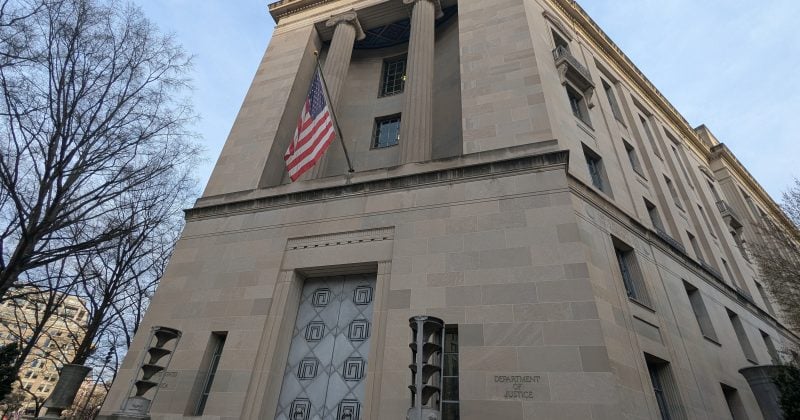
Justice Department’s Criminal Division raises concerns over crypto legislation’s impact on money laundering prosecutions

Justice Department’s Criminal Division raises concerns over crypto legislation’s impact on money laundering prosecutions

Law enforcement groups representing over 70,000 professionals warn that the CLARITY Act's exemptions for DeFi and mixers could create dangerous blind spots for prosecutors

The Department of Justice’s Criminal Division is sounding the alarm on one of Washington’s most closely watched crypto bills, warning that certain provisions could effectively handcuff prosecutors trying to chase dirty money through digital asset networks.

The concern centers on the Digital Asset Market Clarity Act, also known as the CLARITY Act (H.R. 3633), which the Senate Banking Committee advanced on May 12, 2026, with a 15-9 vote. The bill is supposed to bring regulatory clarity to crypto markets.

The exemption problem

The specific flashpoint is Section 604 of the CLARITY Act, which provides broad exemptions for decentralized services, mixers, tumblers, and automated protocols.

On June 23, 2026, law enforcement organizations representing more than 70,000 professionals sent a formal letter to Acting Attorney General Todd Blanche laying out their objections. The signatories included the National Sheriffs’ Association and the National Association of Assistant US Attorneys, among other major law enforcement bodies.

Advertisement

The Bank Policy Institute and Transparency International US echoed these concerns on July 8, 2026, calling for amendments to the bill’s DeFi and mixer exemptions.

What the CLARITY Act actually does

The bill’s stated purpose is to create a federal market structure for digital assets by classifying many intermediaries, think brokers, dealers, and exchanges, as financial institutions under the Bank Secrecy Act. That classification would impose anti-money laundering and customer due diligence requirements on those entities.

The Blockchain Association has pushed back against the law enforcement critique, arguing that the act actually expands law enforcement’s toolkit against fraud and laundering. Their position is that bringing more crypto businesses under the BSA umbrella is a net positive for enforcement, even if certain categories of decentralized protocols get different treatment.

The bill also provides safe harbors for developers and creates new Treasury authorities to go after risky offshore activities. Supporters see it as a pragmatic compromise that resolves years of regulatory turf wars between the SEC and CFTC over who gets to police digital assets.

But critics say the compromise gave away too much ground in one critical area. The carve-outs for decentralized services effectively create a two-tier system: centralized exchanges face full regulatory obligations, while the decentralized infrastructure that increasingly handles significant transaction volume operates under lighter oversight.

The broader enforcement landscape

There’s been a broader move toward prioritizing prosecution of actual crimes, fraud, theft, terrorist financing, over purely regulatory infractions like operating an unregistered exchange. Without suspicious activity reports from mixers and decentralized protocols, investigators lose visibility into exactly the transaction flows they need to follow.

What this means for investors

Investors should watch for any markup sessions that modify Section 604’s language around decentralized exemptions. The bill still needs to clear the full Senate and navigate conference with any House version. That single provision has become the fault line in this debate, and its final form will likely determine whether the CLARITY Act ends up strengthening or undermining the integrity of digital asset markets.

Disclosure: This article was edited by Editorial Team. For more information on how we create and review content, see our Editorial Policy.

Justice Department’s Criminal Division raises concerns over crypto legislation’s impact on money laundering prosecutions

Justice Department’s Criminal Division raises concerns over crypto legislation’s impact on money laundering prosecutions

Law enforcement groups representing over 70,000 professionals warn that the CLARITY Act's exemptions for DeFi and mixers could create dangerous blind spots for prosecutors

The Department of Justice’s Criminal Division is sounding the alarm on one of Washington’s most closely watched crypto bills, warning that certain provisions could effectively handcuff prosecutors trying to chase dirty money through digital asset networks.

The concern centers on the Digital Asset Market Clarity Act, also known as the CLARITY Act (H.R. 3633), which the Senate Banking Committee advanced on May 12, 2026, with a 15-9 vote. The bill is supposed to bring regulatory clarity to crypto markets.

The exemption problem

The specific flashpoint is Section 604 of the CLARITY Act, which provides broad exemptions for decentralized services, mixers, tumblers, and automated protocols.

On June 23, 2026, law enforcement organizations representing more than 70,000 professionals sent a formal letter to Acting Attorney General Todd Blanche laying out their objections. The signatories included the National Sheriffs’ Association and the National Association of Assistant US Attorneys, among other major law enforcement bodies.

Advertisement

The Bank Policy Institute and Transparency International US echoed these concerns on July 8, 2026, calling for amendments to the bill’s DeFi and mixer exemptions.

What the CLARITY Act actually does

The bill’s stated purpose is to create a federal market structure for digital assets by classifying many intermediaries, think brokers, dealers, and exchanges, as financial institutions under the Bank Secrecy Act. That classification would impose anti-money laundering and customer due diligence requirements on those entities.

The Blockchain Association has pushed back against the law enforcement critique, arguing that the act actually expands law enforcement’s toolkit against fraud and laundering. Their position is that bringing more crypto businesses under the BSA umbrella is a net positive for enforcement, even if certain categories of decentralized protocols get different treatment.

The bill also provides safe harbors for developers and creates new Treasury authorities to go after risky offshore activities. Supporters see it as a pragmatic compromise that resolves years of regulatory turf wars between the SEC and CFTC over who gets to police digital assets.

But critics say the compromise gave away too much ground in one critical area. The carve-outs for decentralized services effectively create a two-tier system: centralized exchanges face full regulatory obligations, while the decentralized infrastructure that increasingly handles significant transaction volume operates under lighter oversight.

The broader enforcement landscape

There’s been a broader move toward prioritizing prosecution of actual crimes, fraud, theft, terrorist financing, over purely regulatory infractions like operating an unregistered exchange. Without suspicious activity reports from mixers and decentralized protocols, investigators lose visibility into exactly the transaction flows they need to follow.

What this means for investors

Investors should watch for any markup sessions that modify Section 604’s language around decentralized exemptions. The bill still needs to clear the full Senate and navigate conference with any House version. That single provision has become the fault line in this debate, and its final form will likely determine whether the CLARITY Act ends up strengthening or undermining the integrity of digital asset markets.

Disclosure: This article was edited by Editorial Team. For more information on how we create and review content, see our Editorial Policy.