
US Energy Information Administration nearly triples gas capacity forecast to 66 GW by 2030

US Energy Information Administration nearly triples gas capacity forecast to 66 GW by 2030

AI data centers are rewriting America's energy future, and natural gas is the biggest beneficiary

The US Energy Information Administration just did something unusual: it nearly tripled its own forecast. The agency now projects 66 gigawatts of new natural gas-fired power plant capacity will be built between 2026 and 2030, up from a previous estimate of 23 GW.

What’s driving the revision

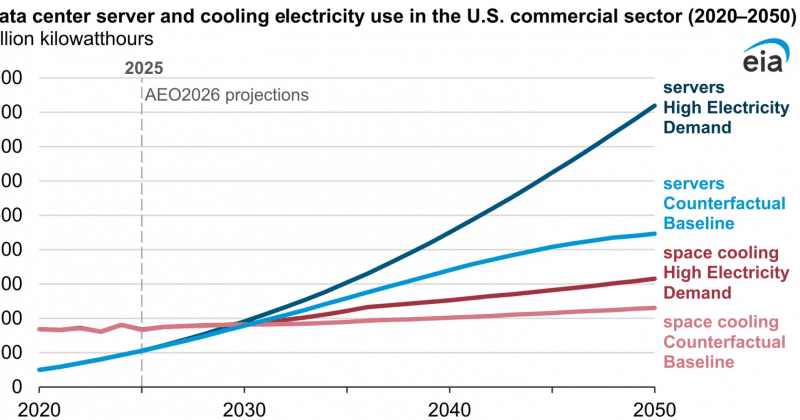
AI data centers have become the single most disruptive force in US electricity planning. The computational demands of training and running large language models require enormous, consistent power loads. Unlike a factory that can ramp production up or down, a data center running inference workloads needs power flowing every second of every day.

Natural gas, as a dispatchable power source, fills that gap in a way that solar and wind currently cannot without massive battery storage buildouts. States like Texas and Virginia, already home to significant data center clusters, have seen accelerated permitting and construction of new gas-fired plants to meet this surging demand.

Advertisement

The Trump administration’s emphasis on domestic energy production has also greased the regulatory wheels. Permitting timelines that might have stretched into multi-year reviews are being compressed, making it faster and cheaper to break ground on new gas capacity.

The numbers in context

The EIA’s Short-Term Energy Outlook projects that natural gas consumption for power generation could hit 46.1 billion cubic feet per day during summer months in 2027. That would be a record. By the end of 2027, total US natural gas-fired generating capacity is projected to reach 508 GW, representing a 3% increase from 2025 levels.

Why crypto investors should care

Crypto mining and AI data centers are increasingly competing for the same scarce resource: cheap, reliable electricity. When electricity supply is tight, prices rise, and mining margins get squeezed. When new capacity comes online, especially dispatchable gas capacity that can stabilize grid pricing, it tends to create more favorable conditions for energy-intensive operations like proof-of-work mining.

Texas, the state leading this gas buildout, is also the epicenter of US Bitcoin mining. The state’s deregulated electricity market means that new supply directly affects spot pricing. More gas plants coming online between 2026 and 2030 could translate into more competitive power rates for miners operating in ERCOT, Texas’s grid operator territory.

But there’s a catch. If AI data centers are willing to pay premium rates for dedicated power, miners could find themselves outbid for the very capacity they were hoping would lower their costs. We’re already seeing this dynamic play out as some mining companies pivot to hosting AI workloads precisely because those customers pay more per megawatt-hour.

Natural gas producers, pipeline operators, and companies involved in power plant construction stand to benefit from what amounts to a multi-year infrastructure supercycle. Investors looking at the energy-crypto nexus might find that the picks-and-shovels play here isn’t blockchain infrastructure at all. It’s turbines and pipelines.

Disclosure: This article was edited by Editorial Team. For more information on how we create and review content, see our Editorial Policy.

US Energy Information Administration nearly triples gas capacity forecast to 66 GW by 2030

US Energy Information Administration nearly triples gas capacity forecast to 66 GW by 2030

AI data centers are rewriting America's energy future, and natural gas is the biggest beneficiary

The US Energy Information Administration just did something unusual: it nearly tripled its own forecast. The agency now projects 66 gigawatts of new natural gas-fired power plant capacity will be built between 2026 and 2030, up from a previous estimate of 23 GW.

What’s driving the revision

AI data centers have become the single most disruptive force in US electricity planning. The computational demands of training and running large language models require enormous, consistent power loads. Unlike a factory that can ramp production up or down, a data center running inference workloads needs power flowing every second of every day.

Natural gas, as a dispatchable power source, fills that gap in a way that solar and wind currently cannot without massive battery storage buildouts. States like Texas and Virginia, already home to significant data center clusters, have seen accelerated permitting and construction of new gas-fired plants to meet this surging demand.

Advertisement

The Trump administration’s emphasis on domestic energy production has also greased the regulatory wheels. Permitting timelines that might have stretched into multi-year reviews are being compressed, making it faster and cheaper to break ground on new gas capacity.

The numbers in context

The EIA’s Short-Term Energy Outlook projects that natural gas consumption for power generation could hit 46.1 billion cubic feet per day during summer months in 2027. That would be a record. By the end of 2027, total US natural gas-fired generating capacity is projected to reach 508 GW, representing a 3% increase from 2025 levels.

Why crypto investors should care

Crypto mining and AI data centers are increasingly competing for the same scarce resource: cheap, reliable electricity. When electricity supply is tight, prices rise, and mining margins get squeezed. When new capacity comes online, especially dispatchable gas capacity that can stabilize grid pricing, it tends to create more favorable conditions for energy-intensive operations like proof-of-work mining.

Texas, the state leading this gas buildout, is also the epicenter of US Bitcoin mining. The state’s deregulated electricity market means that new supply directly affects spot pricing. More gas plants coming online between 2026 and 2030 could translate into more competitive power rates for miners operating in ERCOT, Texas’s grid operator territory.

But there’s a catch. If AI data centers are willing to pay premium rates for dedicated power, miners could find themselves outbid for the very capacity they were hoping would lower their costs. We’re already seeing this dynamic play out as some mining companies pivot to hosting AI workloads precisely because those customers pay more per megawatt-hour.

Natural gas producers, pipeline operators, and companies involved in power plant construction stand to benefit from what amounts to a multi-year infrastructure supercycle. Investors looking at the energy-crypto nexus might find that the picks-and-shovels play here isn’t blockchain infrastructure at all. It’s turbines and pipelines.

Disclosure: This article was edited by Editorial Team. For more information on how we create and review content, see our Editorial Policy.