
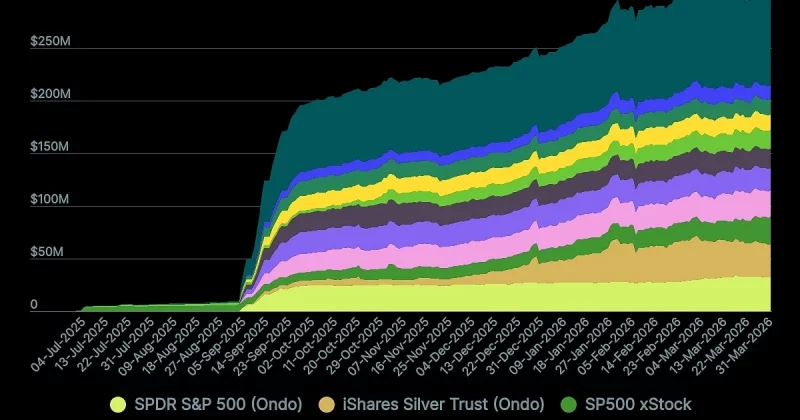
ETFs make up 26.6% of total market cap of tokenized stocks
Ondo Finance leads the charge as tokenized ETFs carve out a serious share of the on-chain equities market, with platforms like Alpaca and Kraken racing to expand offerings.
More than a quarter of the entire tokenized stock market now belongs to ETFs. That’s a remarkable concentration for a product category that barely existed on-chain two years ago.
Tokenized ETFs account for 26.6% of the total market capitalization of tokenized stocks, with the largest single product living on Solana and attributed to Ondo Finance. The shift suggests that when investors want on-chain equity exposure, they’re gravitating toward the same diversified wrappers they already trust in traditional finance.
The players building on-chain Wall Street
The tokenized equities space isn’t evenly distributed. Alpaca commands a 94% market share of tokenized US stocks and ETFs, with $480M in assets under custody. That kind of dominance in any market would raise eyebrows, but in a nascent sector it effectively means one platform is setting the rules for how tokenized equities work in practice.
Kraken is making moves to change that math. Its xStocks product currently covers around 100 tokenized US stocks and ETFs, with plans to expand that roster to 500 by the end of 2026. That’s a fivefold increase in available instruments, which would give retail and institutional users significantly more on-chain options.
Then there’s Ondo Finance, whose Solana-based tokenized ETF product sits at the top of the category by market cap. Ondo has been one of the more aggressive builders in the real-world asset tokenization space, and its presence on Solana, rather than Ethereum, is a deliberate bet on lower fees and faster transaction finality for the kind of high-frequency access that ETF investors expect.
Why tokenized ETFs are gaining traction
The appeal of tokenized ETFs boils down to a simple premise: take a product people already understand and remove the friction. Traditional ETFs trade during market hours, settle on a T+1 basis, and require brokerage accounts with all the associated paperwork. Tokenized versions trade 24/7, settle almost instantly, and live on public blockchains where anyone with a wallet can theoretically participate.
In English: imagine if the stock market never closed and your trades settled before you finished your coffee.
The news moving money, markets, and the world—before your day starts.
Daily. Free. Join 34,000+ readers across crypto, finance, and policy.
Each tokenized share is backed 1:1 by the corresponding traditional asset, which means the on-chain version is supposed to track the real thing perfectly. The blockchain layer adds transparency, since anyone can verify the token supply and custody arrangements on-chain, rather than trusting a broker’s monthly statement.
For institutional players, the 24/7 settlement window is particularly interesting. Portfolio rebalancing, hedging, and arbitrage strategies that currently depend on overlapping market hours across time zones become much simpler when the underlying instruments never stop trading. The composability of DeFi adds another dimension: tokenized ETFs can potentially be used as collateral in lending protocols, staked in yield strategies, or bundled into more complex structured products.
The 26.6% share that ETFs hold within the tokenized stock market also mirrors a broader trend in traditional finance. ETFs have been steadily eating into mutual fund territory for over a decade, and it appears the same dynamic is playing out on-chain. Investors default to diversified, low-cost exposure when given the choice, whether they’re buying through Fidelity or through a Solana wallet.
What this means for investors
The concentration risk in this market is hard to ignore. Alpaca holding 94% of the tokenized US equities market means that a single platform’s technical failure, regulatory issue, or custody mishap could ripple across the entire sector. That’s not a hypothetical concern in crypto, where centralized points of failure have historically been the source of the biggest blowups.
Kraken’s expansion plans offer some hope for diversification. If xStocks successfully scales to 500 products by end of 2026, it could provide meaningful competition and reduce Alpaca’s outsized influence. Competition typically drives better pricing, more robust custody solutions, and stronger regulatory compliance, all of which this market needs to attract serious institutional capital.
The regulatory landscape remains the biggest wildcard. Tokenized securities sit at the intersection of securities law and crypto regulation, two domains that governments worldwide are still trying to reconcile. In the US, the SEC’s stance on what constitutes a security versus a commodity has kept many institutional players on the sidelines. Any clarity, positive or negative, could dramatically reshape the market’s trajectory.
Look, the 26.6% figure tells a compelling story about investor preferences. But the more important number to watch is total market cap growth. A quarter of a small pie is still a small slice in absolute terms. The real inflection point comes when tokenized equities start capturing meaningful volume from traditional exchanges, not just serving as a novelty for crypto-native traders looking for stock exposure without leaving the blockchain.