
Nexo Earn with Nexo
Ethereum Foundation faces calls for new $1B price-focused organization

Ethereum Foundation faces calls for new $1B price-focused organization

A wave of senior departures and growing community frustration have fueled demands for an independent entity dedicated to boosting ETH's market performance.

The Ethereum Foundation is hemorrhaging talent and patience in equal measure. At least eight senior members have departed the organization in 2026, with five leaving in May alone, and the community response has moved beyond grumbling into something more concrete: a proposal for an entirely new organization, funded with at least $1 billion, whose job would be making ETH’s price go up.

The exodus and the mandate

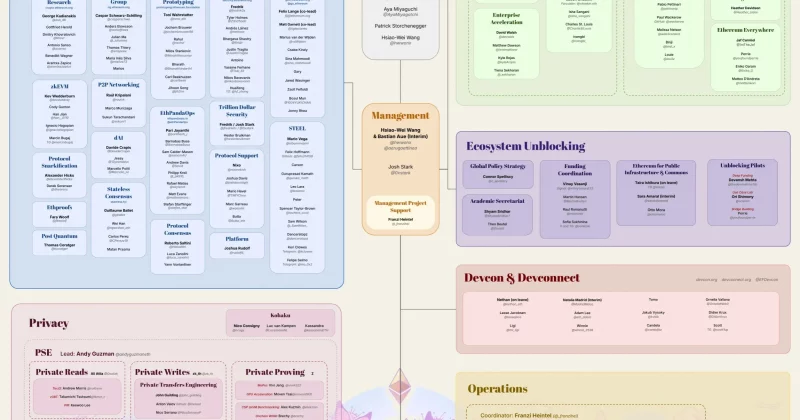
Among the departures are Carl Beekhuizen and Tim Beiko, both prominent figures in Ethereum’s technical infrastructure. The leadership churn follows a turbulent stretch that saw Tomasz StaÅ„czak resign, leading to the February appointment of Co-Executive Directors Bastian Aue and Hsiao-Wei Wang.

On March 13, the EF published what it called its “Mandate” document. The framework centers on what the foundation calls CROPS principles: censorship-resistant, open source, private, and secure. But for a growing faction of the Ethereum community, the Mandate effectively codified the EF’s institutional aversion to anything that looks like actively championing ETH as a financial asset. With ETH trading around $2,100 and carrying a market cap of roughly $258 billion while Bitcoin and Solana outperform it, that distinction feels like a liability.

Advertisement

The billion-dollar proposal

Former EF researcher Dankrad Feist put numbers to the frustration on May 19, proposing the creation of a new, independent organization with initial funding of at least $1 billion. The entity would operate outside the EF’s constraints and focus explicitly on improving Ethereum’s competitive market position. Feist’s proposal envisions a structure built on permanent staking revenue streams, giving it financial independence and a long time horizon.

Ryan Sean Adams, a well-known Ethereum investor and advocate, backed the concept publicly. Adams argued that the future of Ethereum cannot depend solely on the Ethereum Foundation.

The EF currently holds less than 0.1% of the total ETH supply. Critics argue this minimal stake limits the foundation’s ability to influence tokenomics or deploy capital in ways that benefit ETH holders.

Why ETH keeps underperforming

The 2024 Dencun upgrade is often cited as an inflection point. That upgrade altered fee dynamics for layer 2 networks, which had the unintended effect of reducing revenue flowing back to Ethereum’s base layer. Ethereum made its ecosystem cheaper to use, and the market punished it because less fee revenue means less value accrual to ETH. Layer 2s thrived. ETH’s price didn’t follow.

What this means for investors

If the proposed organization materializes, the most likely path to sourcing initial capital involves contributions from large ETH holders, ecosystem projects, and potentially venture capital. The staking revenue model means the organization would earn returns proportional to its ETH holdings, aligning its income with its mission in a way the EF’s structure never did.

The risk is fragmentation. Adding another well-funded entity with a different mandate could create competing power centers. Protocol purists at the EF might resist changes that a price-focused organization demands. Developers could find themselves caught between two patrons with incompatible priorities.

Disclosure: This article was edited by Editorial Team. For more information on how we create and review content, see our Editorial Policy.

Ethereum Foundation faces calls for new $1B price-focused organization

Ethereum Foundation faces calls for new $1B price-focused organization

A wave of senior departures and growing community frustration have fueled demands for an independent entity dedicated to boosting ETH's market performance.

The Ethereum Foundation is hemorrhaging talent and patience in equal measure. At least eight senior members have departed the organization in 2026, with five leaving in May alone, and the community response has moved beyond grumbling into something more concrete: a proposal for an entirely new organization, funded with at least $1 billion, whose job would be making ETH’s price go up.

The exodus and the mandate

Among the departures are Carl Beekhuizen and Tim Beiko, both prominent figures in Ethereum’s technical infrastructure. The leadership churn follows a turbulent stretch that saw Tomasz StaÅ„czak resign, leading to the February appointment of Co-Executive Directors Bastian Aue and Hsiao-Wei Wang.

On March 13, the EF published what it called its “Mandate” document. The framework centers on what the foundation calls CROPS principles: censorship-resistant, open source, private, and secure. But for a growing faction of the Ethereum community, the Mandate effectively codified the EF’s institutional aversion to anything that looks like actively championing ETH as a financial asset. With ETH trading around $2,100 and carrying a market cap of roughly $258 billion while Bitcoin and Solana outperform it, that distinction feels like a liability.

Advertisement

The billion-dollar proposal

Former EF researcher Dankrad Feist put numbers to the frustration on May 19, proposing the creation of a new, independent organization with initial funding of at least $1 billion. The entity would operate outside the EF’s constraints and focus explicitly on improving Ethereum’s competitive market position. Feist’s proposal envisions a structure built on permanent staking revenue streams, giving it financial independence and a long time horizon.

Ryan Sean Adams, a well-known Ethereum investor and advocate, backed the concept publicly. Adams argued that the future of Ethereum cannot depend solely on the Ethereum Foundation.

The EF currently holds less than 0.1% of the total ETH supply. Critics argue this minimal stake limits the foundation’s ability to influence tokenomics or deploy capital in ways that benefit ETH holders.

Why ETH keeps underperforming

The 2024 Dencun upgrade is often cited as an inflection point. That upgrade altered fee dynamics for layer 2 networks, which had the unintended effect of reducing revenue flowing back to Ethereum’s base layer. Ethereum made its ecosystem cheaper to use, and the market punished it because less fee revenue means less value accrual to ETH. Layer 2s thrived. ETH’s price didn’t follow.

What this means for investors

If the proposed organization materializes, the most likely path to sourcing initial capital involves contributions from large ETH holders, ecosystem projects, and potentially venture capital. The staking revenue model means the organization would earn returns proportional to its ETH holdings, aligning its income with its mission in a way the EF’s structure never did.

The risk is fragmentation. Adding another well-funded entity with a different mandate could create competing power centers. Protocol purists at the EF might resist changes that a price-focused organization demands. Developers could find themselves caught between two patrons with incompatible priorities.

Disclosure: This article was edited by Editorial Team. For more information on how we create and review content, see our Editorial Policy.