
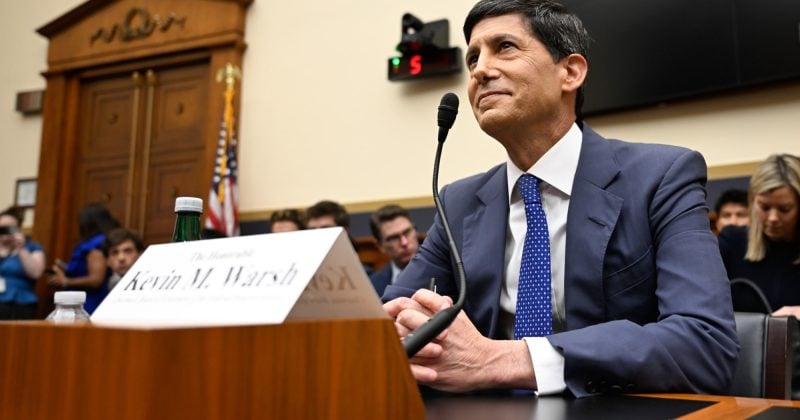
Fed Chair Warsh says no need for balancing test in policy evaluation

Fed Chair Warsh says no need for balancing test in policy evaluation

The new Fed chair's comments suggest a philosophical shift in how the central bank weighs its dual mandate, with potential ripple effects across risk assets including crypto.

Kevin Warsh, the newly installed chair of the Federal Reserve, just said something that sounds bureaucratic but carries serious weight: there’s no need to run a “balancing test” in policy evaluation.

In English: the Fed may no longer feel obligated to carefully weigh inflation against employment in every single decision. For anyone holding risk assets, that’s a sentence worth reading twice.

What a balancing test actually means

The Federal Reserve operates under a dual mandate from Congress. Keep prices stable. Keep people employed. For decades, every major policy decision has involved an implicit balancing act between those two goals.

Advertisement

When inflation runs hot, the Fed raises rates, which can hurt employment. When unemployment spikes, the Fed cuts rates, which can stoke inflation. The “balancing test” is essentially the framework for deciding which priority wins in any given moment.

The new sheriff at the Fed

Warsh was confirmed by the Senate on May 13, 2026, in a razor-thin 54-45 vote. That’s the narrowest confirmation margin for a Fed chair in US history, which tells you something about how polarizing his appointment was.

He was officially sworn in on May 22, 2026, succeeding Jerome Powell for a four-year term that runs through May 21, 2030. His first post-FOMC press conference came after the June 16-17 monetary policy meeting.

Before taking the chair, Warsh had been vocal about one thing in particular: gradually shrinking the Fed’s balance sheet. The central bank’s asset holdings had previously ballooned past $6 trillion during successive rounds of quantitative easing, and Warsh has advocated for careful but deliberate unwinding rather than the kind of rapid fire approach that could destabilize markets.

His confirmation also came against the backdrop of the Iran-related fuel crisis, which has added another layer of complexity to the inflation picture.

Why crypto traders should care

For crypto markets, this matters enormously. Bitcoin and digital assets have shown a persistent correlation with liquidity conditions over the past several years. When the Fed expands its balance sheet and cuts rates, risk assets tend to rally. When the opposite happens, they tend to struggle.

The narrowness of Warsh’s confirmation vote also introduces a political dimension. With only a nine-vote margin in the Senate, his policy choices will face intense scrutiny from both sides. Any perception that he’s ignoring the employment side of the mandate could generate political pressure that forces adjustments, creating the kind of policy uncertainty that tends to increase volatility across asset classes.

Disclosure: This article was edited by Editorial Team. For more information on how we create and review content, see our Editorial Policy.

Fed Chair Warsh says no need for balancing test in policy evaluation

Fed Chair Warsh says no need for balancing test in policy evaluation

The new Fed chair's comments suggest a philosophical shift in how the central bank weighs its dual mandate, with potential ripple effects across risk assets including crypto.

Kevin Warsh, the newly installed chair of the Federal Reserve, just said something that sounds bureaucratic but carries serious weight: there’s no need to run a “balancing test” in policy evaluation.

In English: the Fed may no longer feel obligated to carefully weigh inflation against employment in every single decision. For anyone holding risk assets, that’s a sentence worth reading twice.

What a balancing test actually means

The Federal Reserve operates under a dual mandate from Congress. Keep prices stable. Keep people employed. For decades, every major policy decision has involved an implicit balancing act between those two goals.

Advertisement

When inflation runs hot, the Fed raises rates, which can hurt employment. When unemployment spikes, the Fed cuts rates, which can stoke inflation. The “balancing test” is essentially the framework for deciding which priority wins in any given moment.

The new sheriff at the Fed

Warsh was confirmed by the Senate on May 13, 2026, in a razor-thin 54-45 vote. That’s the narrowest confirmation margin for a Fed chair in US history, which tells you something about how polarizing his appointment was.

He was officially sworn in on May 22, 2026, succeeding Jerome Powell for a four-year term that runs through May 21, 2030. His first post-FOMC press conference came after the June 16-17 monetary policy meeting.

Before taking the chair, Warsh had been vocal about one thing in particular: gradually shrinking the Fed’s balance sheet. The central bank’s asset holdings had previously ballooned past $6 trillion during successive rounds of quantitative easing, and Warsh has advocated for careful but deliberate unwinding rather than the kind of rapid fire approach that could destabilize markets.

His confirmation also came against the backdrop of the Iran-related fuel crisis, which has added another layer of complexity to the inflation picture.

Why crypto traders should care

For crypto markets, this matters enormously. Bitcoin and digital assets have shown a persistent correlation with liquidity conditions over the past several years. When the Fed expands its balance sheet and cuts rates, risk assets tend to rally. When the opposite happens, they tend to struggle.

The narrowness of Warsh’s confirmation vote also introduces a political dimension. With only a nine-vote margin in the Senate, his policy choices will face intense scrutiny from both sides. Any perception that he’s ignoring the employment side of the mandate could generate political pressure that forces adjustments, creating the kind of policy uncertainty that tends to increase volatility across asset classes.

Disclosure: This article was edited by Editorial Team. For more information on how we create and review content, see our Editorial Policy.