
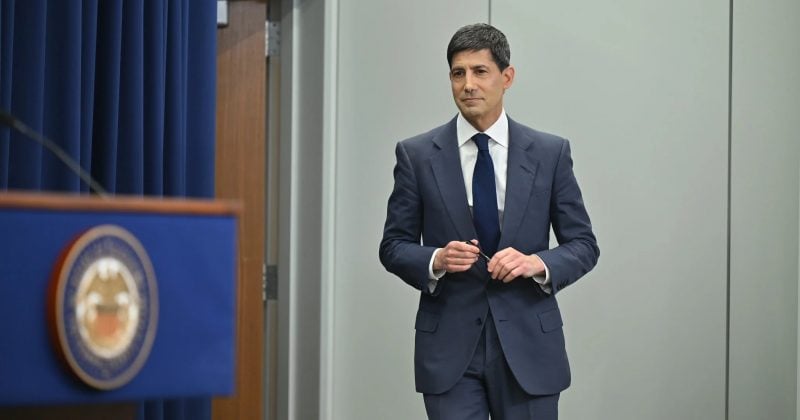
Federal Reserve Chair Warsh highlights strong productivity growth, stable labor market

Federal Reserve Chair Warsh highlights strong productivity growth, stable labor market

The new Fed chair is leaning into AI-driven productivity as a potential disinflationary force, which could reshape monetary policy and ripple into crypto markets

Kevin Warsh, the newest occupant of the most powerful economic chair in the world, is painting an optimistic picture. In his assessment of the US economy, the Fed Chair pointed to strong productivity growth, a broadly stable labor market, and an ongoing internal review of how the central bank meets its objectives.

What Warsh actually said

Warsh, who was confirmed by a 54-45 Senate vote on May 22, 2026, emphasized that productivity growth has been strong and job gains have kept pace with workforce expansion. The unemployment rate has remained broadly stable, a sign that the labor market isn’t overheating or cracking.

Advertisement

Minutes from the FOMC meeting held on June 17, 2026, echoed these themes. The committee noted robust productivity growth alongside continued capital investment, much of it driven by artificial intelligence.

Warsh has gone a step further in previous remarks, arguing that AI-driven productivity gains could act as a disinflationary force.

The task force gambit

On July 9, 2026, Warsh announced the formation of five expert task forces designed to review how the Fed communicates, manages its balance sheet, approaches inflation frameworks, handles data practices, and other operational areas. The roster includes heavy hitters like former Reserve Bank of India Governor Raghuram Rajan and Harvard economist Raj Chetty.

Why crypto investors should pay attention

The relationship between Fed policy and crypto prices is well established at this point. When rates were near zero in 2020 and 2021, Bitcoin went on its most spectacular run. When the Fed pivoted to aggressive tightening in 2022, crypto markets lost roughly two-thirds of their value.

There’s no mention of Bitcoin, Ethereum, or any digital asset in Warsh’s comments. The Fed’s current posture appears laser-focused on traditional economic indicators.

Disclosure: This article was edited by Editorial Team. For more information on how we create and review content, see our Editorial Policy.

Federal Reserve Chair Warsh highlights strong productivity growth, stable labor market

Federal Reserve Chair Warsh highlights strong productivity growth, stable labor market

The new Fed chair is leaning into AI-driven productivity as a potential disinflationary force, which could reshape monetary policy and ripple into crypto markets

Kevin Warsh, the newest occupant of the most powerful economic chair in the world, is painting an optimistic picture. In his assessment of the US economy, the Fed Chair pointed to strong productivity growth, a broadly stable labor market, and an ongoing internal review of how the central bank meets its objectives.

What Warsh actually said

Warsh, who was confirmed by a 54-45 Senate vote on May 22, 2026, emphasized that productivity growth has been strong and job gains have kept pace with workforce expansion. The unemployment rate has remained broadly stable, a sign that the labor market isn’t overheating or cracking.

Advertisement

Minutes from the FOMC meeting held on June 17, 2026, echoed these themes. The committee noted robust productivity growth alongside continued capital investment, much of it driven by artificial intelligence.

Warsh has gone a step further in previous remarks, arguing that AI-driven productivity gains could act as a disinflationary force.

The task force gambit

On July 9, 2026, Warsh announced the formation of five expert task forces designed to review how the Fed communicates, manages its balance sheet, approaches inflation frameworks, handles data practices, and other operational areas. The roster includes heavy hitters like former Reserve Bank of India Governor Raghuram Rajan and Harvard economist Raj Chetty.

Why crypto investors should pay attention

The relationship between Fed policy and crypto prices is well established at this point. When rates were near zero in 2020 and 2021, Bitcoin went on its most spectacular run. When the Fed pivoted to aggressive tightening in 2022, crypto markets lost roughly two-thirds of their value.

There’s no mention of Bitcoin, Ethereum, or any digital asset in Warsh’s comments. The Fed’s current posture appears laser-focused on traditional economic indicators.

Disclosure: This article was edited by Editorial Team. For more information on how we create and review content, see our Editorial Policy.