
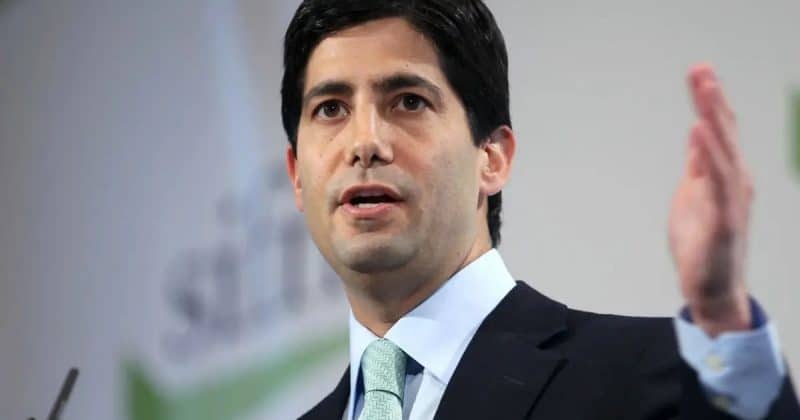
Federal Reserve’s Kevin Warsh signals hawkish stance, boosts US assets and rattles crypto markets

Federal Reserve’s Kevin Warsh signals hawkish stance, boosts US assets and rattles crypto markets

New Fed chair's first FOMC meeting holds rates steady while nine of nineteen members eye a rate hike by year-end

Kevin Warsh just held his first FOMC meeting as Federal Reserve Chair, and he used it to send an unmistakable message: inflation control comes first, your feelings come second.

The Fed held the federal funds rate steady at 3.50%-3.75% during the June 16-17 meeting. That alone wasn’t the surprise. The surprise was what the policy statement didn’t say. There was zero forward guidance on potential easing, a deliberate omission that caught markets off guard and signaled a clean break from the dovish trajectory many traders had been pricing in.

A new sheriff with an old playbook

Warsh was sworn in as Fed Chair on May 22, succeeding Jerome Powell. His appointment by President Trump had initially fueled expectations of a more accommodative posture, perhaps even rate cuts to juice economic growth. Instead, Warsh leaned into price stability and data dependence, two phrases that, in Fed-speak, translate roughly to “we’re not cutting anything anytime soon.”

Warsh previously served as a Fed governor from 2006 to 2011, where he built a reputation as one of the more hawkish voices on the board.

Advertisement

The dot plot, the Fed’s projection tool where individual members signal their rate expectations, painted an even sharper picture. Nine of the nineteen FOMC members indicated they anticipate at least one rate hike before 2026 ends. Not a cut. A hike. With inflation running at approximately 4.2% as of May, more than double the Fed’s 2% target, the math supports the hawkish tilt.

Warsh emphasized that the Fed would remain committed to its 2% inflation benchmark, framing the current rate environment as a necessary tool rather than a temporary inconvenience.

What it means for the dollar and traditional assets

The immediate market reaction tilted predictably. The US dollar strengthened as traders recalibrated their expectations around sustained higher rates. A hawkish Fed generally makes dollar-denominated assets more attractive to global investors, and Warsh’s signaling has reinforced that dynamic.

For US equities, growth stocks, which are particularly sensitive to interest rate expectations, face headwinds from the prospect of rates staying elevated or even climbing higher. The removal of forward guidance on easing means investors can’t rely on the Fed put in the near term.

Crypto feels the chill

For crypto markets, the removal of any easing guidance from the FOMC statement is particularly significant for traders who had been positioning for rate cuts in the second half of 2026. Those bets now look considerably less attractive. With nearly half the FOMC projecting at least one hike, the risk calculus has shifted in a direction that typically suppresses speculative appetite.

A stronger dollar also creates friction for international and institutional investors operating in crypto. Foreign investors converting local currencies into dollars to purchase Bitcoin or Ethereum face higher entry costs, which can dampen demand at the margins.

The key variable to watch is whether Warsh’s hawkish signaling actually succeeds in anchoring inflation expectations. If inflation proves sticky above 4%, traders should prepare for an extended period where the Fed’s priorities and crypto’s preferred conditions remain fundamentally misaligned.

Disclosure: This article was edited by Editorial Team. For more information on how we create and review content, see our Editorial Policy.

Federal Reserve’s Kevin Warsh signals hawkish stance, boosts US assets and rattles crypto markets

Federal Reserve’s Kevin Warsh signals hawkish stance, boosts US assets and rattles crypto markets

New Fed chair's first FOMC meeting holds rates steady while nine of nineteen members eye a rate hike by year-end

Kevin Warsh just held his first FOMC meeting as Federal Reserve Chair, and he used it to send an unmistakable message: inflation control comes first, your feelings come second.

The Fed held the federal funds rate steady at 3.50%-3.75% during the June 16-17 meeting. That alone wasn’t the surprise. The surprise was what the policy statement didn’t say. There was zero forward guidance on potential easing, a deliberate omission that caught markets off guard and signaled a clean break from the dovish trajectory many traders had been pricing in.

A new sheriff with an old playbook

Warsh was sworn in as Fed Chair on May 22, succeeding Jerome Powell. His appointment by President Trump had initially fueled expectations of a more accommodative posture, perhaps even rate cuts to juice economic growth. Instead, Warsh leaned into price stability and data dependence, two phrases that, in Fed-speak, translate roughly to “we’re not cutting anything anytime soon.”

Warsh previously served as a Fed governor from 2006 to 2011, where he built a reputation as one of the more hawkish voices on the board.

Advertisement

The dot plot, the Fed’s projection tool where individual members signal their rate expectations, painted an even sharper picture. Nine of the nineteen FOMC members indicated they anticipate at least one rate hike before 2026 ends. Not a cut. A hike. With inflation running at approximately 4.2% as of May, more than double the Fed’s 2% target, the math supports the hawkish tilt.

Warsh emphasized that the Fed would remain committed to its 2% inflation benchmark, framing the current rate environment as a necessary tool rather than a temporary inconvenience.

What it means for the dollar and traditional assets

The immediate market reaction tilted predictably. The US dollar strengthened as traders recalibrated their expectations around sustained higher rates. A hawkish Fed generally makes dollar-denominated assets more attractive to global investors, and Warsh’s signaling has reinforced that dynamic.

For US equities, growth stocks, which are particularly sensitive to interest rate expectations, face headwinds from the prospect of rates staying elevated or even climbing higher. The removal of forward guidance on easing means investors can’t rely on the Fed put in the near term.

Crypto feels the chill

For crypto markets, the removal of any easing guidance from the FOMC statement is particularly significant for traders who had been positioning for rate cuts in the second half of 2026. Those bets now look considerably less attractive. With nearly half the FOMC projecting at least one hike, the risk calculus has shifted in a direction that typically suppresses speculative appetite.

A stronger dollar also creates friction for international and institutional investors operating in crypto. Foreign investors converting local currencies into dollars to purchase Bitcoin or Ethereum face higher entry costs, which can dampen demand at the margins.

The key variable to watch is whether Warsh’s hawkish signaling actually succeeds in anchoring inflation expectations. If inflation proves sticky above 4%, traders should prepare for an extended period where the Fed’s priorities and crypto’s preferred conditions remain fundamentally misaligned.

Disclosure: This article was edited by Editorial Team. For more information on how we create and review content, see our Editorial Policy.