
Nexo Earn with Nexo
FIFA commits $3.8B to custom grass pitches ahead of 2026 World Cup

FIFA commits $3.8B to custom grass pitches ahead of 2026 World Cup

Eight NFL stadiums will rip out their artificial turf so the world's best soccer players can run on real grass, backed by eight years of turf science research.

FIFA is spending $3.8 billion to make sure every blade of grass at the 2026 World Cup meets its standards. The governing body is converting all 16 host stadiums across the US, Canada, and Mexico to hybrid natural grass surfaces, a project that has quietly become one of the most expensive turf operations in sports history.

Eight of those stadiums currently use artificial turf, primarily because they double as NFL venues.

Eight years of growing grass like it’s a space program

Research into the appropriate grass types for the tournament has spanned more than eight years, involving turf scientists from Michigan State University and the University of Tennessee. The goal: engineer playing surfaces that behave identically whether the match is in Dallas or Vancouver.

Advertisement

Two primary grass blends are being cultivated for the tournament. Bermuda grass will be used in warmer climates, where it thrives under heat and direct sunlight. For indoor venues, the mix shifts to Kentucky bluegrass and perennial ryegrass, blended at a ratio of roughly 84% and 16% respectively. The combination is designed to handle the lower light levels and controlled environments inside domed stadiums.

Custom sod for the pitches is being grown at specialized farms. One of them is operated by Joe Wilkins III near Denver, where specific irrigation and lighting systems simulate the conditions each pitch will face during the tournament.

The pitches themselves are hybrid surfaces, meaning they combine natural grass with synthetic reinforcement fibers woven into the root zone.

Why real grass matters more than you think

FIFA’s insistence on natural grass is not aesthetic. It is a player safety decision. Artificial turf has been a persistent point of contention in professional soccer, with players and their unions arguing that synthetic surfaces increase the risk of joint injuries and alter the way the ball moves. The US Women’s National Team famously protested artificial pitches during the 2015 Women’s World Cup in Canada.

For the 2026 tournament, FIFA has mandated hybrid natural grass for all 104 matches. A pitch in Seattle needs to play the same as one in Mexico City. The ball needs to roll at the same speed. Players need the same amount of give underfoot.

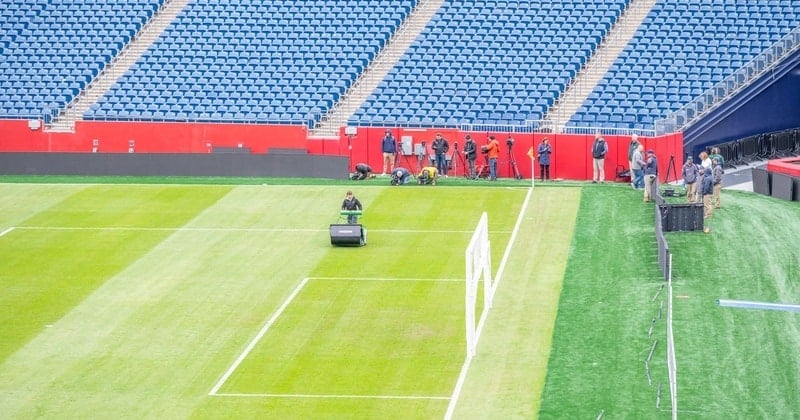
Installations are already underway at several venues, with teams of turf scientists overseeing the process at each location. Every pitch needs to be match-ready, tested, and approved before the tournament kicks off in June 2026.

Disclosure: This article was edited by Editorial Team. For more information on how we create and review content, see our Editorial Policy.

FIFA commits $3.8B to custom grass pitches ahead of 2026 World Cup

FIFA commits $3.8B to custom grass pitches ahead of 2026 World Cup

Eight NFL stadiums will rip out their artificial turf so the world's best soccer players can run on real grass, backed by eight years of turf science research.

FIFA is spending $3.8 billion to make sure every blade of grass at the 2026 World Cup meets its standards. The governing body is converting all 16 host stadiums across the US, Canada, and Mexico to hybrid natural grass surfaces, a project that has quietly become one of the most expensive turf operations in sports history.

Eight of those stadiums currently use artificial turf, primarily because they double as NFL venues.

Eight years of growing grass like it’s a space program

Research into the appropriate grass types for the tournament has spanned more than eight years, involving turf scientists from Michigan State University and the University of Tennessee. The goal: engineer playing surfaces that behave identically whether the match is in Dallas or Vancouver.

Advertisement

Two primary grass blends are being cultivated for the tournament. Bermuda grass will be used in warmer climates, where it thrives under heat and direct sunlight. For indoor venues, the mix shifts to Kentucky bluegrass and perennial ryegrass, blended at a ratio of roughly 84% and 16% respectively. The combination is designed to handle the lower light levels and controlled environments inside domed stadiums.

Custom sod for the pitches is being grown at specialized farms. One of them is operated by Joe Wilkins III near Denver, where specific irrigation and lighting systems simulate the conditions each pitch will face during the tournament.

The pitches themselves are hybrid surfaces, meaning they combine natural grass with synthetic reinforcement fibers woven into the root zone.

Why real grass matters more than you think

FIFA’s insistence on natural grass is not aesthetic. It is a player safety decision. Artificial turf has been a persistent point of contention in professional soccer, with players and their unions arguing that synthetic surfaces increase the risk of joint injuries and alter the way the ball moves. The US Women’s National Team famously protested artificial pitches during the 2015 Women’s World Cup in Canada.

For the 2026 tournament, FIFA has mandated hybrid natural grass for all 104 matches. A pitch in Seattle needs to play the same as one in Mexico City. The ball needs to roll at the same speed. Players need the same amount of give underfoot.

Installations are already underway at several venues, with teams of turf scientists overseeing the process at each location. Every pitch needs to be match-ready, tested, and approved before the tournament kicks off in June 2026.

Disclosure: This article was edited by Editorial Team. For more information on how we create and review content, see our Editorial Policy.