
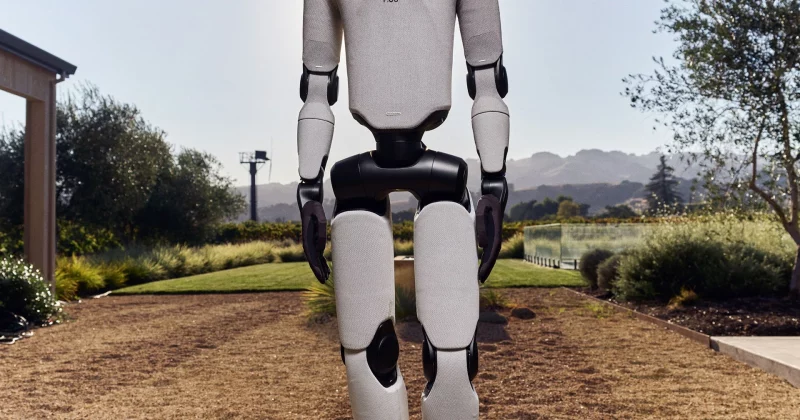
Figure’s F.03 robot completes 200-hour logistics stress test, sorts 250,000 packages
The humanoid robot marathon was supposed to last 8 hours. It ran for 200 with zero hardware failures.
Figure AI’s F.03 humanoid robots just pulled off the kind of endurance test that would make an Amazon warehouse worker weep. Over the course of 200 continuous hours, three robots autonomously sorted nearly 250,000 packages without a single hardware failure.
The test was originally planned as an 8-hour demonstration. It ran for 25 times longer than that.
What actually happened
The livestream kicked off around May 13-14, with Figure AI’s F.03 robots working in shifts at what amounted to a nonstop logistics gauntlet. Three robots, affectionately named Bob, Frank, and Gary by viewers, rotated autonomously through their duties. When one needed to charge, another stepped in. No human remote control required.
The robots were powered by Figure AI’s Helix-02 AI system, which handled package identification and placement. Processing speeds clocked in at roughly 2.6 to 2.83 seconds per package. That’s nearly on par with human workers performing the same task.
The company also staged a separate competition pitting one of its robots against a human intern in a ten-hour package-sorting face-off.
The news moving money, markets, and the world—before your day starts.
Daily. Free. Join 34,000+ readers across crypto, finance, and policy.
The company behind the robots
Figure AI is currently valued at approximately $39 billion. The startup has been scaling aggressively, increasing production capacity by 24 times in recent months.
The company’s dedicated manufacturing facility, called BotQ, now produces one robot per hour.
What this means for investors
The $39 billion valuation looks rich by traditional metrics. But if Figure AI can maintain this production trajectory of one robot per hour and continue demonstrating this level of reliability, the economics start to make more sense. Each robot that can perform the equivalent of multiple human shifts per day has a calculable return on investment for warehouse operators.
The processing speed of 2.6 to 2.83 seconds per package is also worth monitoring over time. Matching human speed is the baseline. Beating it consistently is what would make the economic case irresistible for warehouse operators weighing the cost of a robot against the cost of a human worker, benefits included.