
G7 debt market faces volatility as Iran war drives oil past $100 and reshapes inflation outlook
Bond yields have surged nearly 150 basis points since the conflict began, forcing central banks into an uncomfortable corner between fighting inflation and supporting growth.
The war in the Middle East is doing what wars tend to do to financial markets: making everything more expensive and everyone more nervous. G7 government bond yields have climbed to around 4.6% on the 10-year, up from 3.2% before the US-Israeli military campaign against Iran began on February 28. That’s a 140-basis-point jump in roughly three months, the kind of move that reprices entire portfolios overnight.
Brent crude hit $111 per barrel by mid-May, a level not seen since the worst of the post-Ukraine energy shock. The catalyst is straightforward: Iran’s closure of the Strait of Hormuz, the narrow waterway that handles roughly 20% of the world’s oil trade. Shut that down and you don’t just get an oil price spike. You get a global inflation problem.
The G7 response: concern without clarity
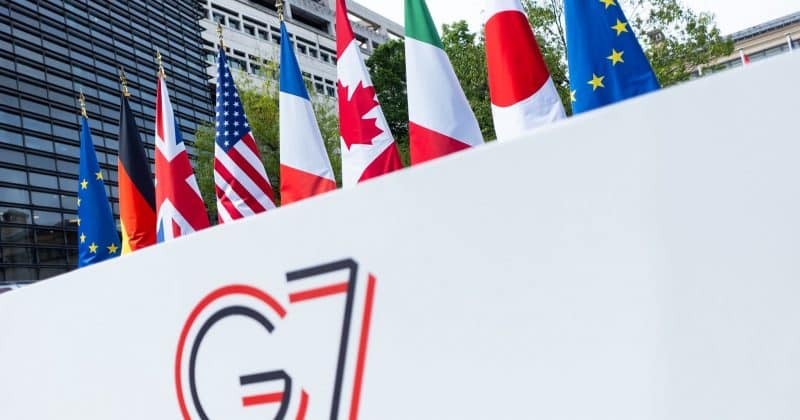
G7 finance ministers and central bank governors gathered in Paris from May 19-21 to address what has become the defining economic challenge of 2026. Their joint statement acknowledged that the conflict “heightens risks to both economic growth and inflation,” citing disruptions across energy, food, and fertilizer supply chains.
Here’s the thing about G7 joint statements: they’re designed to signal coordination without committing to specifics. This one was no different. The ministers flagged the problem. They did not announce a solution.
The real question facing central banks is one they’d rather not answer. Inflation is running hot again thanks to energy prices, which means rate cuts are off the table. But growth is slowing, which means rate hikes could tip fragile economies into recession. In English: they’re stuck.
The IMF isn’t exactly offering comfort either. The fund downgraded its 2026 growth forecast for emerging markets to a baseline of 3.65%, with a worst-case scenario of just 2.6% if the war drags on. That prolonged-war scenario is looking less hypothetical by the week.
How the conflict reshaped bond markets
The traditional playbook says investors flee to government bonds during geopolitical crises. That’s technically happening. Demand for G7 debt has surged as investors seek safety. But the safety trade looks different when inflation is the primary threat.
Bond prices and yields move inversely, so rising yields mean bond prices are falling even as demand increases. The paradox makes sense when you think about it: investors want safe assets, but they also want to be compensated for the very real risk that inflation will erode the value of those fixed payments over the next decade. The result is a market pulling in two directions simultaneously.
US Treasuries, historically the ultimate safe haven, are now yielding 4.6% on the 10-year. That’s a decent nominal return. But if inflation runs at 4-5% annually, which energy prices suggest is plausible, the real return is close to zero. Safety, in other words, isn’t free.
The IMF has warned that tighter financial conditions stemming from the conflict could affect non-bank financial entities and overall economic stability. That’s central bank code for “shadow banking might have problems,” which is the kind of sentence that should make people pay attention.
What this means for crypto and alternative assets
Look, every geopolitical crisis produces a wave of “Bitcoin is a safe haven” arguments, and most of them age poorly. But the current environment has a feature that makes the case slightly more interesting than usual: the traditional safe havens aren’t working the way they’re supposed to.
When government bonds offer negative real yields, when oil prices are being driven by a conflict with no clear end date, and when central banks are paralyzed between competing mandates, the argument for alternative stores of value gets harder to dismiss. Bitcoin’s narrative as an inflation hedge has always been more story than substance, but stories matter in markets, especially when the alternatives are actively disappointing.
The more immediate concern for crypto investors is the second-order effect of tighter financial conditions. If the IMF’s warnings about funding markets materialize, liquidity could dry up across all asset classes, crypto included. The 2022 playbook showed that Bitcoin doesn’t decouple from risk assets during genuine financial stress. It sells off alongside everything else.
Traders should watch two things closely. First, whether G7 central banks break from their current holding pattern on rates. A surprise hike to combat energy-driven inflation would tighten conditions further and likely pressure risk assets. A surprise cut to support growth would signal panic, which is its own kind of bearish.
Second, the Strait of Hormuz. As long as it remains closed, oil stays above $100, inflation stays elevated, and central banks stay trapped. Any diplomatic breakthrough that reopens the strait would be the single most bullish event for global markets this year, deflating oil prices and giving policymakers room to maneuver. Until then, volatility isn’t a bug. It’s the whole system.