
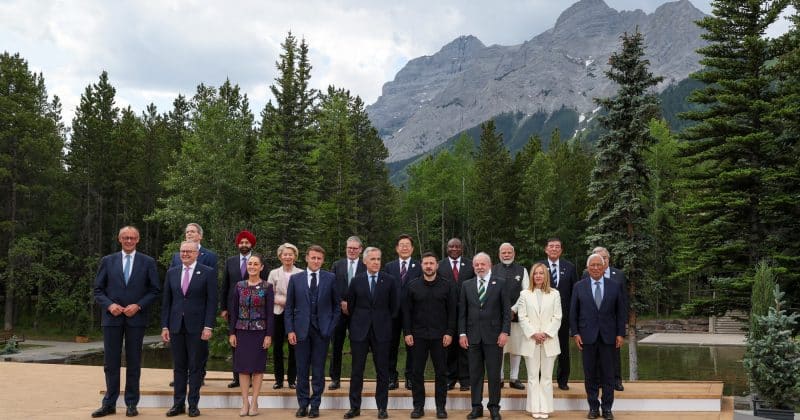
G7 agrees Russia is not winning war, discusses more sanctions targeting energy and banking

G7 agrees Russia is not winning war, discusses more sanctions targeting energy and banking

Ukrainian President Zelenskiy announced G7 consensus on Russia's battlefield setbacks as leaders weigh fresh sanctions on oil exports, banks, and military production

G7 leaders meeting in Évian-les-Bains, France, reached a consensus that Russia is not winning its war against Ukraine, according to Ukrainian President Volodymyr Zelenskiy. The announcement, made on June 16, came alongside discussions about implementing a new wave of sanctions aimed at Russia’s energy exports, banking system, and military production capabilities.

The war is now in its fifth year since Russia’s full-scale invasion began in February 2022.

What the G7 actually agreed on

Zelenskiy told reporters that G7 leaders acknowledged Russia is experiencing significant personnel losses and has lost strategic initiative on multiple fronts.

Advertisement

The proposed sanctions would target three pillars of Russia’s war economy: energy exports, which remain Moscow’s primary revenue lifeline; its banking infrastructure, which processes those revenues; and its military production sector, which converts rubles into rockets.

US President Donald Trump, who attended the summit, signaled the potential for a swift reimposition of sanctions on Russian oil. That move would be tied to recent diplomatic developments concerning Iran.

Zelenskiy also indicated he expected a significant bilateral meeting with Trump later in the day, focused on increasing pressure on Russia.

What this means for crypto and digital finance

The summit discussions notably did not include any mention of cryptocurrencies or digital assets.

Since 2022, crypto has played an increasingly visible role in sanctions evasion and enforcement. Russian entities have turned to digital assets to move money across borders when traditional banking channels were blocked. At the same time, blockchain analytics firms have provided Western governments with tools to track those flows with a precision that wasn’t possible a decade ago.

For crypto markets, the more immediate concern is the macroeconomic fallout from tighter sanctions. If restrictions on Russian oil exports push energy prices higher, that feeds into inflation, which influences central bank policy, which moves risk assets.

Investors in the crypto space should watch for two things. First, whether new sanctions explicitly address digital asset usage as a circumvention tool, which could bring fresh regulatory scrutiny to exchanges and DeFi protocols. Second, how energy price volatility from sanctions affects the broader risk appetite that drives crypto market cycles.

Disclosure: This article was edited by Editorial Team. For more information on how we create and review content, see our Editorial Policy.

G7 agrees Russia is not winning war, discusses more sanctions targeting energy and banking

G7 agrees Russia is not winning war, discusses more sanctions targeting energy and banking

Ukrainian President Zelenskiy announced G7 consensus on Russia's battlefield setbacks as leaders weigh fresh sanctions on oil exports, banks, and military production

G7 leaders meeting in Évian-les-Bains, France, reached a consensus that Russia is not winning its war against Ukraine, according to Ukrainian President Volodymyr Zelenskiy. The announcement, made on June 16, came alongside discussions about implementing a new wave of sanctions aimed at Russia’s energy exports, banking system, and military production capabilities.

The war is now in its fifth year since Russia’s full-scale invasion began in February 2022.

What the G7 actually agreed on

Zelenskiy told reporters that G7 leaders acknowledged Russia is experiencing significant personnel losses and has lost strategic initiative on multiple fronts.

Advertisement

The proposed sanctions would target three pillars of Russia’s war economy: energy exports, which remain Moscow’s primary revenue lifeline; its banking infrastructure, which processes those revenues; and its military production sector, which converts rubles into rockets.

US President Donald Trump, who attended the summit, signaled the potential for a swift reimposition of sanctions on Russian oil. That move would be tied to recent diplomatic developments concerning Iran.

Zelenskiy also indicated he expected a significant bilateral meeting with Trump later in the day, focused on increasing pressure on Russia.

What this means for crypto and digital finance

The summit discussions notably did not include any mention of cryptocurrencies or digital assets.

Since 2022, crypto has played an increasingly visible role in sanctions evasion and enforcement. Russian entities have turned to digital assets to move money across borders when traditional banking channels were blocked. At the same time, blockchain analytics firms have provided Western governments with tools to track those flows with a precision that wasn’t possible a decade ago.

For crypto markets, the more immediate concern is the macroeconomic fallout from tighter sanctions. If restrictions on Russian oil exports push energy prices higher, that feeds into inflation, which influences central bank policy, which moves risk assets.

Investors in the crypto space should watch for two things. First, whether new sanctions explicitly address digital asset usage as a circumvention tool, which could bring fresh regulatory scrutiny to exchanges and DeFi protocols. Second, how energy price volatility from sanctions affects the broader risk appetite that drives crypto market cycles.

Disclosure: This article was edited by Editorial Team. For more information on how we create and review content, see our Editorial Policy.