
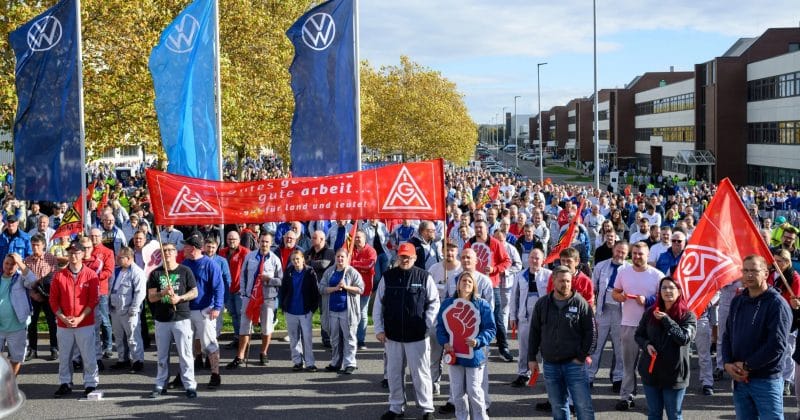
German carmakers implement historic job cuts amid Chinese competition
Volkswagen considers cutting up to 100,000 jobs and closing four plants as BYD and other Chinese EV makers eat into European market share
Germany’s automotive industry is undergoing significant restructuring. Volkswagen is reportedly planning to cut up to 100,000 jobs, roughly 15% of its global workforce, as Chinese electric vehicle competitors continue to gain ground.
Four major production plants in Germany, including facilities in Hanover, Zwickau, Emden, and Audi’s Neckarsulm site, are reportedly on the chopping block.
The scale of the restructuring
Audi has its own plan to eliminate 7,500 jobs in Germany by 2029. Bosch intends to cut 13,000 positions in its automotive division by 2030.
The German Association of the Automotive Industry, known as VDA, has revised its job loss projections upward by 35,000 for the coming decade. The VDA now estimates an additional 125,000 positions will disappear, on top of the roughly 100,000 jobs the sector has already shed in recent years.
The German auto industry has historically employed around 800,000 people directly, with millions more in adjacent supply chains.
Why BYD changed everything
Chinese EV manufacturers have systematically undercut European rivals on price while matching or exceeding them on technology. German automakers have watched their market share slide to levels not seen in 13 years. Chinese manufacturers benefit from lower labor costs, massive government subsidies, and vertically integrated supply chains that give them structural advantages on unit economics.
Macro, rates, and crypto—what moved markets and what matters next.
Daily. Free. Join 34,000+ readers across crypto, finance, and policy.
German automakers invested billions in EV transition but bet on a pace of adoption that hasn’t materialized in Europe, while simultaneously underestimating how quickly Chinese competitors would scale globally. The result is enormous capital expenditures on EV production capacity that isn’t being fully utilized, paired with legacy combustion engine operations that are becoming less profitable. Energy prices in Germany remain elevated compared to pre-2022 levels, and regulatory compliance costs continue to climb.
Labor pushback and political fallout
IG Metall, Germany’s powerful metalworkers’ union, has pushed back hard against the proposed cuts.
Towns like Zwickau in Saxony face severe downstream effects on local businesses, tax revenues, and social services when VW, the largest employer in the region, begins closing plants.
What this means for investors
Short-term stock volatility for Volkswagen and its subsidiaries is likely as plant closure decisions get finalized and union negotiations play out. Restructuring charges will hit earnings reports.
The fact that job loss estimates keep being revised upward, by 35,000 in the latest VDA update alone, suggests the industry itself doesn’t yet have a clear picture of where the floor is.
European parts suppliers, many of whom depend on Volkswagen and its peers for the majority of their revenue, face their own reckoning as restructuring ripples through the supply chain.