
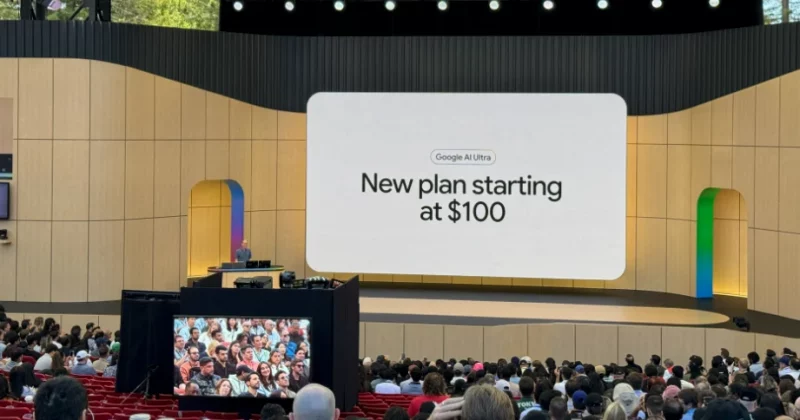
Google launches new $100 AI Ultra plan, cuts top-tier price to $200 at I/O 2026
Google restructures its AI subscription tiers with a new mid-range option for developers and a price cut on its premium plan, signaling an aggressive push to lock in users against Microsoft and OpenAI.
Google just reshuffled the deck on its AI subscription pricing, and the message is pretty clear: the company wants to be the default toolkit for anyone building with AI, from hobbyists to hardcore developers.
At I/O 2026, Google introduced a new $100/month “AI Ultra” plan while simultaneously dropping the price of its previous top-tier Ultra plan from $250 to $200. In a market where competitors keep raising prices, Google is doing the opposite. That alone is worth paying attention to.
What the new pricing actually looks like
Google’s AI subscription lineup now has four distinct tiers. Plus sits at $7.99/month, Pro at $19.99, the new AI Ultra at $99.99, and the higher-limit Ultra at $200.
The gap between $20 and $250 was, frankly, a canyon. The new $100 tier fills that void in a way that makes practical sense for developers and power users who need more than Pro but don’t require everything the top plan offers.
Here’s the thing: the $100 AI Ultra plan gives subscribers 5x the usage limits compared to the $20 Pro tier. It also comes with 20TB of storage and priority access to Google’s Antigravity platform, along with integration with fast inference models. For developers running serious workloads, that’s a meaningful step up without the $200 commitment.
The $200 Ultra plan, meanwhile, keeps its full feature set intact despite the $50 price reduction. Subscribers at that level get 20x Pro usage limits, access to Project Genie (Google’s experimental world-building platform), and 25,000 AI credits per month. Nothing was stripped out to justify the lower price.
In English: Google made its most expensive plan cheaper and added a new middle option, so users aren’t forced to choose between a compact sedan and a private jet.
Why this matters beyond the price tags
The AI tooling market is entering a phase where the land grab is less about having the best model and more about having the stickiest ecosystem. Google, Microsoft, and OpenAI are all fighting for the same pool of developers and enterprise customers. Pricing is one of the most effective levers any of them can pull.
AI, tech, and the markets they move—in one daily briefing.
Daily. Free. Join 34,000+ readers across crypto, finance, and policy.
Google’s approach here is classic platform strategy. By creating a $100 tier that’s specifically designed around developer workflows, priority model access, and generous usage caps, the company is building a migration path. Get users comfortable at $20, give them a reason to jump to $100 when their needs grow, and let the $200 tier exist as the ceiling for the most demanding workloads.
The inclusion of 25,000 AI credits per month for Ultra members is particularly noteworthy. Credits function as a usage currency within Google’s AI ecosystem, and bundling a generous allotment at the subscription level reduces friction for developers who would otherwise need to manage separate compute budgets. It’s the kind of detail that doesn’t make headlines but shapes which platform people actually stick with.
Meanwhile, the price cut on the top-tier plan from $250 to $200 suggests Google is feeling competitive pressure. When a company lowers the price on its flagship product without removing features, the calculation is straightforward: they’d rather have more subscribers at a lower margin than fewer subscribers watching from the sidelines.
The competitive landscape is getting crowded
Google isn’t making these moves in a vacuum. Microsoft has been aggressively integrating AI capabilities across its product suite, leveraging its OpenAI partnership to embed models into everything from Office to Azure. OpenAI itself has been expanding its own subscription offerings and API pricing to capture both consumer and enterprise markets.
The battleground has shifted from “who has the smartest model” to “who has the most useful platform.” Google’s advantage has always been its breadth: search, cloud, productivity tools, mobile, and now AI models that can plug into all of those surfaces. A tiered subscription model that scales with user sophistication is how you monetize that breadth without alienating anyone.
Project Genie, which remains exclusive to the $200 tier, is an interesting signal about where Google sees the frontier. World-building platforms suggest a bet on generative environments, not just generative text or images. It’s the kind of experimental feature that gives the premium tier a reason to exist beyond just “more of the same.”
What this means for investors
For anyone watching Alphabet stock or the broader AI sector, Google’s pricing restructure reveals a company in acquisition mode, not harvesting mode. Cutting prices and adding tiers is a growth strategy, not a margin strategy. That’s important context for how to interpret Alphabet’s AI revenue numbers in coming quarters.
The risk here is straightforward: if Google is spending heavily on compute infrastructure to support millions of Ultra subscribers at lower price points, margins could compress before revenue scales enough to compensate. The 25,000 monthly AI credits bundled into the plan aren’t free to deliver.
But the upside is equally clear. If the $100 tier successfully captures developers who were previously bouncing between platforms or managing piecemeal API budgets, Google locks in recurring revenue and ecosystem dependency. Developers who build on a platform tend to stay on that platform.
The crypto-adjacent angle is worth noting too. As AI infrastructure becomes increasingly central to everything from trading algorithms to on-chain analytics, the cost and accessibility of advanced AI tools directly impacts the builder ecosystem in Web3. A $100/month plan with 5x Pro usage limits and fast inference model access is meaningfully more accessible than what was available even six months ago.
Watch for Microsoft and OpenAI’s response in the coming weeks. Pricing moves in AI subscriptions tend to cascade quickly, and Google just set a new anchor point that competitors will need to address, whether through matching price cuts, feature bundling, or both.