
Nexo Earn with Nexo
Google unveils Managed Agents API for simplified AI deployment at I/O 2026

Google unveils Managed Agents API for simplified AI deployment at I/O 2026

The new API lets developers deploy autonomous AI agents with a single call, trading granular control for radical simplicity.

Google just made building autonomous AI agents significantly easier. At its I/O 2026 developer conference, the company unveiled the Managed Agents API, a new offering within the Gemini and Antigravity stack that lets developers spin up AI agents capable of reasoning, planning, browsing the web, and executing code, all through a single API call.

The pitch is straightforward: stop managing infrastructure, start building things that actually do stuff. Google is betting that the future of AI isn’t chatbots answering questions. It’s agents that autonomously execute multi-step workflows without a human babysitting every decision.

What the Managed Agents API actually does

Think of it as “agent-as-a-service.” Developers define what they want an agent to accomplish, and Google handles everything underneath: the compute, the sandboxing, the scaling. Each agent runs inside an ephemeral Linux environment, meaning it spins up, does its job, and disappears. No VMs to provision. No containers to orchestrate.

The agents themselves can reason through problems, break tasks into sub-steps, browse live web content, and run code in an isolated sandbox.

Google is positioning this squarely at enterprise developers. The API is currently in preview, with an emphasis on governance and security.

Advertisement

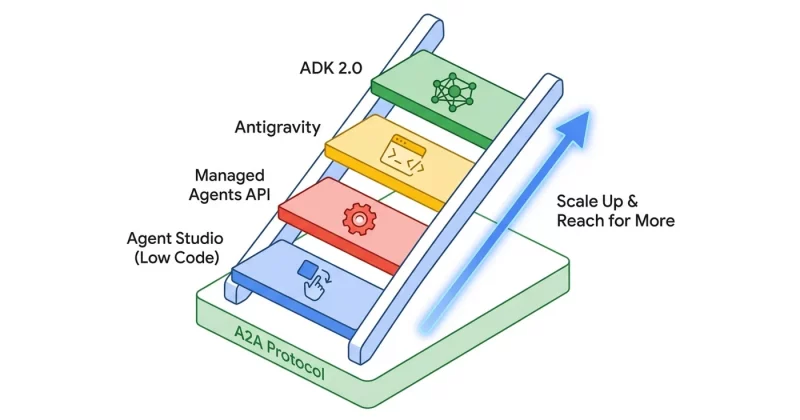
The development workflow pairs with the rest of Google’s tooling. Antigravity 2.0, a desktop application for local testing, lets developers prototype agents on their own machines before pushing them to Google Cloud for production deployment.

The trade-off nobody should ignore

By abstracting away the execution layer, Google is reducing developer control over how agents actually run. You don’t get to tweak the container configuration. You don’t get to inspect the sandbox in real time. You don’t get to run custom monitoring on the underlying compute. For use cases requiring auditability, deterministic behavior, or compliance with specific regulatory frameworks, that’s a conversation worth having before committing.

The preview-stage rollout, combined with the emphasis on governance features, suggests the company is building guardrails before the product reaches general availability.

Why crypto and DeFi developers should pay attention

The Managed Agents API isn’t targeting blockchain or decentralized finance specifically. Google didn’t mention crypto once in the announcement. But an autonomous agent with web browsing, code execution, and reasoning capabilities has clear applications in a DeFi context: on-chain monitoring agents that watch liquidity pools, research bots that ingest market data from multiple sources, and automation tools that respond to real-time events like governance proposals, liquidation thresholds, or bridge activity.

Today, building these tools requires stitching together multiple services: a language model API, a web scraping layer, a code execution environment, an orchestration framework, and hosting for all of it. The Managed Agents API collapses much of that stack into a single call.

The ephemeral Linux sandbox is particularly relevant here. Agents that execute code in isolated environments could be used to simulate transactions, test smart contract interactions, or run quantitative models against live data without exposing the developer’s own infrastructure to risk.

If Google’s platform decides to rate-limit, deprecate, or modify the API’s behavior, any DeFi automation built on top of it inherits that dependency. Most DeFi infrastructure already runs on AWS, Google Cloud, or Azure, so adding an agent layer on top of that existing centralized stack is a less dramatic shift than it might appear.

Google also introduced “information agents” as part of its search enhancements at I/O 2026. These agents autonomously monitor topics and deliver notifications, leveraging the same underlying technology as the Managed Agents API. For crypto market participants who need to track regulatory developments, protocol upgrades, or token unlock schedules, this feature could replace a patchwork of alerts, RSS feeds, and manual monitoring.

Google’s advantage in this space is vertical integration: the model (Gemini), the orchestration framework (Antigravity), the execution environment (Cloud), and the distribution channel (Search) all live under one roof.

Disclosure: This article was edited by Editorial Team. For more information on how we create and review content, see our Editorial Policy.

Google unveils Managed Agents API for simplified AI deployment at I/O 2026

Google unveils Managed Agents API for simplified AI deployment at I/O 2026

The new API lets developers deploy autonomous AI agents with a single call, trading granular control for radical simplicity.

Google just made building autonomous AI agents significantly easier. At its I/O 2026 developer conference, the company unveiled the Managed Agents API, a new offering within the Gemini and Antigravity stack that lets developers spin up AI agents capable of reasoning, planning, browsing the web, and executing code, all through a single API call.

The pitch is straightforward: stop managing infrastructure, start building things that actually do stuff. Google is betting that the future of AI isn’t chatbots answering questions. It’s agents that autonomously execute multi-step workflows without a human babysitting every decision.

What the Managed Agents API actually does

Think of it as “agent-as-a-service.” Developers define what they want an agent to accomplish, and Google handles everything underneath: the compute, the sandboxing, the scaling. Each agent runs inside an ephemeral Linux environment, meaning it spins up, does its job, and disappears. No VMs to provision. No containers to orchestrate.

The agents themselves can reason through problems, break tasks into sub-steps, browse live web content, and run code in an isolated sandbox.

Google is positioning this squarely at enterprise developers. The API is currently in preview, with an emphasis on governance and security.

Advertisement

The development workflow pairs with the rest of Google’s tooling. Antigravity 2.0, a desktop application for local testing, lets developers prototype agents on their own machines before pushing them to Google Cloud for production deployment.

The trade-off nobody should ignore

By abstracting away the execution layer, Google is reducing developer control over how agents actually run. You don’t get to tweak the container configuration. You don’t get to inspect the sandbox in real time. You don’t get to run custom monitoring on the underlying compute. For use cases requiring auditability, deterministic behavior, or compliance with specific regulatory frameworks, that’s a conversation worth having before committing.

The preview-stage rollout, combined with the emphasis on governance features, suggests the company is building guardrails before the product reaches general availability.

Why crypto and DeFi developers should pay attention

The Managed Agents API isn’t targeting blockchain or decentralized finance specifically. Google didn’t mention crypto once in the announcement. But an autonomous agent with web browsing, code execution, and reasoning capabilities has clear applications in a DeFi context: on-chain monitoring agents that watch liquidity pools, research bots that ingest market data from multiple sources, and automation tools that respond to real-time events like governance proposals, liquidation thresholds, or bridge activity.

Today, building these tools requires stitching together multiple services: a language model API, a web scraping layer, a code execution environment, an orchestration framework, and hosting for all of it. The Managed Agents API collapses much of that stack into a single call.

The ephemeral Linux sandbox is particularly relevant here. Agents that execute code in isolated environments could be used to simulate transactions, test smart contract interactions, or run quantitative models against live data without exposing the developer’s own infrastructure to risk.

If Google’s platform decides to rate-limit, deprecate, or modify the API’s behavior, any DeFi automation built on top of it inherits that dependency. Most DeFi infrastructure already runs on AWS, Google Cloud, or Azure, so adding an agent layer on top of that existing centralized stack is a less dramatic shift than it might appear.

Google also introduced “information agents” as part of its search enhancements at I/O 2026. These agents autonomously monitor topics and deliver notifications, leveraging the same underlying technology as the Managed Agents API. For crypto market participants who need to track regulatory developments, protocol upgrades, or token unlock schedules, this feature could replace a patchwork of alerts, RSS feeds, and manual monitoring.

Google’s advantage in this space is vertical integration: the model (Gemini), the orchestration framework (Antigravity), the execution environment (Cloud), and the distribution channel (Search) all live under one roof.

Disclosure: This article was edited by Editorial Team. For more information on how we create and review content, see our Editorial Policy.