
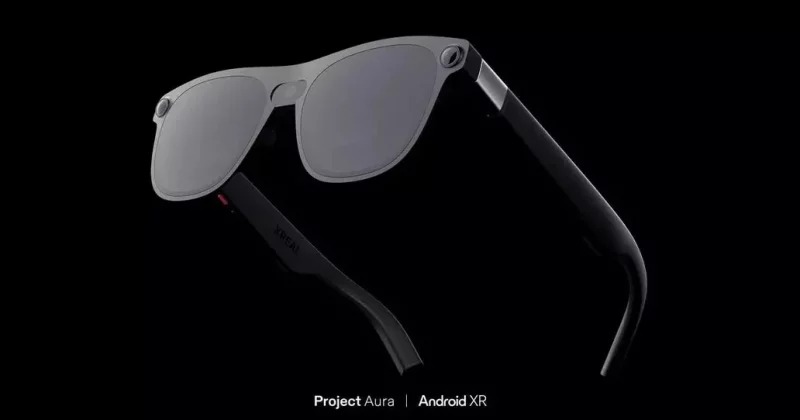
Google unveils Project Aura Android XR glasses with new features
Google and XREAL's lightweight smart glasses run full Android XR, weigh about 90 grams, and could eventually become a new front door for Web3 apps.
Google just pulled the curtain back on Project Aura, a pair of smart glasses built with XREAL that represent the company’s most concrete bet yet on wearable spatial computing. The glasses run Android XR, the same operating system powering Samsung’s Galaxy XR headset, which means they inherit an entire app ecosystem from day one.
What Project Aura actually is
Aura features optical see-through displays with a 70-degree field of view, packed into a frame that weighs roughly 90 grams. To keep that weight down, Google and XREAL moved the heavy lifting off your head entirely. A pocket-sized compute puck, wired to the glasses, handles processing and battery duties. Inside that puck sits Qualcomm’s Snapdragon XR2+ Gen 2 chip.
On the software side, Aura runs a full immersive version of Android XR. It can run the same spatial applications being developed for Samsung’s Galaxy XR headset, and supports Windows desktop streaming. AI features are baked in, including real-time translation, navigation overlays, and contextual information surfacing.
The broader XR ecosystem play
Google has lined up partnerships with Samsung, Warby Parker, and Gentle Monster to expand its XR and AI glasses ecosystem. XREAL’s Aura glasses are slated to be the first device supporting the full immersive Android XR experience, with a launch targeted for 2026.
Google is explicitly targeting what it calls “episodic applications,” meaning use cases where you put the glasses on for specific tasks rather than wearing them all day. Navigation during a walk, translation during a conversation, reference information during a repair job.
AI, tech, and the markets they move—in one daily briefing.
Daily. Free. Join 34,000+ readers across crypto, finance, and policy.
Why the crypto world should be paying attention
Project Aura doesn’t have any crypto integration today. No wallet support, no token gating, no NFT gallery floating in your field of view. But Android XR inherits Google’s developer ecosystem, which means any decentralized application built for Android can potentially be adapted for spatial computing. A 70-degree field of view paired with AI-driven contextual awareness creates a new canvas for dApp interfaces.
Meta’s Orion prototype, Apple’s Vision Pro, and now Google’s Android XR platform are all vying to become the next dominant computing paradigm. The 2026 launch window coincides with a period when several Layer 2 networks and wallet providers are actively building mobile-first experiences.
Google’s track record with new hardware platforms is mixed. Google Glass launched in 2013, generated enormous hype, and was quietly shelved. But the difference this time is ecosystem depth: Samsung as a hardware partner, Qualcomm providing purpose-built silicon, and an existing Android developer base numbering in the millions.