
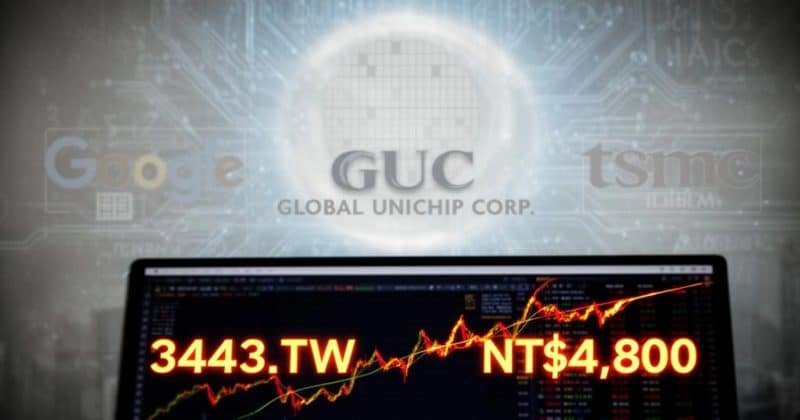
GUC hits all-time high as AI demand boosts CPU estimates
Taiwan's ASIC design specialist has more than tripled in value over the past year as hyperscalers race to build custom silicon
Global Unichip Corp., the TSMC-affiliated chip design house that most people outside Taiwan have never heard of, just hit an all-time high of NT$5,950. The stock has gained over 240% in the past year. That is not a typo.
The catalyst is straightforward: the biggest names in cloud computing need custom CPUs for their AI infrastructure, and GUC is one of the few companies on the planet that can design them. Revenue estimates keep climbing as the company cements its role as a back-end design partner for hyperscalers including Google and Microsoft.
The numbers behind the surge
GUC, which trades under ticker 3443.TW, reached its record price between May 11-12, 2026. For context, the stock’s 52-week range stretches from NT$1,160 to NT$5,950.
Net sales for September 2025 came in at NT$3,612 million, representing a 104.9% year-over-year increase. Third quarter 2025 revenue hit NT$8,613 million, up 41.1% from the prior quarter. Year-to-date, the stock has returned roughly 109%.
Analysts estimate that Microsoft-related work alone could contribute between $200 million and $300 million in revenue.
GUC does not manufacture chips. It handles the back-end design services that turn a client’s architecture into something TSMC can actually fabricate.
AI, tech, and the markets they move—in one daily briefing.
Daily. Free. Join 34,000+ readers across crypto, finance, and policy.
Why CPUs are suddenly the star of the AI show
Agentic AI workloads — systems that can plan, reason, and execute multi-step tasks autonomously — orchestrate workflows, manage memory, and coordinate across multiple models simultaneously. That kind of work leans heavily on high-performance CPUs, not just the brute-force parallel processing that GPUs excel at.
Hyperscalers like Google and Microsoft are not content buying off-the-shelf processors for these workloads. They want custom silicon tailored to their specific software stacks and data center architectures. Building that custom silicon requires exactly the kind of ASIC design expertise GUC provides.
In January 2026, GUC announced a partnership with Lightmatter, a company building photonic interconnects for AI data centers. The collaboration integrates GUC’s ASIC design capabilities with Lightmatter’s optical communication technology, targeting the next generation of AI hyperscaler infrastructure.
What this means for investors
Amazon has its Graviton and Trainium chips. Google has its TPUs. Microsoft is building its own Maia AI accelerators and Cobalt CPUs. Apple has been designing its own chips for years. Every single one of these programs requires design services partners.
The risk is concentration. A significant portion of GUC’s growth story hinges on a small number of very large customers. If Google or Microsoft were to bring more design work in-house, or shift to a competing design partner, the revenue impact would be meaningful. The $200 to $300 million estimated contribution from Microsoft alone represents a substantial dependency.
GUC is not the only ASIC design house in the game. Alchip Technologies, another Taiwan-based firm, competes for similar contracts. Broadcom has a massive custom chip design business serving hyperscalers.