
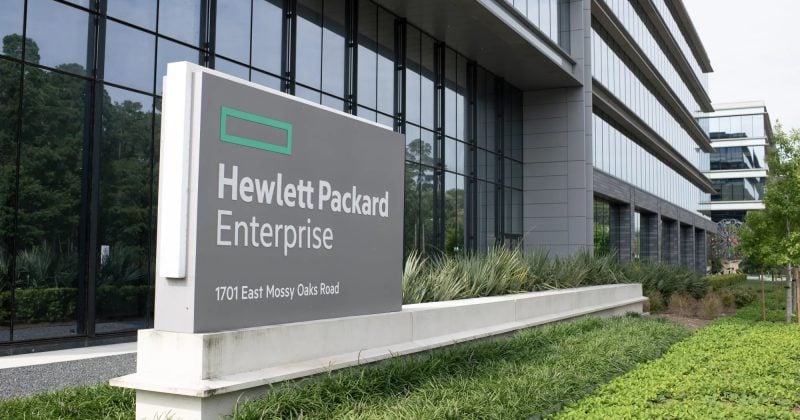
Hewlett Packard Enterprise’s backlog nears $6B amid AI spending surge

Hewlett Packard Enterprise’s backlog nears $6B amid AI spending surge

HPE's fiscal Q2 revenue jumped 40% year-over-year as the company rides an AI infrastructure wave that's pulling in former crypto miners too

Hewlett Packard Enterprise just posted the kind of quarter that makes Wall Street forget every complaint it ever had. The company reported fiscal Q2 2026 revenue of $10.68 billion, a 40% jump from the same period last year, driven almost entirely by an insatiable appetite for AI infrastructure.

HPE’s AI server backlog climbed to nearly $6 billion, up from $5 billion reported just three months earlier in March. The stock responded accordingly, surging roughly 28% and adding approximately $17 billion to the company’s market cap in what amounts to a single-day validation of its AI pivot.

The numbers behind the AI gold rush

CEO Antonio Neri struck an optimistic tone about the company’s trajectory, noting that HPE’s AI backlog has doubled in recent quarters.

Advertisement

HPE raised its full-year revenue growth outlook to 29-33%, a significant upward revision that signals management believes the demand spike isn’t a one-quarter anomaly. The company also adjusted its networking growth forecast for fiscal year 2026 to 72-75%, a figure driven almost entirely by AI data center buildouts.

For context, the broader AI infrastructure market is projected to reach $700 billion in 2026. HPE is competing for its slice of that pie against Dell, which reported $16.1 billion in AI server shipments and a staggering $51.3 billion backlog of AI-related orders back in April 2026.

HPE’s strategic partnership with NVIDIA continues to underpin its AI server capabilities, giving it access to the GPU architectures that hyperscalers and enterprise clients are demanding. The company’s $14 billion acquisition of Juniper Networks has also started paying dividends, strengthening its networking stack for AI data center environments.

Where crypto miners fit into the picture

The pivot from crypto mining to AI hosting has become one of the most significant trends in the digital infrastructure space. Companies like Core Scientific, which built their businesses around proof-of-work mining operations, have transitioned their facilities to serve AI workloads. That transition creates direct demand for enterprise-grade server hardware, exactly the kind HPE specializes in.

Bitcoin mining facilities already have the power infrastructure, cooling systems, and physical space that AI data centers require. What they need are different servers, better networking equipment, and enterprise-level management tools.

What this means for investors watching the AI-crypto intersection

HPE’s stock surge of 28% in a single session illustrates how aggressively the market is repricing AI infrastructure plays. The opportunity lies in the genuine demand driving backlog growth. The risk is that $6 billion in orders doesn’t mean $6 billion in delivered revenue, and supply chain bottlenecks around GPUs and networking components could stretch fulfillment timelines.

The networking growth forecast of 72-75% for fiscal 2026 deserves particular attention. AI workloads are notoriously network-intensive, and HPE’s bet on Juniper Networks positions it to capture recurring revenue streams at the networking layer of AI data centers.

Disclosure: This article was edited by Editorial Team. For more information on how we create and review content, see our Editorial Policy.

Hewlett Packard Enterprise’s backlog nears $6B amid AI spending surge

Hewlett Packard Enterprise’s backlog nears $6B amid AI spending surge

HPE's fiscal Q2 revenue jumped 40% year-over-year as the company rides an AI infrastructure wave that's pulling in former crypto miners too

Hewlett Packard Enterprise just posted the kind of quarter that makes Wall Street forget every complaint it ever had. The company reported fiscal Q2 2026 revenue of $10.68 billion, a 40% jump from the same period last year, driven almost entirely by an insatiable appetite for AI infrastructure.

HPE’s AI server backlog climbed to nearly $6 billion, up from $5 billion reported just three months earlier in March. The stock responded accordingly, surging roughly 28% and adding approximately $17 billion to the company’s market cap in what amounts to a single-day validation of its AI pivot.

The numbers behind the AI gold rush

CEO Antonio Neri struck an optimistic tone about the company’s trajectory, noting that HPE’s AI backlog has doubled in recent quarters.

Advertisement

HPE raised its full-year revenue growth outlook to 29-33%, a significant upward revision that signals management believes the demand spike isn’t a one-quarter anomaly. The company also adjusted its networking growth forecast for fiscal year 2026 to 72-75%, a figure driven almost entirely by AI data center buildouts.

For context, the broader AI infrastructure market is projected to reach $700 billion in 2026. HPE is competing for its slice of that pie against Dell, which reported $16.1 billion in AI server shipments and a staggering $51.3 billion backlog of AI-related orders back in April 2026.

HPE’s strategic partnership with NVIDIA continues to underpin its AI server capabilities, giving it access to the GPU architectures that hyperscalers and enterprise clients are demanding. The company’s $14 billion acquisition of Juniper Networks has also started paying dividends, strengthening its networking stack for AI data center environments.

Where crypto miners fit into the picture

The pivot from crypto mining to AI hosting has become one of the most significant trends in the digital infrastructure space. Companies like Core Scientific, which built their businesses around proof-of-work mining operations, have transitioned their facilities to serve AI workloads. That transition creates direct demand for enterprise-grade server hardware, exactly the kind HPE specializes in.

Bitcoin mining facilities already have the power infrastructure, cooling systems, and physical space that AI data centers require. What they need are different servers, better networking equipment, and enterprise-level management tools.

What this means for investors watching the AI-crypto intersection

HPE’s stock surge of 28% in a single session illustrates how aggressively the market is repricing AI infrastructure plays. The opportunity lies in the genuine demand driving backlog growth. The risk is that $6 billion in orders doesn’t mean $6 billion in delivered revenue, and supply chain bottlenecks around GPUs and networking components could stretch fulfillment timelines.

The networking growth forecast of 72-75% for fiscal 2026 deserves particular attention. AI workloads are notoriously network-intensive, and HPE’s bet on Juniper Networks positions it to capture recurring revenue streams at the networking layer of AI data centers.

Disclosure: This article was edited by Editorial Team. For more information on how we create and review content, see our Editorial Policy.