
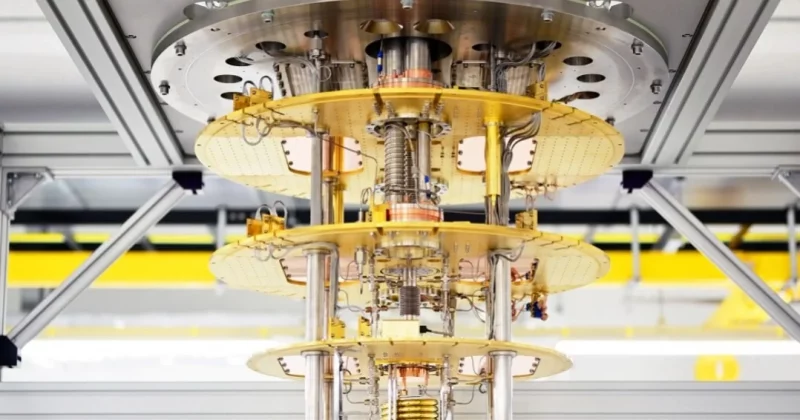
IBM and US Commerce Department unveil first purpose-built quantum foundry with $1B support
The CHIPS Act-funded facility marks a major escalation in the quantum computing arms race, with direct implications for the future of blockchain cryptography.
IBM and the US Department of Commerce are building the first facility in the world designed exclusively to manufacture quantum chips, backed by a proposed $1 billion in federal funding from the CHIPS and Science Act.
The announcement lands amid a broader IBM commitment to pour $150 billion into US operations over the next five years, with more than $30 billion earmarked specifically for research and development in quantum computer manufacturing. That is not a rounding error. That is a bet-the-farm figure on a technology most people still consider science fiction.
What a quantum foundry actually is
Think of a semiconductor foundry, the kind TSMC and Intel operate, but instead of stamping out classical silicon chips, this facility will produce the exotic hardware that powers quantum computers. Superconducting qubits, cryogenic components, the whole works.
In English: this is a factory purpose-built for quantum-era chips, not a retrofitted cleanroom with some quantum experiments happening in the corner.
The distinction matters. Quantum computing hardware is notoriously finicky. Qubits need to operate at temperatures colder than outer space, and even the slightest vibration can destroy a calculation. Building a facility from scratch that accounts for these constraints is fundamentally different from trying to shoehorn quantum production into existing chip fabs.
The proposed $1 billion in CHIPS Act funding would flow through the CHIPS Research and Development Office, the arm of the Commerce Department tasked with managing federal quantum R&D investments. The federal government has been increasingly active in this space, having explored equity stakes in publicly traded quantum firms like IonQ, Rigetti, and D-Wave for investments of at least $10 million in funding.
IBM’s new foundry represents a different approach entirely. Rather than taking minority positions in startups, the government is co-funding dedicated manufacturing infrastructure. It is the difference between buying shares in an airline and building an airport.
The crypto connection nobody is talking about enough
Here is the thing. Quantum computing is not just a physics curiosity or a government prestige project. It is an existential question mark hovering over every cryptographic system currently in use, including the ones securing Bitcoin, Ethereum, and every other blockchain network.
The news moving money, markets, and the world—before your day starts.
Daily. Free. Join 34,000+ readers across crypto, finance, and policy.
Modern blockchain security relies on mathematical problems that classical computers cannot solve in any reasonable timeframe. Elliptic curve cryptography, SHA-256 hashing, the foundational locks on the digital vault. A sufficiently powerful quantum computer could, in theory, pick those locks.
IBM’s own Quantum Readiness Index suggests that significant quantum computing advantages could materialize by the end of 2026. That is not a far-off theoretical horizon. That is eighteen months from now.
Now, “significant advantages” does not necessarily mean “can crack Bitcoin tomorrow.” The gap between demonstrating quantum advantage on specific computational problems and actually breaking production-grade encryption is still substantial. But the trajectory is clear, and the timeline is compressing faster than most people in crypto seem to appreciate.
The National Institute of Standards and Technology has already published post-quantum cryptographic standards, and enterprises are beginning the migration to quantum-safe algorithms. The blockchain industry, with its decentralized governance and sometimes glacial upgrade processes, faces a uniquely difficult version of this transition.
Imagine trying to get every Bitcoin node operator, every Ethereum validator, every Layer 2 network to coordinate a cryptographic migration before a quantum computer capable of breaking current encryption comes online. The coordination problem alone is staggering.
What this means for investors
The $1 billion foundry announcement is a signal, not a surprise. The US government has been telegraphing its quantum ambitions for years. But the shift from research grants and equity investments to dedicated manufacturing infrastructure represents a meaningful escalation.
For crypto investors, the implications are layered. In the near term, this changes nothing about day-to-day market dynamics. No quantum computer is breaking blockchain encryption this quarter or next quarter. The more relevant question is whether blockchain protocols are moving fast enough on quantum-safe upgrades to stay ahead of the hardware curve.
Projects that are actively researching or implementing post-quantum cryptography, lattice-based signatures, hash-based authentication schemes, will have a narrative advantage as quantum milestones accelerate. Projects that are ignoring the issue entirely are making an implicit bet that the timeline is long enough not to matter. IBM’s readiness index suggesting quantum advantage by late 2026 should make that bet increasingly uncomfortable.
On the broader technology front, a purpose-built quantum foundry gives the US a manufacturing base that does not currently exist anywhere in the world. The geopolitical implications mirror the semiconductor wars playing out with China over classical chips, but for next-generation computing hardware. Countries and companies with quantum manufacturing capability will hold significant leverage over those without it.
For the digital asset industry specifically, the smart move is watching two things closely. First, the pace at which IBM and its peers achieve quantum milestones relative to their published roadmaps. Second, the speed at which major blockchain protocols adopt quantum-resistant cryptographic primitives. The gap between those two timelines is, quite literally, the margin of safety for the entire crypto ecosystem’s security model.