
Nexo Earn with Nexo
Injective reports record $33.7B in tokenized real-world assets market

Injective reports record $33.7B in tokenized real-world assets market

The tokenized RWA market has grown from under $1 billion in early 2023 to nearly $34 billion, with on-chain perpetual futures topping $500 billion in Q1 trading volume.

Real-world assets living on blockchains just crossed a milestone that would have sounded absurd two years ago. The tokenized RWA market hit approximately $33.78 billion in May, according to data highlighted by Injective Labs.

For context, this same market was sitting below $1 billion in early 2023. That’s roughly a 34x expansion in under 18 months, the kind of growth rate that makes even seasoned crypto observers do a double-take.

What’s driving the surge

The biggest engine behind this explosion is tokenized US Treasuries and cash equivalents. In a world where yield-hungry investors are constantly searching for safer returns, putting government debt on-chain turns out to be a compelling proposition.

Think of it like this: instead of going through layers of brokers and custodians to hold Treasury bills, investors can access the same exposure through blockchain-based tokens that settle in minutes rather than days. The appeal is obvious. Lower friction, faster settlement, and 24/7 accessibility.

The numbers extend beyond just static asset values. On-chain perpetual futures markets recorded over $500 billion in trading volume during Q1 2024 alone. Perpetual futures, for the uninitiated, are derivatives contracts that let traders bet on asset prices without expiration dates. They’re the bread and butter of crypto trading, and their volume is now substantial enough to rival some segments of traditional finance.

Key players in the RWA tokenization space include Ondo Finance, Franklin Templeton, MakerDAO, and Maple Finance. Each occupies a slightly different niche, from tokenized money market funds to on-chain lending backed by real-world collateral.

Advertisement

Wall Street is paying attention

Here’s the thing about this particular crypto trend: it’s not just native crypto projects building it. Major institutional players like BlackRock and JPMorgan are actively participating in RWA tokenization efforts.

When the world’s largest asset manager starts putting funds on-chain, the “crypto is a toy” narrative gets harder to maintain. BlackRock’s foray into tokenized funds has been one of the most closely watched developments in the space, signaling that traditional finance sees blockchain rails as more than experimental.

JPMorgan, for its part, has been exploring tokenization through its Onyx platform for several years. The bank’s involvement lends credibility to the thesis that blockchain infrastructure can handle institutional-grade financial products.

This convergence between traditional finance and decentralized ecosystems is arguably the most significant structural shift happening in crypto right now. It’s not about replacing Wall Street. It’s about rebuilding its plumbing.

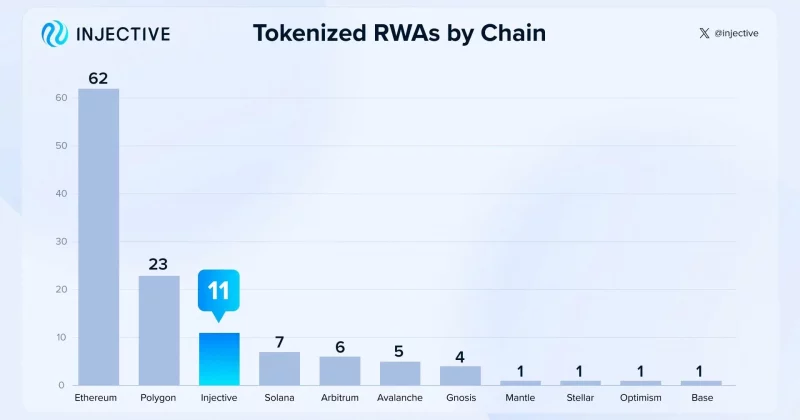
Injective positions itself squarely at this intersection. The Layer-1 blockchain is specifically designed for financial applications, with a focus on integrating tokenized RWAs within its derivatives ecosystem. The protocol’s architecture is built to support the kind of complex financial instruments that institutional participants expect, including order book-based trading and cross-chain interoperability.

What this means for investors

The growth trajectory from under $1 billion to $33.7 billion creates a natural question: how much room is left? Global fixed-income markets alone represent over a hundred trillion dollars in value. Even tokenizing a small fraction of that would dwarf current figures.

But scale isn’t guaranteed. Regulatory clarity remains the single biggest variable. Tokenized securities exist in a gray zone in many jurisdictions, and how regulators ultimately classify and oversee these instruments will determine whether the current growth continues or hits a ceiling.

The competitive landscape is also worth watching closely. With institutions like BlackRock and Franklin Templeton entering the space alongside crypto-native protocols like Ondo Finance and Injective, the fight for market share is intensifying. Protocols that can offer the deepest liquidity, the most robust compliance frameworks, and the smoothest user experience will likely capture outsized value.

For crypto investors specifically, the RWA trend represents something unusual: a use case that traditional finance actually wants. Most crypto narratives require convincing the outside world that something new is valuable. RWA tokenization flips that script. It takes something the world already values, government bonds, real estate, private credit, and makes it more accessible through blockchain infrastructure.

The risk, as always, lies in execution. Smart contract vulnerabilities, oracle failures, and liquidity fragmentation across chains remain real concerns. The $500 billion in quarterly perpetual futures volume shows that on-chain markets can handle serious throughput, but scaling tokenized real-world assets introduces additional complexity around legal enforceability and custodial arrangements that purely digital assets don’t face.

One metric to track going forward: the ratio of institutional versus retail participation in tokenized RWA products. If institutions continue accelerating their involvement at the current pace, this market could look very different by year’s end.

Disclosure: This article was edited by Editorial Team. For more information on how we create and review content, see our Editorial Policy.

Injective reports record $33.7B in tokenized real-world assets market

Injective reports record $33.7B in tokenized real-world assets market

The tokenized RWA market has grown from under $1 billion in early 2023 to nearly $34 billion, with on-chain perpetual futures topping $500 billion in Q1 trading volume.

Real-world assets living on blockchains just crossed a milestone that would have sounded absurd two years ago. The tokenized RWA market hit approximately $33.78 billion in May, according to data highlighted by Injective Labs.

For context, this same market was sitting below $1 billion in early 2023. That’s roughly a 34x expansion in under 18 months, the kind of growth rate that makes even seasoned crypto observers do a double-take.

What’s driving the surge

The biggest engine behind this explosion is tokenized US Treasuries and cash equivalents. In a world where yield-hungry investors are constantly searching for safer returns, putting government debt on-chain turns out to be a compelling proposition.

Think of it like this: instead of going through layers of brokers and custodians to hold Treasury bills, investors can access the same exposure through blockchain-based tokens that settle in minutes rather than days. The appeal is obvious. Lower friction, faster settlement, and 24/7 accessibility.

The numbers extend beyond just static asset values. On-chain perpetual futures markets recorded over $500 billion in trading volume during Q1 2024 alone. Perpetual futures, for the uninitiated, are derivatives contracts that let traders bet on asset prices without expiration dates. They’re the bread and butter of crypto trading, and their volume is now substantial enough to rival some segments of traditional finance.

Key players in the RWA tokenization space include Ondo Finance, Franklin Templeton, MakerDAO, and Maple Finance. Each occupies a slightly different niche, from tokenized money market funds to on-chain lending backed by real-world collateral.

Advertisement

Wall Street is paying attention

Here’s the thing about this particular crypto trend: it’s not just native crypto projects building it. Major institutional players like BlackRock and JPMorgan are actively participating in RWA tokenization efforts.

When the world’s largest asset manager starts putting funds on-chain, the “crypto is a toy” narrative gets harder to maintain. BlackRock’s foray into tokenized funds has been one of the most closely watched developments in the space, signaling that traditional finance sees blockchain rails as more than experimental.

JPMorgan, for its part, has been exploring tokenization through its Onyx platform for several years. The bank’s involvement lends credibility to the thesis that blockchain infrastructure can handle institutional-grade financial products.

This convergence between traditional finance and decentralized ecosystems is arguably the most significant structural shift happening in crypto right now. It’s not about replacing Wall Street. It’s about rebuilding its plumbing.

Injective positions itself squarely at this intersection. The Layer-1 blockchain is specifically designed for financial applications, with a focus on integrating tokenized RWAs within its derivatives ecosystem. The protocol’s architecture is built to support the kind of complex financial instruments that institutional participants expect, including order book-based trading and cross-chain interoperability.

What this means for investors

The growth trajectory from under $1 billion to $33.7 billion creates a natural question: how much room is left? Global fixed-income markets alone represent over a hundred trillion dollars in value. Even tokenizing a small fraction of that would dwarf current figures.

But scale isn’t guaranteed. Regulatory clarity remains the single biggest variable. Tokenized securities exist in a gray zone in many jurisdictions, and how regulators ultimately classify and oversee these instruments will determine whether the current growth continues or hits a ceiling.

The competitive landscape is also worth watching closely. With institutions like BlackRock and Franklin Templeton entering the space alongside crypto-native protocols like Ondo Finance and Injective, the fight for market share is intensifying. Protocols that can offer the deepest liquidity, the most robust compliance frameworks, and the smoothest user experience will likely capture outsized value.

For crypto investors specifically, the RWA trend represents something unusual: a use case that traditional finance actually wants. Most crypto narratives require convincing the outside world that something new is valuable. RWA tokenization flips that script. It takes something the world already values, government bonds, real estate, private credit, and makes it more accessible through blockchain infrastructure.

The risk, as always, lies in execution. Smart contract vulnerabilities, oracle failures, and liquidity fragmentation across chains remain real concerns. The $500 billion in quarterly perpetual futures volume shows that on-chain markets can handle serious throughput, but scaling tokenized real-world assets introduces additional complexity around legal enforceability and custodial arrangements that purely digital assets don’t face.

One metric to track going forward: the ratio of institutional versus retail participation in tokenized RWA products. If institutions continue accelerating their involvement at the current pace, this market could look very different by year’s end.

Disclosure: This article was edited by Editorial Team. For more information on how we create and review content, see our Editorial Policy.