
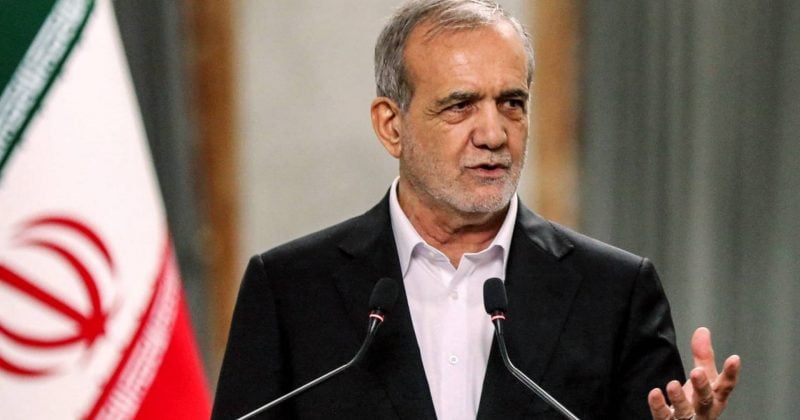
Iranian President Pezeshkian reportedly resigns, citing IRGC dominance over government
The reported resignation letter to Supreme Leader Khamenei comes as US authorities seize roughly $1 billion in IRGC-linked crypto assets, spotlighting Iran's deep ties to digital currency sanctions evasion.
Iranian President Masoud Pezeshkian has reportedly submitted a resignation letter to Supreme Leader Mojtaba Khamenei, accusing the Islamic Revolutionary Guard Corps of effectively hijacking large portions of the government. The letter, first reported by Iran International citing an anonymous official, paints a picture of a president who has lost the ability to govern on his own terms.
The resignation has not been officially confirmed, and conflicting signals from within Tehran suggest the situation remains fluid.
What happened inside Tehran
The IRGC, led by chief Ahmad Vahidi, has reportedly been functioning as a de facto ruling authority within Iran’s political structure. Since around March and April of this year, the military organization has blocked key presidential appointments, including nominees for intelligence minister.
Pezeshkian has not been quiet about his frustrations. In May, he publicly referred to the IRGC’s conduct as “madness,” a word choice that, in the careful lexicon of Iranian politics, is roughly the equivalent of flipping over the chessboard.
The IRGC has also reportedly established a military council that is influencing national decision-making, further sidelining the elected president’s authority.
The crypto connection: $1 billion in seized assets
Iran has long relied on cryptocurrency as a tool to circumvent international sanctions, and the IRGC has been at the center of those efforts.
US authorities have seized approximately $1 billion from Iranian-linked crypto wallets tied to IRGC activities. It is one of the largest sanctions-related crypto seizures on record.
Separately, Tether froze $344 million in USDT linked to addresses associated with the IRGC and the Central Bank of Iran.
Iran’s largest crypto exchange, Nobitex, has reportedly facilitated hundreds of millions of dollars in transactions for sanctioned entities.
What this means for crypto markets
If the political situation in Tehran deteriorates further, escalated US sanctions enforcement could target additional crypto wallets, exchanges, or protocols perceived as facilitating Iranian transactions. That kind of action tends to create short-term price pressure, particularly on stablecoins like USDT that have been directly implicated in IRGC-linked flows.
The Tether freeze is particularly worth monitoring. A $344 million freeze raises the question of whether more freezes are coming. For USDT holders, this is a reminder that stablecoins are not beyond the reach of enforcement actions, as assets can be frozen at the issuer level.
For exchanges operating in or near Iranian markets, the compliance risk has increased significantly. Nobitex is already under scrutiny, and the US Treasury has shown a willingness to designate not just wallets but entire mixing services and exchanges when it identifies sanctions evasion patterns.