
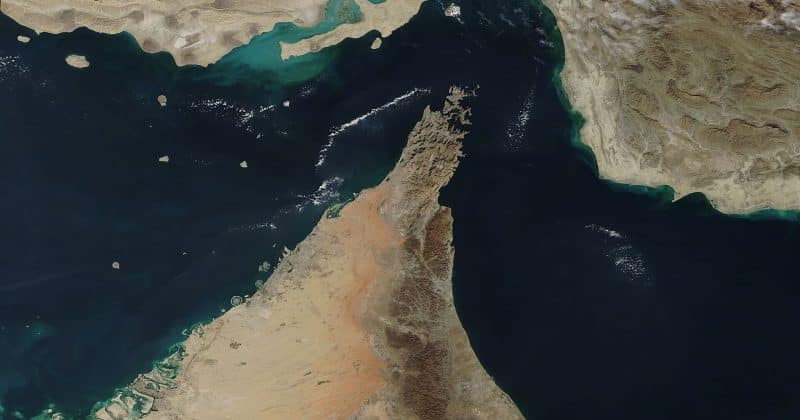
Iran plans to generate $40B annually from fees in Strait of Hormuz
Tehran's ambitious toll system on the world's most critical oil chokepoint accepts crypto payments, but actual revenue collection tells a very different story


Iran has started charging ships to pass through the Strait of Hormuz, the narrow waterway through which roughly a fifth of the world’s oil supply flows daily. The government says it expects to pull in $40 billion a year from the tolls. Here’s the thing: the math doesn’t come close to working out.
The toll system, which went live in mid-March 2026, charges vessels for what Iran describes as security and escort services. Payments are accepted in cash, goods, Chinese yuan via the Cross-Border Interbank Payment System (CIPS), and, notably, digital assets including Bitcoin and USDT.
The gap between ambition and reality
Iran’s government has projected potential annual revenues ranging from $40 billion to over $100 billion, assuming maritime traffic through the strait returns to pre-conflict levels.
As of mid-April 2026, only about 5 to 6 cargo ships were transiting the strait daily. For context, typical pre-conflict traffic ran around 150 tankers per day. That’s a 96% drop in volume.
Independent analysts have estimated that actual annual revenue from the toll system is more likely in the range of $1 billion to $2 billion. Still a meaningful number, but a far cry from the $40 billion headline figure Tehran is advertising.
The fee structure itself is tiered. Oil tankers face charges of roughly $0.50 to $1 per barrel, while a Very Large Crude Carrier gets hit with a bill of $1.5 million to $2 million per transit.
The news moving money, markets, and the world—before your day starts.
Daily. Free. Join 34,000+ readers across crypto, finance, and policy.
The tolling process was formalized under the “Strait of Hormuz Management Plan,” adopted on March 30-31, 2026. The plan codifies the IRGC’s oversight role in managing the strait, effectively linking one of the world’s most strategically important shipping lanes to Iran’s military apparatus.
Crypto as a sanctions workaround
By accepting Bitcoin and USDT, Iran has created a payment channel that operates entirely outside the traditional banking system. Payments in crypto are reportedly routed through intermediaries linked to the IRGC, enabling settlements without touching the SWIFT network or any Western-controlled financial infrastructure.
Blockchain analysis firms have flagged this as a pioneering case of a nation-state using digital assets to generate sovereign revenue from a strategic asset. The on-chain evidence so far suggests limited large-scale Bitcoin transactions connected to the tolls. Stablecoins, particularly USDT, appear to be seeing more usage in this context.
International pushback and precedent concerns
US Secretary of State Marco Rubio has warned that accepting Iranian tolls on international waterways could lead to “total chaos” in global maritime operations.
The strait is governed under international maritime law, specifically the United Nations Convention on the Law of the Sea, which generally provides for transit passage through straits used for international navigation. Iran’s toll system pushes directly against that framework.
With daily transits at a fraction of historical norms, the toll system is collecting a trickle rather than a flood. The $40 billion projection requires traffic levels that simply don’t exist right now.