
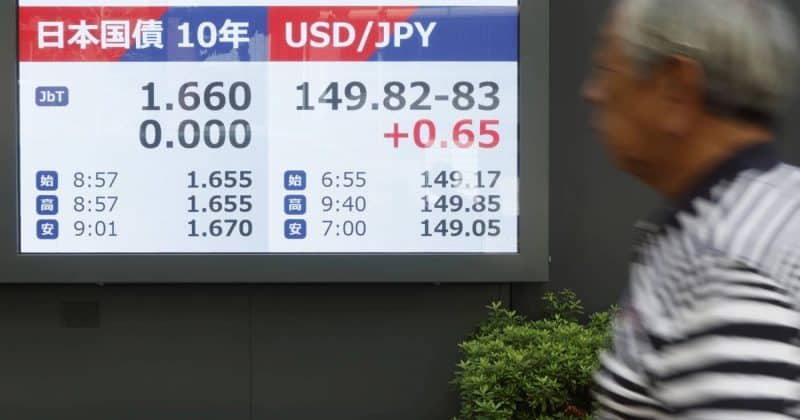
Japan 10-year bond sale draws weaker demand than average

Japan 10-year bond sale draws weaker demand than average

Soft auction results and rising yields in Japan's bond market are sending ripples through global risk assets, including crypto.

Japan’s government bond market is flashing warning signs, and the rest of the financial world is paying attention. The country’s latest 10-year bond auction drew weaker demand than its trailing average, continuing a pattern that has quietly unsettled investors across asset classes.

The February 2026 auction for the 10-year Japanese Government Bond posted a bid-to-cover ratio of 3.02, slipping below the 12-month average. A bid-to-cover ratio measures how much demand exists relative to the bonds on offer.

Why Japan’s bond market is struggling to find buyers

The demand problem is not isolated to 10-year paper. June’s 30-year JGB auction recorded a bid-to-cover ratio of 2.94, the weakest reading since mid-2025, against a 12-month average of roughly 3.4.

Advertisement

Investor hesitation stems from a few converging pressures. Looming elections and fiscal policy uncertainty have made buyers cautious about locking into long-duration debt. Meanwhile, the Bank of Japan has been stepping back as a buyer, cutting its monthly JGB purchases to ¥2.9 trillion in the first quarter of 2026, down sharply from ¥5.7 trillion in August 2024.

The 10-year JGB yield climbed to roughly 2.47% in April 2026, a level Japan has not seen since the mid-1990s. At one point this year, yields pushed into the 2.5% to 2.8% range. The BOJ has held its policy rate at 0.75% even as inflation persists.

The crypto connection investors should not ignore

Rising JGB yields affect global carry trades, where investors borrow cheaply in yen to fund positions in higher-yielding assets including equities, commodities, and crypto. When Japanese yields rise, the cost of that trade increases, and positions start getting unwound.

January 2026 offered a live demonstration. A surge in JGB yields, with 30-year bond yields jumping roughly 31 basis points, coincided with Bitcoin dropping below $91,000.

There is also a second-order effect worth considering. If weak auction demand forces Japan’s government to offer higher yields to attract buyers, that raises the relative attractiveness of holding yen-denominated safe assets versus speculative ones. Capital that might otherwise flow into emerging market assets or crypto has a reason to stay closer to home.

For years, Japanese institutional investors, including insurers and pension funds, suppressed domestic yields while deploying capital abroad. That dynamic is now slowly reversing.

Disclosure: This article was edited by Editorial Team. For more information on how we create and review content, see our Editorial Policy.

Japan 10-year bond sale draws weaker demand than average

Japan 10-year bond sale draws weaker demand than average

Soft auction results and rising yields in Japan's bond market are sending ripples through global risk assets, including crypto.

Japan’s government bond market is flashing warning signs, and the rest of the financial world is paying attention. The country’s latest 10-year bond auction drew weaker demand than its trailing average, continuing a pattern that has quietly unsettled investors across asset classes.

The February 2026 auction for the 10-year Japanese Government Bond posted a bid-to-cover ratio of 3.02, slipping below the 12-month average. A bid-to-cover ratio measures how much demand exists relative to the bonds on offer.

Why Japan’s bond market is struggling to find buyers

The demand problem is not isolated to 10-year paper. June’s 30-year JGB auction recorded a bid-to-cover ratio of 2.94, the weakest reading since mid-2025, against a 12-month average of roughly 3.4.

Advertisement

Investor hesitation stems from a few converging pressures. Looming elections and fiscal policy uncertainty have made buyers cautious about locking into long-duration debt. Meanwhile, the Bank of Japan has been stepping back as a buyer, cutting its monthly JGB purchases to ¥2.9 trillion in the first quarter of 2026, down sharply from ¥5.7 trillion in August 2024.

The 10-year JGB yield climbed to roughly 2.47% in April 2026, a level Japan has not seen since the mid-1990s. At one point this year, yields pushed into the 2.5% to 2.8% range. The BOJ has held its policy rate at 0.75% even as inflation persists.

The crypto connection investors should not ignore

Rising JGB yields affect global carry trades, where investors borrow cheaply in yen to fund positions in higher-yielding assets including equities, commodities, and crypto. When Japanese yields rise, the cost of that trade increases, and positions start getting unwound.

January 2026 offered a live demonstration. A surge in JGB yields, with 30-year bond yields jumping roughly 31 basis points, coincided with Bitcoin dropping below $91,000.

There is also a second-order effect worth considering. If weak auction demand forces Japan’s government to offer higher yields to attract buyers, that raises the relative attractiveness of holding yen-denominated safe assets versus speculative ones. Capital that might otherwise flow into emerging market assets or crypto has a reason to stay closer to home.

For years, Japanese institutional investors, including insurers and pension funds, suppressed domestic yields while deploying capital abroad. That dynamic is now slowly reversing.

Disclosure: This article was edited by Editorial Team. For more information on how we create and review content, see our Editorial Policy.