
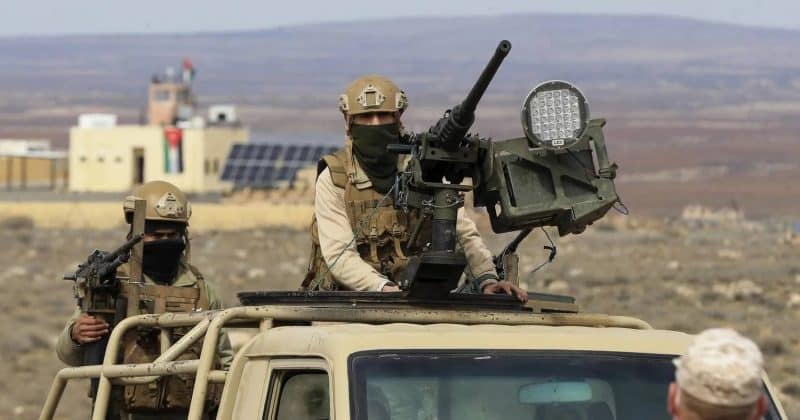
Jordan’s military intercepts Iranian missiles as Middle East tensions escalate
Jordanian air defenses have now shot down more than 20 Iranian missiles in 2026, raising questions about what prolonged regional conflict means for risk assets
Jordan’s military has been busy. The kingdom’s air defense systems have intercepted at least 20 out of 22 Iranian missiles fired over the course of recent weeks, a striking demonstration of both the severity of Iran’s strikes and the effectiveness of Jordan’s defensive capabilities.
The most recent incident occurred on June 10, when Jordanian forces destroyed five Iranian missiles targeting the Al-Azraq region, home to US military personnel. No casualties or material damage were reported, though debris from the destroyed projectiles fell on Jordanian soil.
A pattern of escalation
This wasn’t a one-off event. Back in March 2026, Jordanian forces intercepted 20 out of 22 Iranian missiles over the span of a week. The targets weren’t limited to Jordan either. Iranian strikes have also been directed at US military assets stationed in Kuwait and Bahrain.
The Iranian attacks are reportedly retaliatory, stemming from previous US military operations against Iran, including the recent downing of a US Apache helicopter in the region.
The fact that Jordan has managed to intercept the vast majority of incoming projectiles, roughly 91% based on the March figures, is noteworthy.
The news moving money, markets, and the world—before your day starts.
Daily. Free. Join 34,000+ readers across crypto, finance, and policy.
What this means for markets
Crypto-focused outlets have found no immediate links between the Jordan-Iran missile exchanges and price action in Bitcoin, Ethereum, or any other major token.
Geopolitical risk tends to affect crypto markets through second-order effects, not direct ones. The transmission mechanism usually involves one or more of the following: oil price spikes, trade disruptions, expanded sanctions regimes, or a broad flight to safety that either includes or excludes digital assets depending on the market’s mood that week.
The bigger picture for investors
The pattern worth watching isn’t any single missile interception. It’s the trajectory. Twenty-two missiles in March. Five more in June. US military assets being targeted across multiple countries simultaneously.
Bitcoin has historically shown mixed reactions to geopolitical crises. Sometimes it trades like digital gold, rallying when fear spikes. Other times it behaves like a high-beta tech stock, selling off alongside equities when uncertainty peaks.
Right now, Jordan’s missile interceptions fall squarely in the “contained” category. The defenses are holding. Casualties have been avoided. The conflict hasn’t disrupted energy supplies or triggered broader economic fallout. For crypto markets, this registers as background noise.